|
|



|
|
|


2600-series Cars
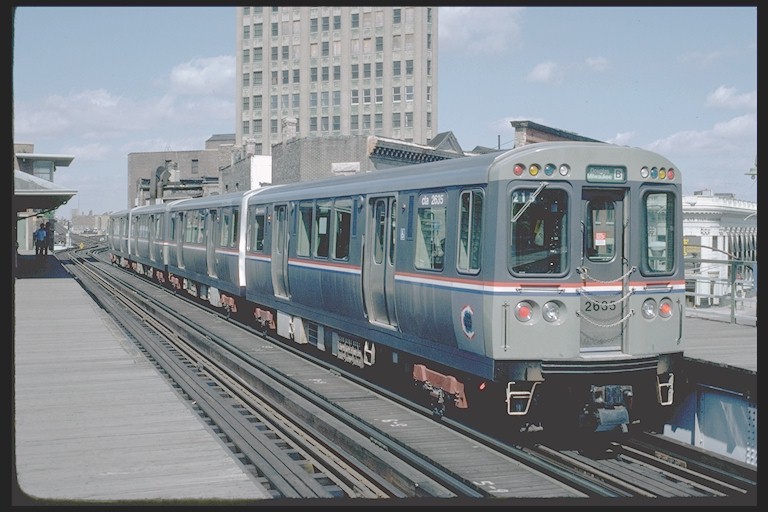
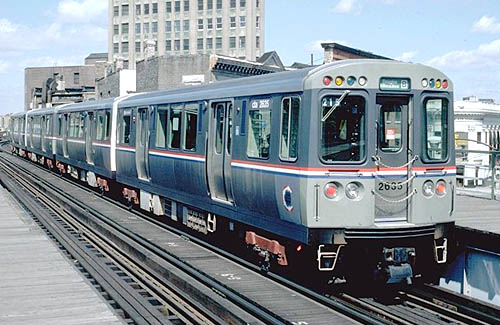 Car 2635, brand new, trails a four-car Douglas-Milwaukee "B" train at Damen on December 1, 1982. For a larger view, click here. (Photo by Doug Grotjahn, Collection of Joe Testagrose) |
|
|
|
|
|
2600-series Cars
|
Car 2635, brand new, trails a four-car Douglas-Milwaukee "B" train at Damen on December 1, 1982. For a larger view, click here. (Photo by Doug Grotjahn, Collection of Joe Testagrose) |
Specifications:
Built by: Budd Company/Transit America
Year: 1981-1987
Length: 48'-0"
Width at Floor: 8'-8"
Width at Windows: 9'-4"
Height over Roof: 12'-0"
Trucks: Wegmann
Truck centers: 33'-8"
Truck wheelbase: 78"
Coupler: #1 end / #2 end: Form 5 / tubular
Wheel diameter: 28"
|
Seats: |
. |
A-43 B-49 (as-built) |
|
A-45 B-46 (after mid-life rehab) * |
* Cars rebuilt by Alstom in 1998-2002
+ The propulsion package, while capable of higher speeds, is limited by the logic of the car controls and the external signal system.
History:
In the early 1980s, with access to more federal funds as well as capital generated by the newly formed RTA, the CTA decided the time was right to catch up in the replacement of its rapidly aging rolling stock. Initially the order was to be for 300 cars, but it was ultimately increased to 600 (300 married-pairs ).
The prospect for an order this big attracted a number of bidders and Boeing-Vertol (manufacturer of the previous series) seemed a shoe-in, but surprisingly the winning bid came from Budd. The design was largely unchanged from the CTA's previous car order. The interior space was slightly increased without changing the overall design of the car. The exterior styling of the car was slightly altered, especially on the front end of the car.
A promotional brochure published in 1982 by CTA, Riding in Style, to commemorate the arrival of the new 2600-series cars described the new series of rapid transit cars...
These light-weight, stainless-steel, air-conditioned cars, built by The Budd Company of Philadelphia, are now being delivered to CTA. A total of 300 of these new cars will become part of CTA's rolling stock by 1984, and an additional order of 300 cars will be in service by 1986.
One hundred of these cars will serve riders on the O'Hare Extension service, which will extend CTA's Milwaukee line to O'Hare International Airport in early 1983. The remaining cars will replace older equipment throughout CTA's rapid transit system.
Rider comfort and convenience features were given primary consideration in the design of the new cars. These sleek-looking, streamlined cars are equipped with an air comfort system designed to maintain a temperature of 65 degrees in winter and 72 degrees in the summer. Ninety-two padded cushions in contoured fiberglass shells in each 2-car unit provide comfortable seating.
Riders may board quickly through sliding doors which provide up to 50 inches of clearance for passengers. The wide doors also provide accessibility for passengers using wheelchairs. Riders will know immediately where service aboard a train is available for the handicapped by the wheelchair logo displayed both on the interior and exterior of the car. One fold-up seat makes room for a wheelchair secured by a locking device. On the O'Hare Extension service, this fold-up seat also provides a space where passengers may store luggage during their trip to or from the airport.
Other features include modern fluorescent lighting in doorway areas and fluorescent fixtures over windows, which backlight advertising panels and provide direct lighting for reading. A more panoramic view greets the rider through larger picture windows of tinted safety glass.
The manufacturer has achieved a reduced noise level in the 2600-series cars through the use of fiberglass insulation throughout the walls and ceilings, and extensive use of rubber in the construction of the car trucks which support axles, wheels, and motors. An improved public address system can be easily heard by persons waiting on station platforms, as well as riders already aboard.
The attractive exterior bodies of the 2600-series cars are accented by red, white and blue vinyl striping, the colors of our nation and the City of Chicago, while the interior decor tastefully reflects the preferences of CTA riders as determined by a city-wide survey conducted in 1971: brown and orange seats; dusky walnut woodgrain pattern on lower side walls; beige upper walls; off-white ceilings.
The purchase of the new rapid transit cars is part of CTA's on-going capital development program, and was funded by the U.S. Department of Transportation and the Illinois Department of Transportation.
In each married-pair unit, only the 'A' car (the odd-numbered car) had a flip seat with a designated wheelchair position, which was located on the back side of the motorcab. The side-facing seat between the #1 sidedoor and the flip seat was omitted in these cars to provide enough room for someone in a wheelchair to maneuver. This, combined with the conductor's door control boxes being at the #2 end of the 'A' car as well and the resulting seats omitted to allow room for those crew positions, resulted in the 'A' car of each pair having few seats than the 'B' car.
Early on, several cars from the last group in the order had luggage racks retrofit into the interiors for use on the West-Northwest Route (later Blue Line) service to O'Hare Airport. The even-numbered cars in the 3162-3180 group had overhead luggage racks retrofit over the center aisles in the middle of the car between the sidedoor sets. The even-numbered cars in the be 3182-3200 group had a shelf-type luggage rack installed in place of a single seat, behind the #3 sidedoor next to the end door at the #2 end of the car. The racks were made with stanchion material by Skokie Shops. Cars with either type of rack were identified on the exterior of the car by a blue decal with a pictogram of a suitcase and the text "Luggage rack equipped" in white next to the sidedoors. Some of the luggage racks were removed in later years, as the racks were not well-utilized. Some of the issues with the racks were that the size of overhead racks could not accommodate larger suitcases, and that the racks at the end of the car were not convenient as passengers would not want to leave bags unattended due to fear of theft. The remainder of the racks were removed during the cars' mid-life overhaul (see below).
This large series of cars, the most of any one type of car with the exception of the 6000-series, makes up a sizable portion of the CTA's rolling stock. With the completion of the order, Transit America (the name Budd had since changed to) retired from car building.
One-Person Train Operation (OPTO)
As the CTA began to institute one-person train operation (OPTO) -- motormen and conductors were replaced by an operator who would operate the train, open and close doors and make announcements -- on the Red, Blue, and Purple lines, the 2600-series cars had to be modified to provide for a full-width crew area at the front of each car so that the operator could work the doors on the non-motorcab side of the car. This was initially accomplished very simply by removing the single seat and sanding equipment opposite the motorcab at the #1 end of cars 2801-3200. (Cars 2601-2800 were designated "belly cars", relegated to the middle of train consists, and could not be at the leading end of a train running OPTO.) The fixed side window nearest the #1 end of the car was replaced with a drop-sash window, a raised step was installed, and a door control box with a single toggle switch (which operated all doors along that side of the train) was installed next to the window. An identical door control box was also installed inside the motorcab. A retractable cloth tape was installed on the exterior corner of the motorcab that the operator could use to block off the aisle to designate the front of the car as a crew area when in use.
After OPTO had been in place for a while, cars in the 2801-3200 group were further modified to provide a better working position for operators by creating a true full-width cab. The transverse double-seat nearest the front of the car on the non-motorcab side was removed and a full-height wall installed to create an enclosed crew space. In addition to the motorcab door, which remained intact, a second partial-height door (it didn't go down to the floor so as to be able to clear the window step on the side wall) was attached to the new partition wall to allow the operator to close off the aisle and create a fully enclosed, locked crew area when in use. When not in use, the partial-height door was swung against the partition wall to allow passengers access to the motorcab side of the car.
Mid-Life Overhaul
The shortcomings of this series became evident when about 300 went out of service during the Blizzard of '99. Most notably, the undercarriage of the car was such that light snow could be sucked into the ventilation and electrical systems -- obviously a potentially-harmful situation -- making the cars susceptible to breakdown in poor weather.
The CTA launched a mid-life overhaul of the 2600-series cars in 1998 to ensure a service life of up to 30 years for each rail car. Over four years, Alstom Transportation, Inc. of Hornell, New York has continuously rehabbed the cars, delivering them at a rate of 10 to 14 per month, with up to 42 cars off CTA property at any given time. The first rehabbed cars began appearing in service on the Red, Blue and Purple Lines in March 1999.
 Car 3018, a typical rehabbed 2600-series unit, brings up the rear on an O'Hare-bound Blue Line train at California on September 3, 2001. For a larger view, click here. (Photo by Mike Farrell) |
The overhaul included rebuilding the traction motors, installing new armatures, replacing the original air-cooled motor alternator systems with state-of-the-art inverters (which operate without rotating parts and are enclosed in sealed boxes), and new stainless steel control boxes for the heating, lighting and air conditioning controls. These changes will correct the problem of wind-blown snow and contaminants getting into the electrical system, which was the cause of the 2600s' failure during the Blizzard of '99. During the winter of 2001-02, the rehabbed railcars already returned to the system performed exceptionally well, experiencing a more than 300 percent improvement in performance.
Additional changes included upgraded door systems, installation of new microprocessor-controlled propulsion, cab signal and auxiliary power systems, remanufactured side door controls with the push button controls replaced with toggle switches, new full-width cabs for one-person operation, installation of high-voltage cabling, new public address systems and air conditioning systems with air diffusers for greater air flow and cooling power, hopper windows that can be opened in the event of air conditioning failure, and glass panels on windscreens to reduce drafts and improve passenger safety and comfort. The original orange and tan padded seat inserts were replaced with cloth-upholstered seats with a red and black fabric pattern. The backlit advertising sash was replaced with a stainless steel unlit sash and new fluorescent lights added in dual rows where the sashes meet the ceiling. Flip seats with designated wheelchair positions were added to the 'B' (even-numbered) car of each unit, so that every 2600-series car has a wheelchair position.
The cars' original exterior paint scheme with the charcoal band through the windows and red-white-and-blue belt rail was replaced with a new paint scheme. Actually, "paint scheme" is an inaccurate phrase since all the paint and decals were stripped off the cars. Left natural stainless steel and with their end caps painted gray to match, the cars' only decoration is now their car numbers next to the sidedoors and on the end door, and the CTA logo on the side under the motorcab windows on both sides of the #1 end of each car. This was done to reduce maintenance and make the cars better blend in the with 3200-series (and 2200-series) cars, which have natural aluminum fluted side panels. Both the car numbers and the CTA "speed lines" logo were originally black; the "speed lines" logos were replaced with red, white, and blue CTA "dot" logos after that graphic device came into use in late 2004.
The last of 598 rehabbed 2600-series cars returned to Chicago on October 23, 2002, ready for service and armed with increased service life. CTA President Frank Kruesi and bus and rail officials welcomed rehabbed cars to the Skokie Shops Heavy Maintenance Shop in a ceremony celebrating the completion of the $354.7 million overhaul program.
Recent Developments
The 2003-2007 capital improvement plan included FY 2003-2007 funding for the start up of a "C" overhaul for the 2600-series (as part of their three-quarters life mini-rehab).
In 2012, with the continuing delivery of the new 5000-series cars and their assignment to the Pink Line, a number of Pink-assigned 2600-series cars again began to be transferred to Red Line service. The reassignment kept to CTA's preferred method of car assignment to minimize the number of different series assigned to a terminal (to allow for more efficient and economical maintenance and parts stocking), since many 2600's were already assigned out of Howard for Red and Purple Line service. The last 2600-series cars were off the Pink Line on Friday, June 8, 2012. What is interesting about these car moves is that the group of 2600's assigned to the Pink Line, from the cars numbered 3103-3200, had been in service on the West-Northwest Route (later Blue Line, of which the Douglas branch was a part until the creation of the Pink Line in 2006) since they were delivered in 1981 (except for a brief period in 1988 when they were temporarily transferred to the West-South Route), serving continuously on the same branch for 30 years.
In February 2013, the CTA began to retrofit the 2600-series cars with security cameras. Four cameras capable of panning 360 degrees -- which provide the same amount of surveillance coverage as the seven cameras installed on the 5000-series railcars -- and one video recorder were installed on each 2600-series car, as well as every 3200-series rail cars.1 Due to their impending retirement, the older 2200- and 2400-series cars were not included in the program. Although about 200 2600-series cars are planned to be retired as well toward the end of the delivery of the new 5000-series cars, they will remain in service long enough to justify the camera investment, according to the CTA. The $13.9 million upgrades were funded by a federal Homeland Security grant. The installations were scheduled to be complete in September 2013.2
Retirement
The 2600s are the oldest cars currently in scheduled "L" passenger service. While a few 2600-series cars were retired before 2014, usually due to accidents or other damage, 594 of the 600 cars built remained on CTA property (of which 561 were in revenue service) in late 2014, when retirement of the cars began in earnest.
With the delivery of production units of the new 5000-series cars beginning in 2011, and accelerating in 2012, the CTA began retiring the 2200-series cars, the oldest in service at the time. After all of the 2200s were out of service in August 2013, the CTA began removing 2400s from service. Once the last of those cars were removed from service for retirement in October 2014, CTA began to retire the 2600-series cars. However, the number of cars in the 5000-series order will only allow about half of the 2600s to be retured, with the remainder still needed until delivery of the 7000-series cars can begin.

|
|
1. "CTA to Expand Surveillance Cameras on Rail Cars". CTA Press Release, February 11, 2013.
2. Hilkevitch, Jon. "CTA adding cameras to older rail cars", Chicago Tribune, February 9, 2013.