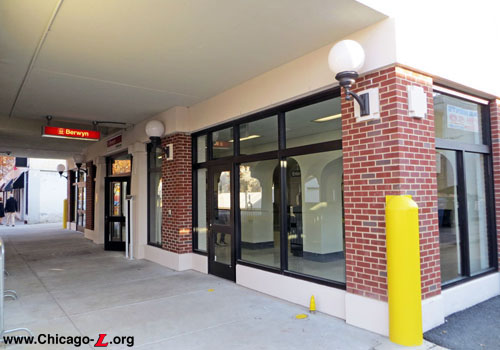
The front entrances of
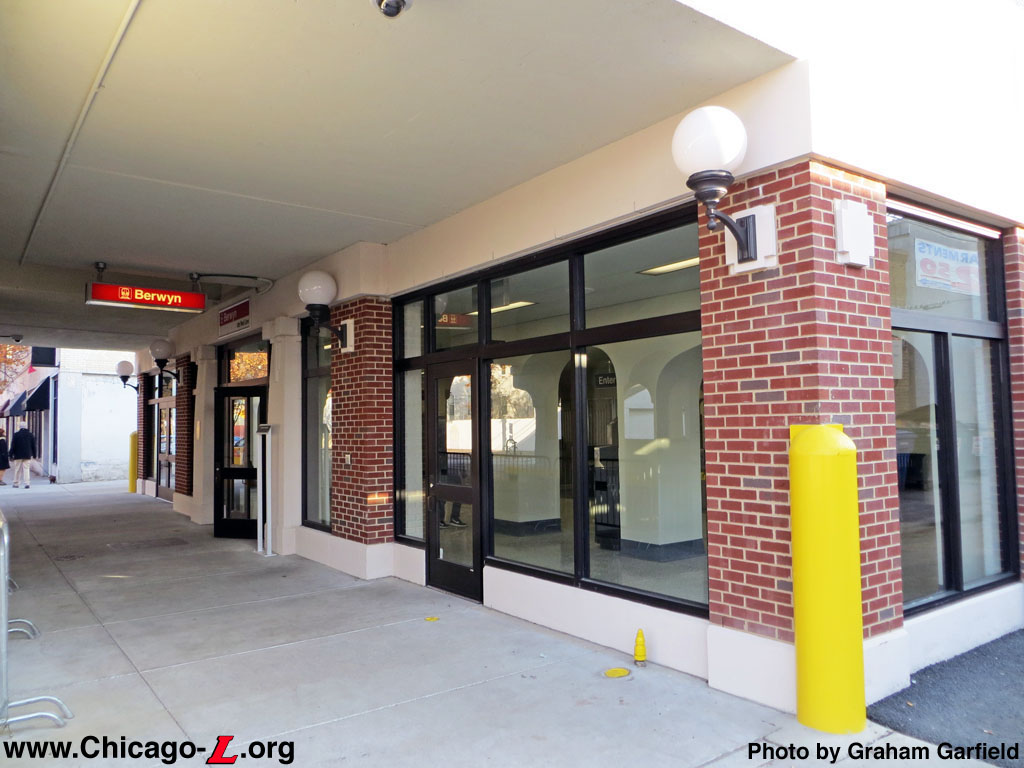
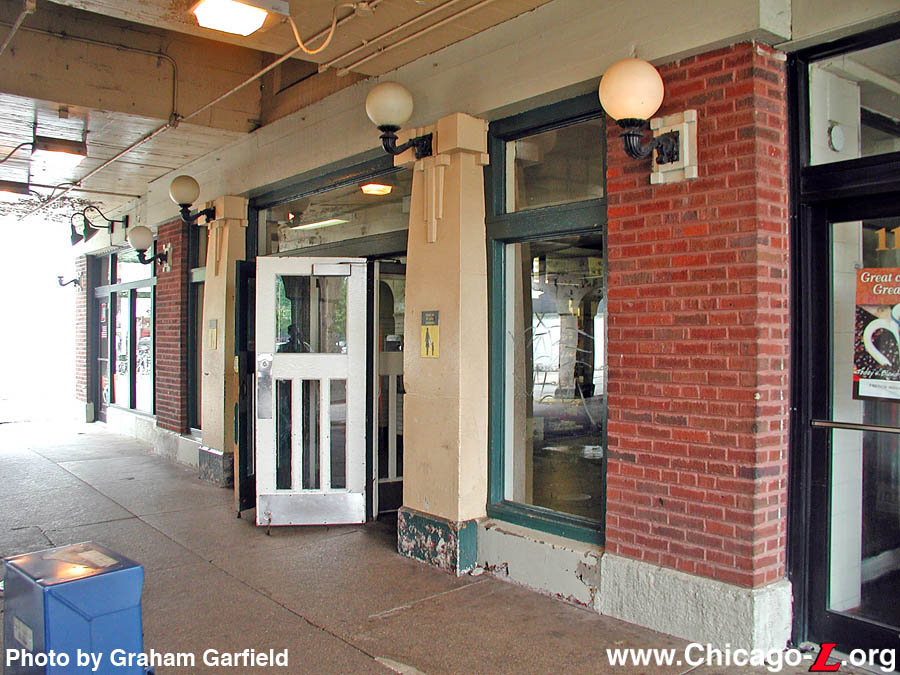
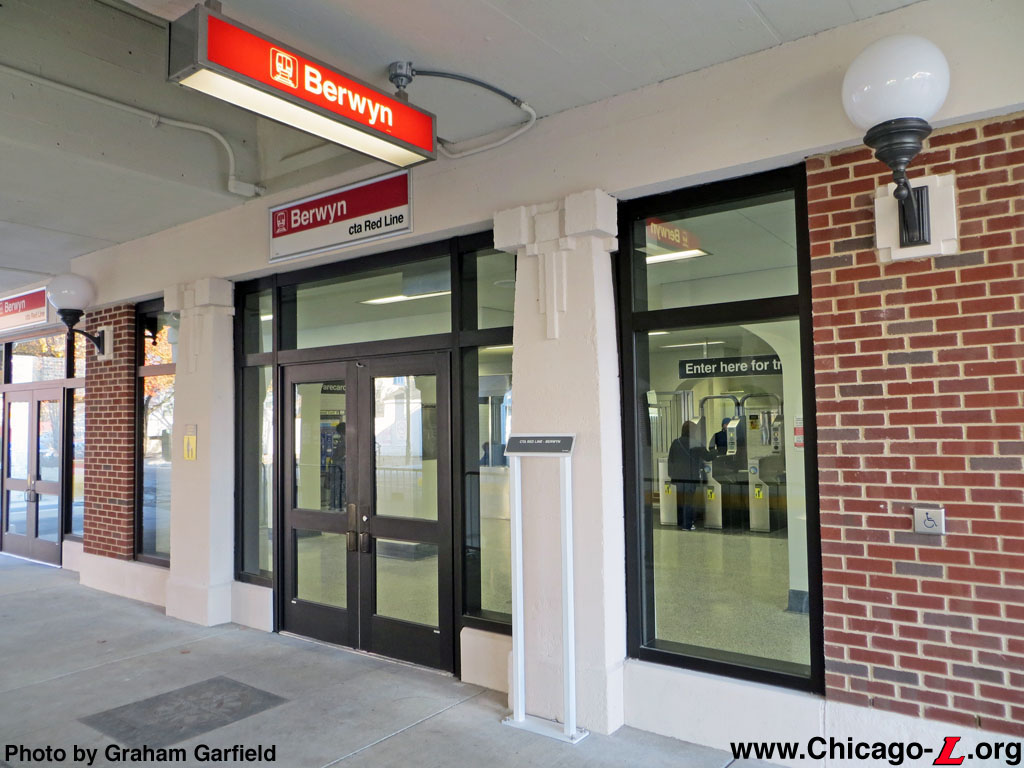
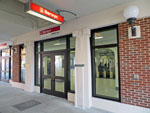
Berwyn station, looking southeast on November 17, 2012, the first full day the station was open after renovation. The station house's exterior masonry was refurbished and a new storefront of doors and windows was installed, including on the portions which were formally separate retail spaces but which are now part of the station. The pilasters framing the center doors and the ornamentation around the
light fixtures convey the station's Prairie School
influences. For a larger view, click here. (Photo by Graham
Garfield) |
Berwyn
(5300N/1200W)
Berwyn Avenue and
Broadway, Edgewater
Service
Notes:

|
Red Line:
Howard |

|
Accessible
Station |

|
Owl
Service |
Quick Facts:
Address: 1121 W. Berwyn
Avenue
Established: 1916
Original Line: Northwestern Elevated Railroad
Previous Names: Edgewater Beach
|
Skip-Stop Type:
|

|
Station
|
Rebuilt: 1921, 2012, 2021-25
Status: In Use
History:
"L" service first entered north Chicago and Evanston by way of an
agreement to use the tracks of the Chicago, Milwaukee and St. Paul
Railway's tracks, replacing the steam service that
the St. Paul had previously provided. The Chicago City Council
authorized the electrification of the tracks of the Chicago,
Milwaukee and St. Paul Railroad's tracks from Graceland Avenue
(Irving Park Road) to the city limits on July 1, 1907. Unlike Evanston (as per the 1907 franchise agreement from the city),
the Chicago City Council did not require that the grade-level tracks
be elevated, but they did prohibit the use of a third rail for
safety's sake, necessitating the use of overhead trolley wire. "L" service north of Wilson to Central Avenue in Evanston began on May 16, 1908.
Track Elevation and a New Station
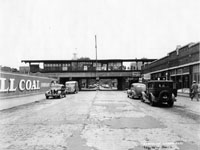
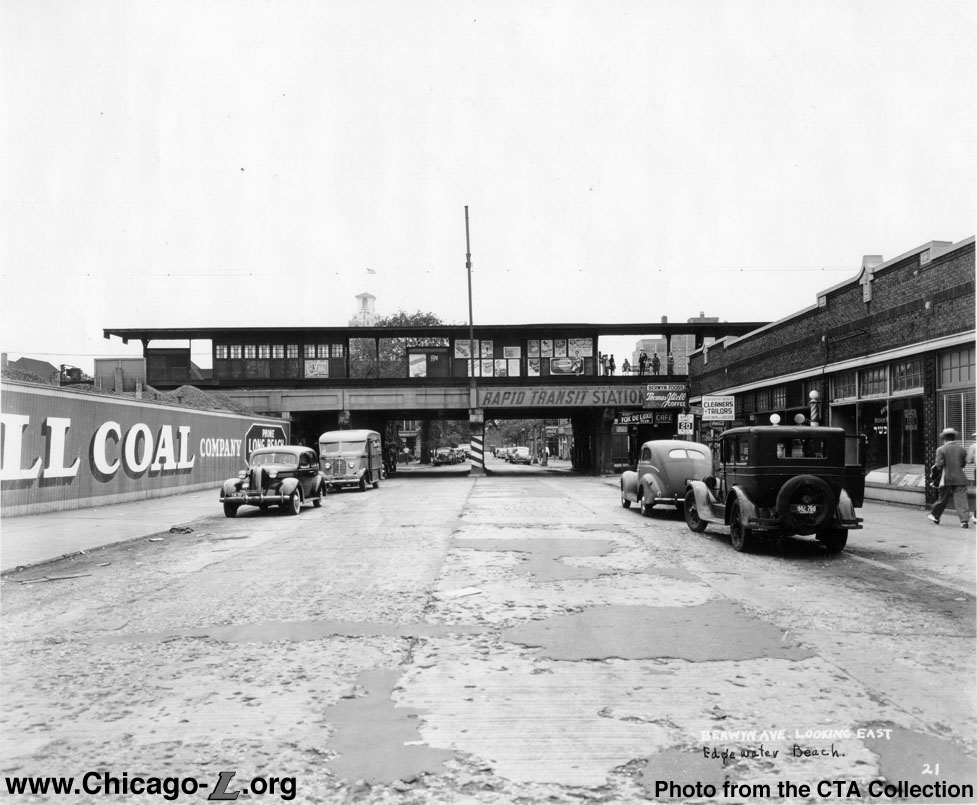
Berwyn station is seen looking east on Berwyn Avenue circa the 1940s. Although the details have changed -- the partitions, furniture, and stairway enclosures on the platform; the identification sign on the viaduct; the cars and street lights on the street -- the structure is the same today, as seen in the same view in 2012. The Lill Coal Company, the CTA's last freight customer, is visible on the left, where a Jewel-Osco grocery store is in 2012. For a larger
view, click here. (Photo from the CTA Collection) |
In the mid-1910s, the Northwestern Elevated began to elevate the
tracks north from Wilson to Howard, but
work was slow due to the city's refusal to close intersecting streets
and the narrow right-of-way. The elevation work involved complex staging and the temporary relocation of tracks to maintain service while building the new elevated embankment in the same right-of-way. In early 1916, trains were moved onto a
temporary trestle, allowing demolition of the original tracks and stations, but construction of a permanent embankment had to
wait until the end of World War I due to a materials shortage.
Unlike the other locations along the new "L" extension where there are currently stations, the St. Paul had not had a station at Berwyn Avenue. Other new stations added during the elevation project included Thorndale and Lawrence. The Seventh Church of Christ Scientist, which opened its facility at 5318 N. Kenmore in 1908, was one of the petitioners before the Illinois Public Utilities Commission for adding a stop at Berwyn. The Commission issued an order on November 12, 1914, for the Northwestern Elevated Railroad to open a station at Berwyn.1
A station at Berwyn Avenue, originally named Edgewater Beach
station, was added during the track elevation process. Although the exact
date of the station's opening has not been identified, the station opened sometime between January 1, 1916, and May 1916. A question submitted by a citizen to
the "To Friend of the People" column of the Chicago Daily
Tribune in the December 14, 1915 edition asked if the Berwyn
station would open by January 1, 1916, to which the Northwestern
Elevated Railroad Company replied: "Berwyn station will not be opened
until a permanent station is built in the spring. It is expected that
operations will commence on the elevated embankment some time during
January." In reality, the elevated embankment was not completed for
another five or six years. However, a Chicago Elevated map dated May 1916 shows the stop, strongly suggesting it was in operation by then. The timing of the station's opening may have been in anticipation of the opening of the Edgewater Beach Hotel, which opened in June 1916. Another Tribune item dated
February 18, 1917 mentions a property as "adjoining the Berwyn L
station", establishing that the station existed by that time. Whenever it opened, the station built at that time was only a temporary facility that was utilized
during the track elevation project.
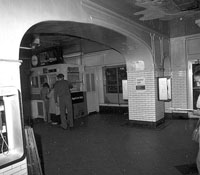
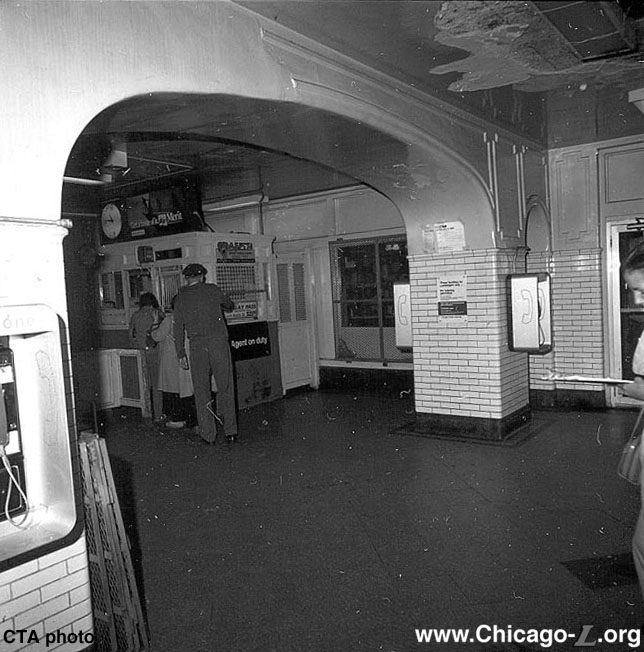
The interior of Berwyn station is largely unchanged in this view looking southwest on May 6, 1986 -- the original glazed brick and plaster walls, flooring, and wooden ticket agent's booth are still original -- but the details have begun to change with the times, such as the fluorescent fixtures and the agent's booth painted white and tan, to present a brighter, more "modern" appearance. In addition, water infiltration and deterioration of the plaster walls and ceiling have begun to take effect. For a larger
view, click here. (CTA photo, from the Graham Garfield Collection) |
As part of the track elevation, a new, permanent station was constructed. The entrance to the "L" station was located on the north
side of Berwyn Avenue. The station had a design typical of the
facilities built as part of the Wilson-Howard elevation project.
Designed by architect Charles P. Rawson and engineered by C.F Loweth,
the architectural design was a Prairie School-influenced vernacular
form, with the Prairie influence seen most acutely in the ornamental
cement pilasters on the front facade and in the details of the wooden
doors, windows, and ticket agents' booths. The exterior was brick and
cast concrete with a bedford stone base, wooden doors and large plate
glass windows and transoms. Ornamental globed light fixtures
decorated the pilaster capitals. The station house was centered
within the solid-fill embankment, with retail spaces flanking it on
both sides filling in the remaining width of the embankment.
The interior was rendered in plaster, wood, glazed brick, and
brick with terrazzo floors. There were arches stretching across the
interior between the support columns. In the center of the interior,
passengers found a decorative wooden ticket agent's booth with
ornamental woodwork and a metal grille over the ticket agent's
window. The station also had public restrooms.
There were four tracks through Edgewater Beach station, but the outer two tracks were for express trains and were not served by the station. A single island platform between the two center tracks served local trains. The platform
had wood decking and a canopy with metal columns down the center line
which split into gently-curving gull wing-shaped roof supports,
supporting a wooden canopy roof. The stairs were sheltered by wooden
enclosures with wooden bottoms and windows on top, divided into rows
of square panes, with swinging doors at the front of each enclosure. Like most of the stations north
of Lawrence, there was originally an
auxiliary exit, located on the south side of the street, descending down in
the middle of retail spaces built under the elevated. The auxiliary exit was closed and removed some time in the CTA era.
In December 1920, it was reported that the Edgewater Beach station, along with Argyle, Bryn Mawr, Thorndale, Granville, and Jarvis, would be completed by late Spring 1921.2 However, that timeframe may have ended up being optimistic. By
early 1922, the new four track mainline was completed, allowing full
express service to the city limits. But the Chicago, Milwaukee and St. Paul
Railway's annual report for 1922 indicated that while the six aforementioned stations were constructed during 1922, only Bryn Mawr was "turned over to traffic" that year; the report said the other five, including Thorndale, were planned to be in service in early 1923.3
Recent Developments
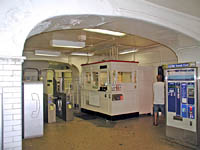
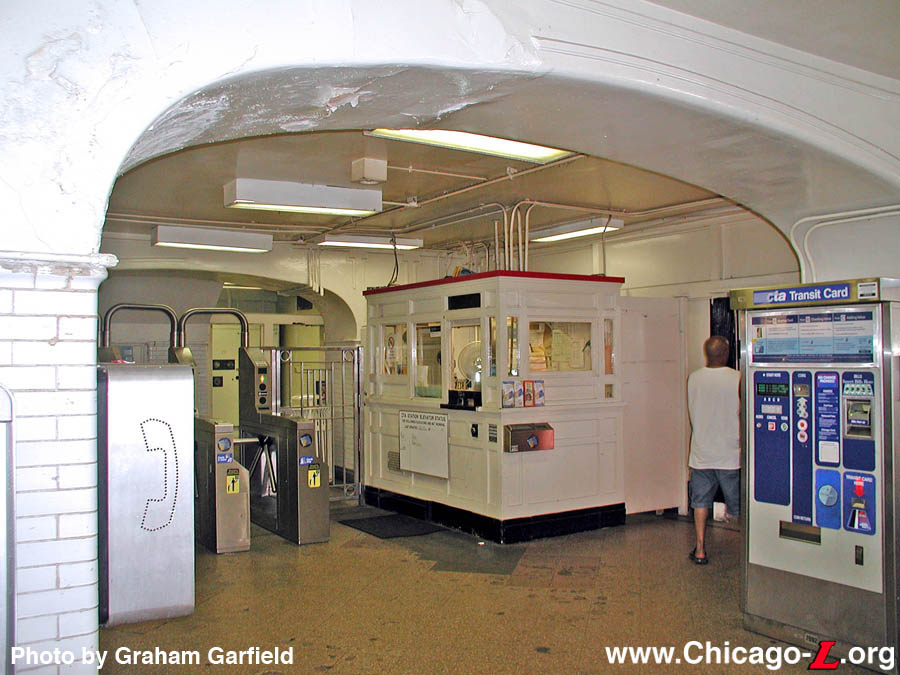
The interior of Berwyn
station on July 21, 2005. The agent's booth, with its
intricate wooden moldings and decorations, is original, one
of the few that were left in the North Side embankment stations. For a
larger view, click here. (Photo by Graham
Garfield) |
The station's name was changed from "Edgewater Beach" to "Berwyn"
by 1960, with an intermediate stage during which the station was
listed as "Berwyn - Edgewater Beach" on system maps throughout the
1950s.
In 2006, the station name signs and column signs on the platform
were replaced, with Green Line
Graphic Standard signs replacing the KDR
Standard graphics, and new entrance signs installed as part of a
signage upgrade project on the Red
Line. As part of this effort, the station also received granite
compass roses inset into the sidewalk in front of the station
entrance to assist customers leaving the station to navigate their
way, and three-sided galvanized steel pylons in the station house and
on the platform to display maps and station timetables.
In 2008, the canopy at Berwyn was refurbished. The roof was
removed and replaced with a new corrugated metal top. The metal
canopy supports were stripped and repainted. New lighting was also
installed as part of the renovation.
North Red Line Life-Extension Renovations
By the early 21st century, the stations, track, and elevated infrastructure on the north Red Line, between Wilson and Howard, were in severe need of rehabilitation, both to maintain a good state of repair as well as to modernize certain systems and amenities. The scale of the work and the funding necessary to undertake it were large enough that a broad study and planning effort were needed to properly scope the work and apply for sufficient funding. While this study was undertaken, and due to the presumed amount of time it would take to complete the study, secure funding, and complete design engineering, the CTA felt it was necessary to undertake modest-scale renovations in the meantime to extend the life of the existing infrastructure.
On February 8, 2012, the Chicago Transit Board approved the awarding of a design/build contract to Kiewit Infrastructure Co. to rehabilitate seven rail stations on the North Main Line section of the Red Line: Jarvis, Morse, Granville, Thorndale, Berwyn, Argyle and Lawrence. The work would provide a life-extension for the seven stations until a long-term capital improvement plan is determined for this portion of the Red Line as part of the Red-Purple Modernization Project (see below). "These interim improvements are important because we cannot postpone repairs which need our immediate attention. The CTA wants to be good stewards of the infrastructure we have now, as we continue to plan for the future and pursue additional funding," said CTA President Forrest Claypool. "This contract will allow us to quickly address some much needed capital maintenance work, while also improving the quality and experience for our riders and neighbors."
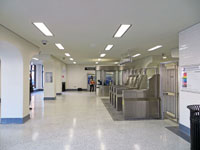
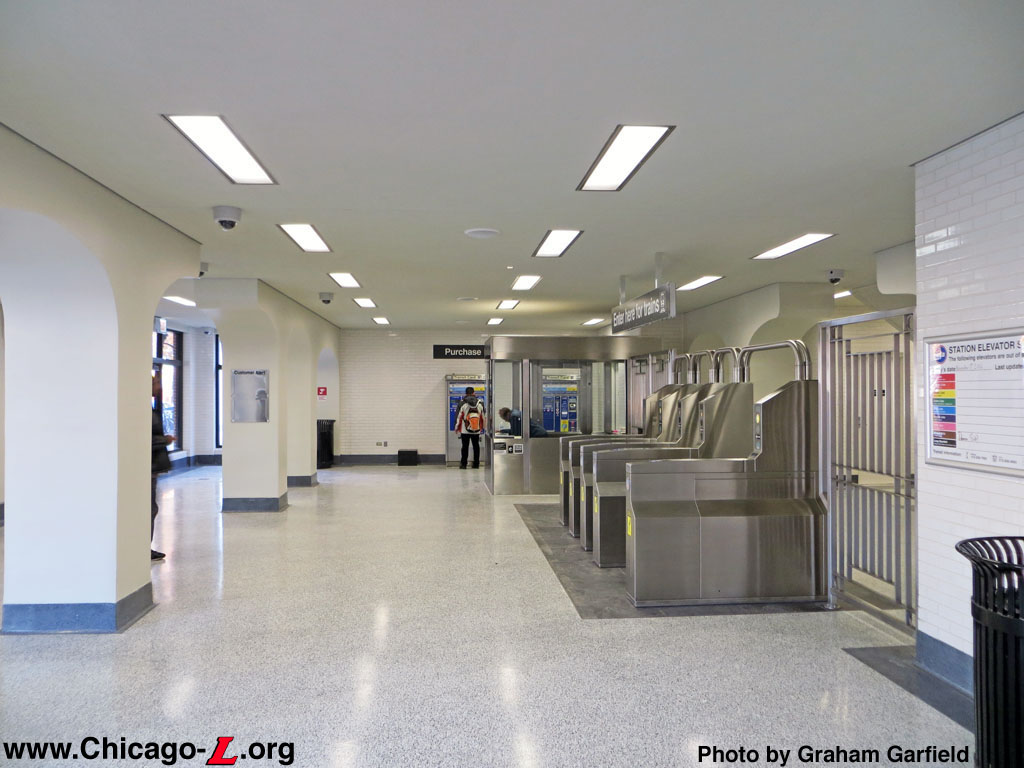
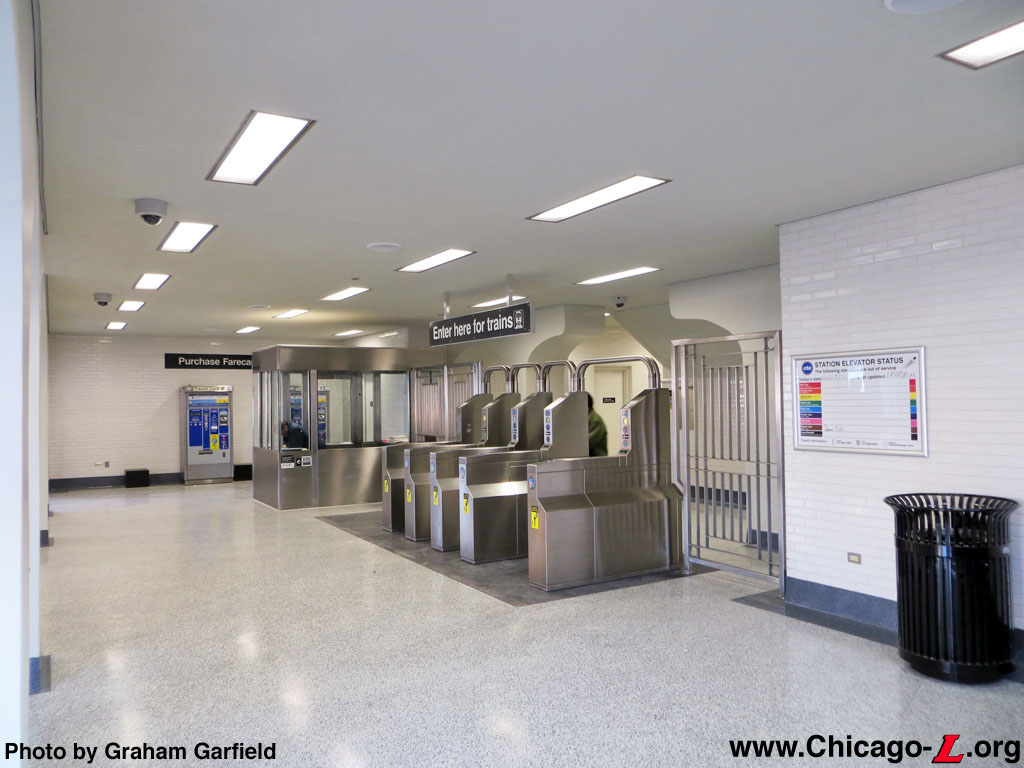
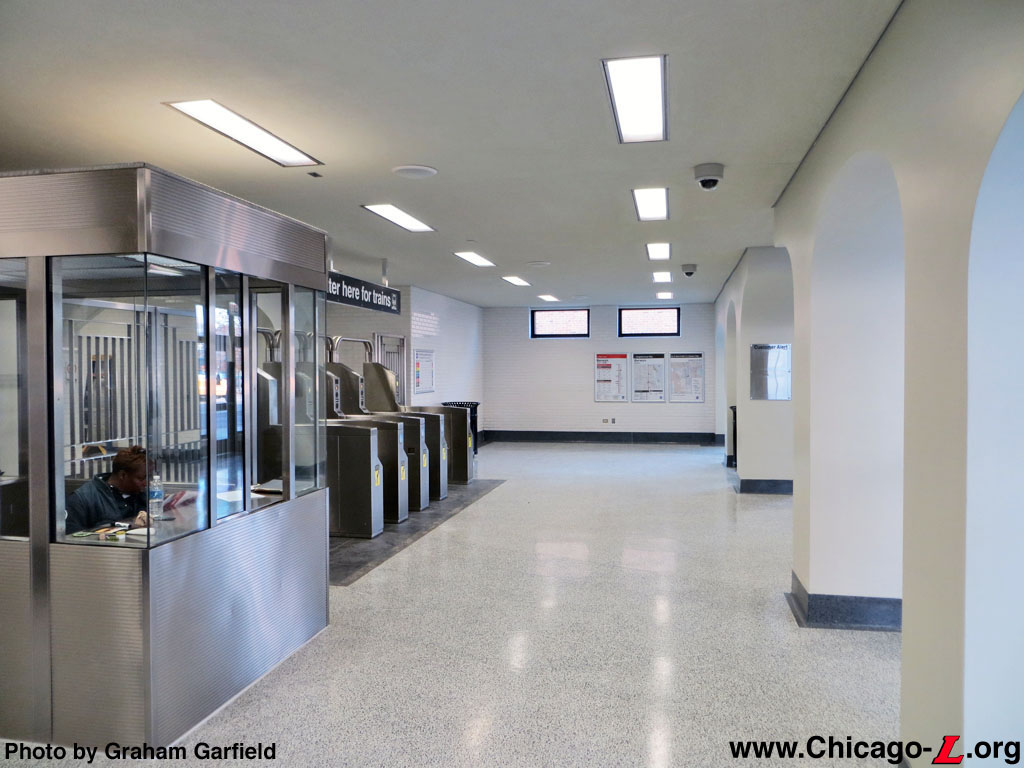
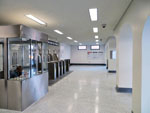
The interior of the renovated Berwyn station is seen looking east in the unpaid area on November 17, 2012. The rehabilitation gutted the interior and installed new terrazzo flooring, wall tiles, cement plaster walls and ceiling, lighting, and fixtures. The floor space was also expanded into adjacent former retail spaces -- both the viewpoint location and the location of the the farecard vending machines are in what were formerly a separate storefronts. For a larger view, click here. (Photo by Graham Garfield) |
Kiewit Infrastructure Co. was awarded the contract to through a competitive bid process. Design work began in Spring 2012. Per the terms of the contract, construction was to conclude in early 2013 (though most work was actually completed by the end of 2012) and was not to exceed $57.4 million for services, labor and materials.
Construction plans included temporary station closures for no more than six weeks. Adjacent stations were not closed simultaneously. To minimize impact to customers, service reroutes were scheduled for overnight and weekends only.
Improvement work at each location included renovations to the station facilities, the viaduct, and the tracks. The station houses received new windows, doors and exterior lighting; exterior tuck pointing; improved station layouts; new turnstiles; new interior finishes, including new wall tiling, floors, walls and ceilings; new signage and interior lighting; and site improvements including sidewalk repairs and new bike racks. The platform deck structure and foundation was replaced, the platform fixtures, furnishings and canopy improved, and a new customer communication system installed. Concrete repairs to the viaducts and to the track-level walls were made at each station, and a new waterproofing and drainage system was installed. In addition, the viaducts received painting/coating and new, brighter lighting under the viaducts. New track, ties, and ballast was laid through the station area.4
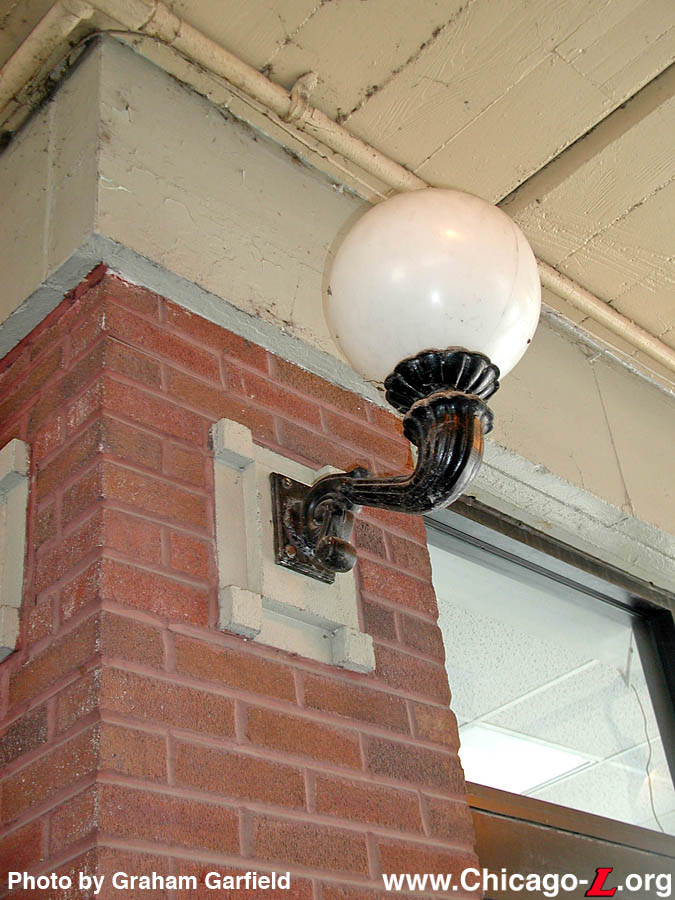
The exterior masonry, including the brick walls and concrete trim, was cleaned and the brickwork re-tuckpointed. The wooden door and window frames were removed and a new dark brown aluminum storefront installed. New globed lights were installed on the piers.
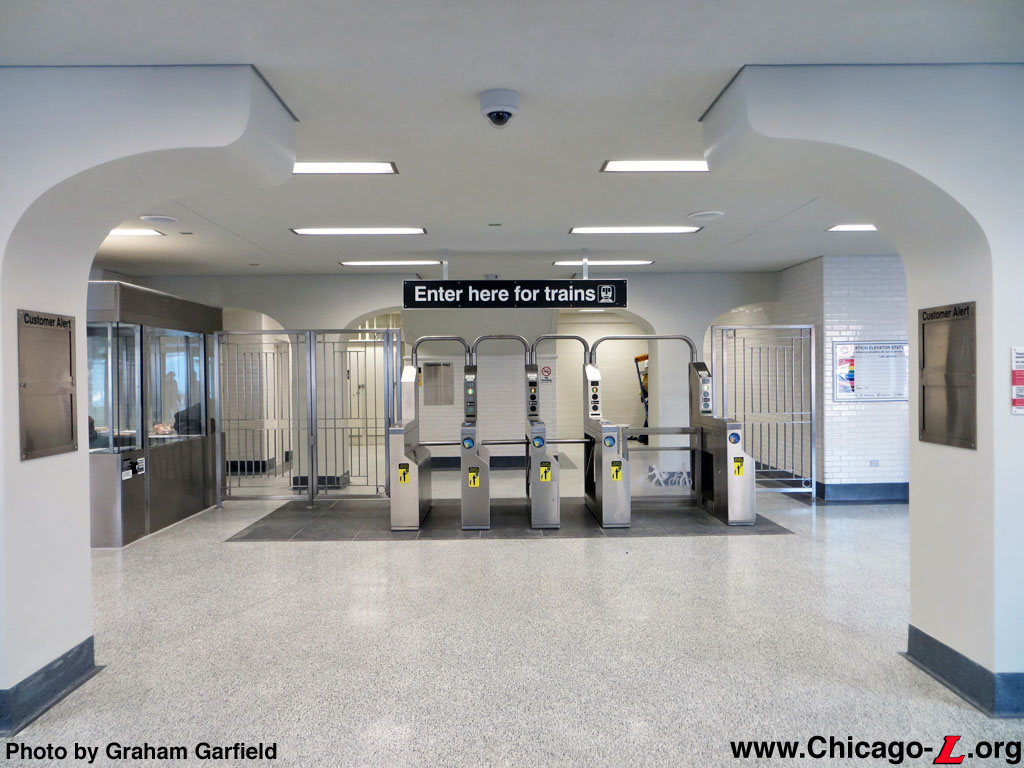
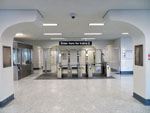
Inside, the station house was gutted down to the structural shell. The retail spaces that originally flanked the station house on both sides were demolished and the common walls removed so that the station interior could be expanded into the former rental spaces. The concession stand added inside the station house opposite the agent's booth at an earlier date was removed as well. The enlarged station interior allowed for a more open space and improved passenger circulation. Farecard vending machines, the new Customer Assistant kiosk, and an employee restroom were installed in the former east retail space. The floor space formerly occupied by the west rental space was divided up, with the area in the front (north) half of the station interior included in the newly expanded passenger space. In the rear (south) half of the station, new wall was constructed roughly where the former wall between the station and rental space was to create a new room for storage. The reconfiguration of the interior had the net effect of nearly doubling the floor space of the station's unpaid area.
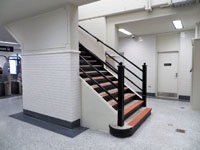
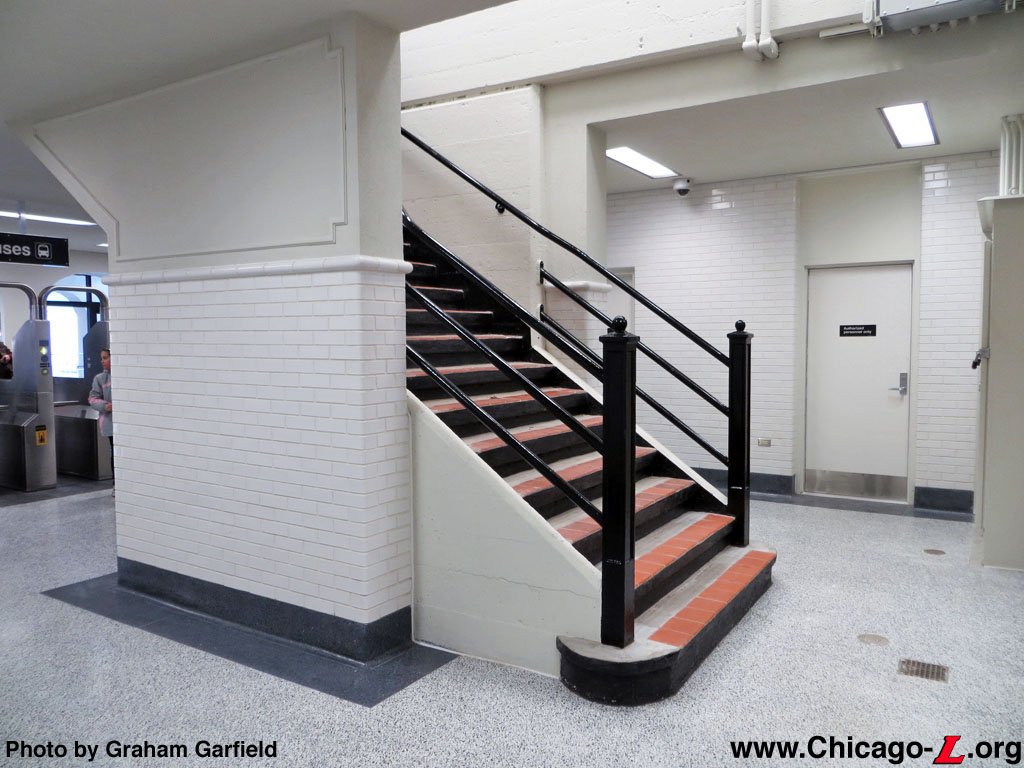
The only portion of the renovated interior that maintained the original style of white tiled walls up to a six-foot height, topped with a bullnose trim, and ornamental trim in the cement-plaster walls above, were the walls on the sides and back of the north stairs up to the platform. The original cast iron newel posts at the bottom of the stairs and the original railings were also kept. The west side wall is seen looking east on November 17, 2012. For a larger view, click here. (Photo by Graham Garfield) |
The interior walls were clad in new white modular glazed brick similar to the original material, though with some difference -- while the walls were originally clad only to a height just over 6 feet from the floor with plaster walls and ornamental trim above, nearly all of the renovated station interior's walls were clad in glazed brick up to the new suspended plaster ceiling. In addition, the free-standing columns, which originally were also tiled up to a height of about 6 feet and topped with a bullnose trim course, had their tiling removed and were refinished with a smooth plaster-cement skim coat. The middle portions of the center set of arches were removed, with the curved arches modified to taper up to the ceiling; the arches on the ends of the colonnades remain intact. The original ornamental trim on the plaster walls was not replicated in the renovated station, except on the rear angled wall under the north stairs to the platform which retained the original design of glazed brick extended up to a height of 6 feet, topped with a rounded bullnose trim, and cement plaster coating the walls above. In addition, the original cast iron newel posts at the bottom of the stair railings were kept. The decorative tan art marble piers with ornamental Prairie School capitals that flank the front doors inside the station were retained, but unlike some of the stations that were completed before Berwyn -- Thorndale and Argyle -- they were painted white rather than refurbished and restored to their original finish. A new light gray terrazzo floor with dark gray edges along the walls was installed on top of a sand cushion, and a new plaster ceiling installed with recessed lighting. A new Customer Assistant kiosk was also installed, typical of those installed by the CTA at new Brown Line stations and other recent projects like the renovations at North/Clybourn and Cermak-Chinatown, with stainless steel lower walls and roof and glass panels on all side for maximum visibility.
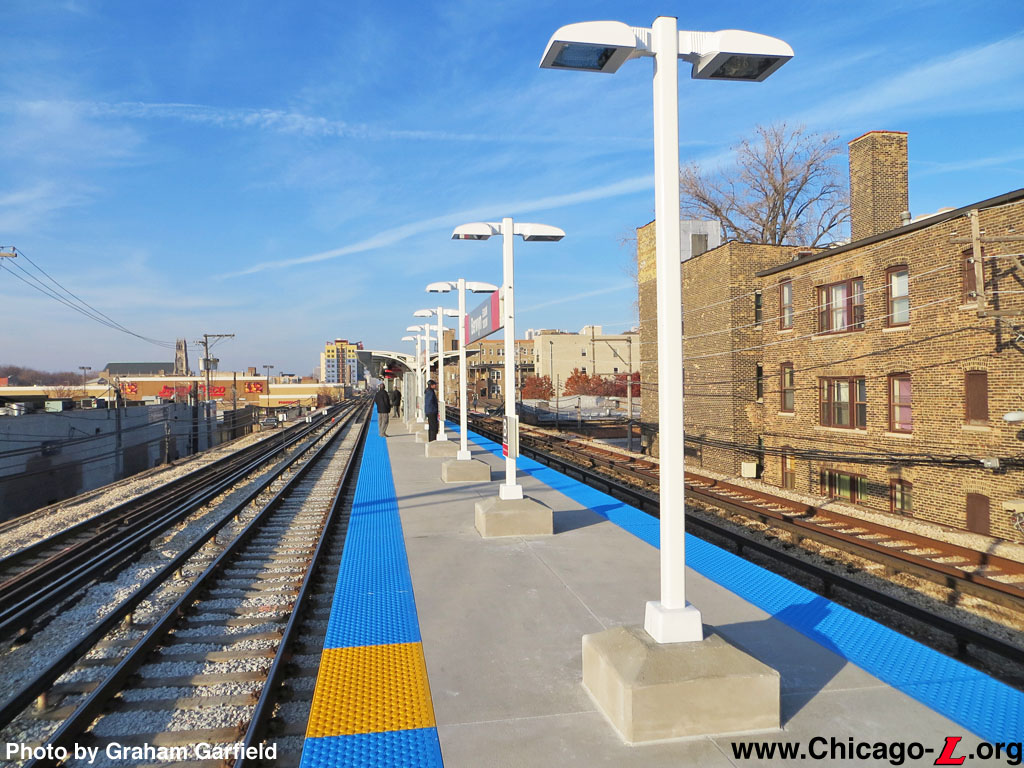
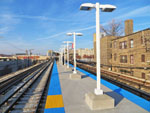
The wooden platform deck was completely removed and new foundations and supports installed to supplement the original structure. A new precast concrete deck was installed, edged with blue tactile panels. The original 1921 platform canopy was retained, stripped, rehabilitated, and repainted. The canopy roof installed in 2008 was retained. New fixtures including galvanized steel windbreaks and stairway enclosures, new benches, lighting, sandboxes, speakers, and signage were installed.
Installing elevators to make all the stations wheelchair-accessible is not part of the short-term project.5 Work is also planned for the roofs of adjacent station buildings, so that inside concession spaces can be leased and begin to generate revenue for the Authority.6
Berwyn temporarily closed for renovation at the end of the day Friday, October 5, 2012. The station reopened following renovation at 9pm, Friday, November 16, 2012, an hour earlier than originally scheduled.
Funding for the station rehabilitation project is from the Federal Transportation Administration (FTA) and is part of the $1 billion Red Line investment project. The $1 billion capital investment is a combination of state, local and federal funds, which will support other Red Line projects including track and station renewal along the Dan Ryan branch; the renovation of the Clark/Division and Wilson stations; and several other track, substation and station renewal projects along the North Side Main Line.
The scope for the seven north Red Line stations also included new original artwork. At Berwyn, the installation was a colorful mural designed by Dorothy Hughes. The 5-by-8 foot mural of glazed-and-fired tiles represents the water, trees, architecture and people of Edgewater. The blue, green and yellow mural includes raised elements, including leaves and buildings, and is comprised of 40 tiles. The artwork was installed inside the station in January 2015, completed the week of January 25.7
Red-Purple Lines Modernization (RPM) Project
Due to the deteriorating condition of the infrastructure and approaching ridership capacity on the Red Line north of Belmont and on the Purple Line by the 2000s, the CTA initiated the Red-Purple Modernization Project (RPM) to bring the existing transit stations, track systems, and structures into a state of good repair. The project, which stretches along the existing Red and Purple lines from north of Belmont station to Linden terminal, would help bring the existing transit line into a state of good repair, reduce travel times, improve access to job markets and destinations, and provide improved access to people with disabilities.
The RPM program began with a "vision study", conducted between fall 2009 and fall 2010 to assess the scope of needs, conduct an existing conditions analysis, understand the public's priorities and concerns, and frame project alternatives. The analysis helped define the purpose and need for the project and included a high-level evaluation of potential improvements to the corridor. This produced several alternatives to how to approach improvements in the total RPM corridor (Belmont to Linden).
In January 2011, the CTA and Federal Transit Administration (FTA) initiated the scoping process and environmental review process in accordance with the National Environmental Policy Act (NEPA), which included further study, refining, and eventually narrowing of these alternatives as part of an environment impact study (EIS). The process included numerous public meetings and input opportunities, and study of various alternatives for achieving a good state of repair for the infrastructure in the project area.
A number of alternatives were considered for the RPM project, including the comprehensive reconstruction of track, stations, and structures along the line. By early 2012, there were four alternatives under consideration and study, not including an FTA-required "no action" baseline scenario, included:
- Basic Rehabilitation: provides a strategic mix of repairs, rehabilitation, and replacement of the existing infrastructure for a useful life of 20 years, plus the addition of a transfer station at Loyola; all station locations remain the same.
- Modernization with Station Consolidation: provides a brand new elevated structure between Lawrence and Howard, modern amenities at stations, increases speed of service, includes new transfer station at Loyola, and major reconstruction and renovation to extend the useful life to 60-80 years; several stations would be consolidated by closing one station and adding a second entrance at an adjacent station.
- Modernization without Station Consolidation: provides a brand new elevated structure between Lawrence and Howard, modern amenities at stations, modest increase in speed of service, includes new transfer station at Loyola, and major reconstruction and renovation to extend the useful life to 60-80 years; all station locations remain the same.
The Modernization with Station Consolidation option includes the consolidation of Thorndale station with the Granville and Bryn Mawr stations by closing the existing Thorndale station and adding entrances to Granville and Bryn Mawr -- at Glenlake Avenue for Granville station, approximately one block north of Thorndale station and one block south of Granville station; and at Hollywood Avenue, approximately two blocks south of Thorndale station and one block north of Bryn Mawr station.
Other alternatives considered earlier in the study but subsequently eliminated due to public comment and further study included basic rehabilitation without adding a transfer station at Loyola, a modernization option with only three tracks between Lawrence and Howard, and a modernization option with a 2-track subway under Broadway.
Once the program study and environmental analysis had reached this point, CTA had gathered enough information on the corridor, its needs, and community preferences to shift gears and focus on developing a more defined initial slate of projects, which would bring maximum benefit to the most people, to pursue for final EIS and funding. This initial slate of projects in the overall RPM corridor is what became RPM Phase One. (For more background and information about the planning, development, and funding of RPM Phase One, see the Red-Purple Modernization Project section of the North Side Main Line page.)
The Chicago Transit Board approved the award of a $1.2 billion contract to The Walsh-Fluor Design Build Team (WFDBT) on December 12, 2018 to engineer, design and build RPM Phase One. Led by Walsh Construction with joint venture partner Fluor, the WFDBT also included lead designer Stantec and lead architects EXP. CTA broke ground on the RPM Phase One project on October 2, 2019.
Station Design
The new Berwyn station includes a main station house on the south side of the street, an auxiliary exit on the north side of the street, and a new 530-foot long precast platform with a steel framed and polycarbonate canopy structure along the entire length. The platform is served by three stairs, one escalator, and one elevator.
CTA first unveiled renderings of what the new RPM Phase One stations would look like on January 28, 2021.
Station Renovation Construction
Lawrence and Berwyn temporarily closed at the start of Stage A, and remained closed through the end of Stage B. However, Bryn Mawr and Argyle remained open during Stages A and B construction through the use of temporary station facilities.
The Berwyn station closed for reconstruction at 12:17am, Sunday, May 16, 2021.
The rebuilt, accessible Berwyn station opened for service shortly after midnight, Sunday, July 20, 2025.
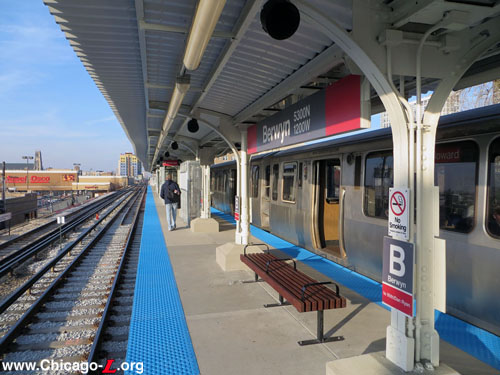
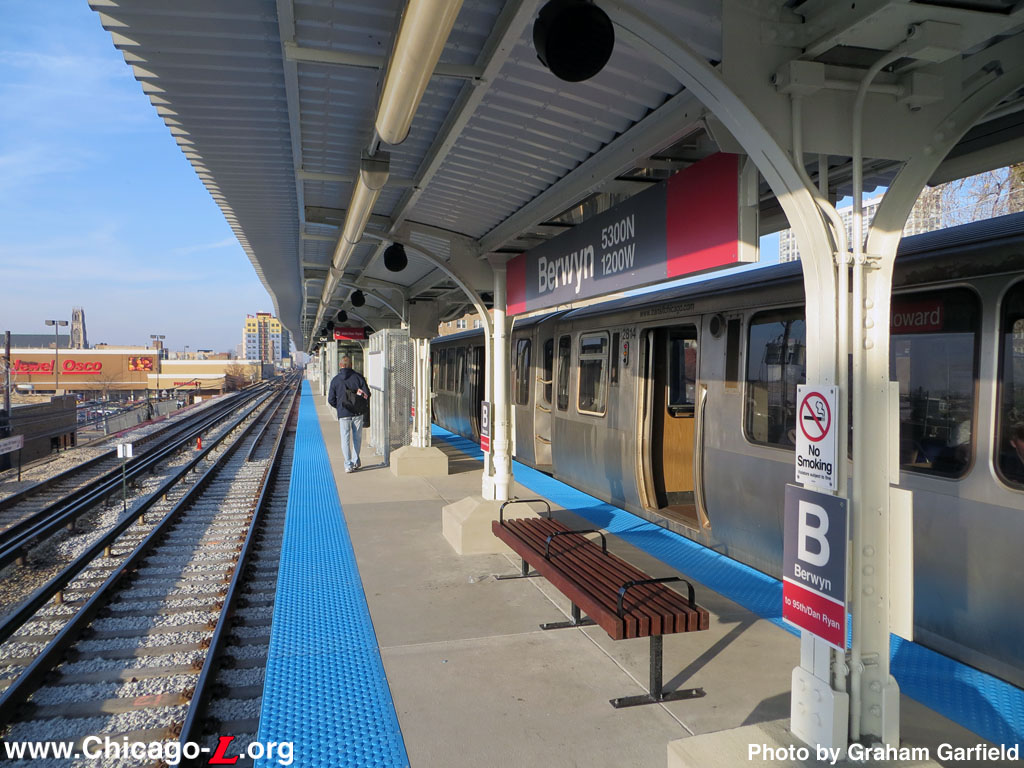
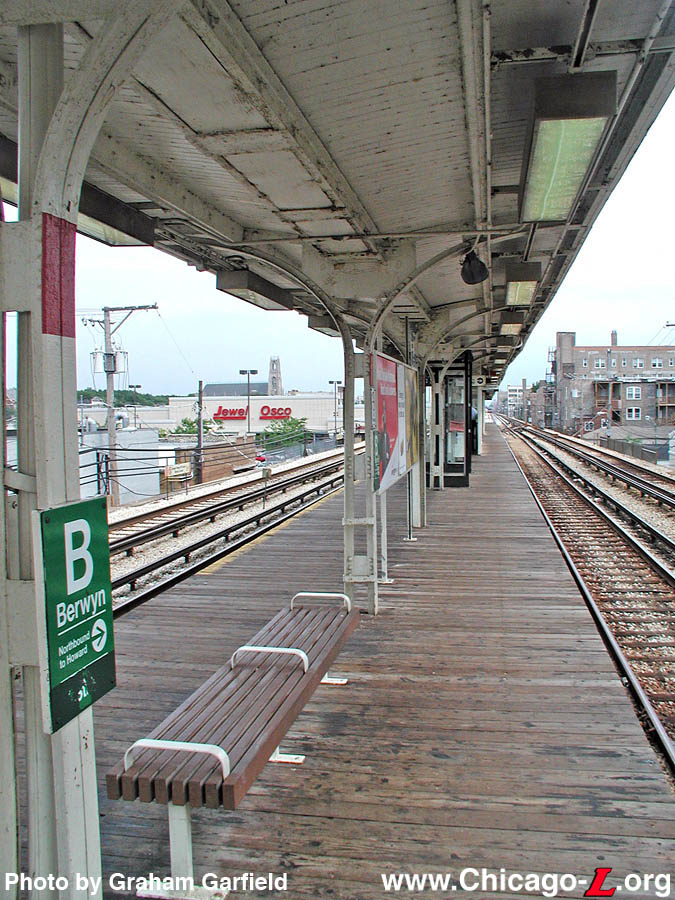
The Berwyn island platform, looking north on November 17, 2012, following renovation. The gullwing canopy is original to the 1921 station, but the recent rehabilitation replaced the wood platform deck with precast concrete, refurbished the canopy structure, and provided new platform signage and furniture. For a larger view, click here. (Photo by Graham
Garfield) |

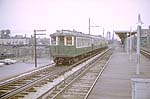
|
cta4271d.jpg
(105k)
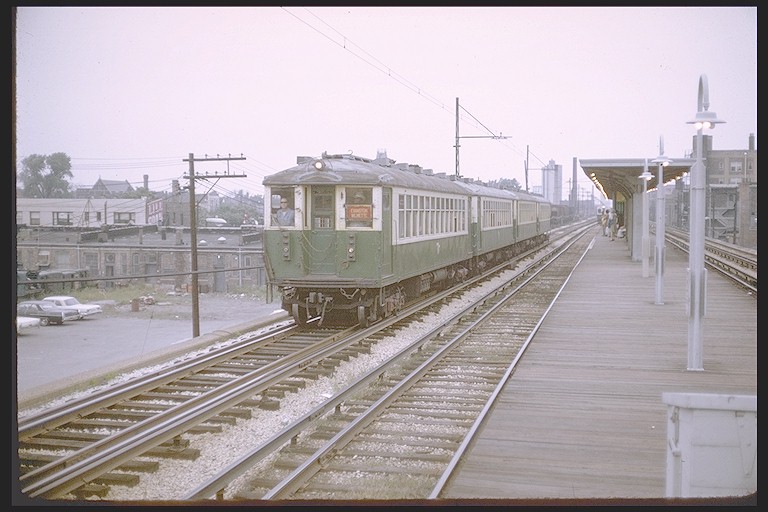
Car 4271 leads a four-car southbound Evanston
Express passing Berwyn station on the North-South
Route on September 15, 1969. (Photo by
Doug Grotjahn, Collection of Joe Testagrose)
|
 |
berwyn02.jpg (125k)
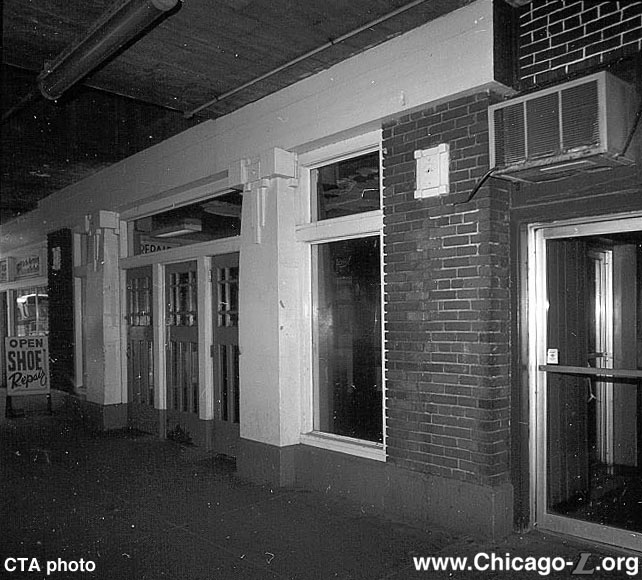
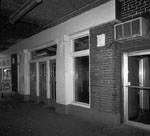
The exterior of the entrance to Berwyn station is seen looking southeast on May 6, 1986. The station's 1921facade is still intact in this view, including the original doors and windows. The only changes to the station are the painting of the cement piers and the removal of the original light fixtures. The storefront on the right has received some additional modifications, like the new door and air conditioner cantilevered in the transom. (CTA photo) |
 |
berwyn04.jpg (138k)
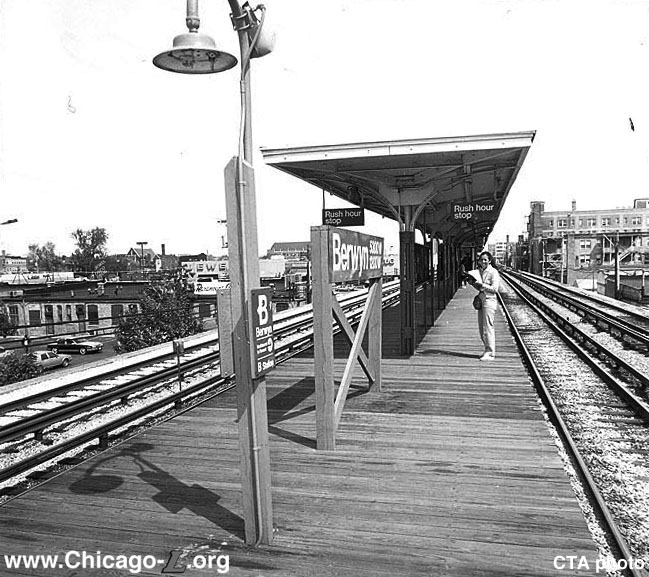
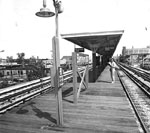
The Berwyn platform is seen looking north from the south end on May 6, 1986. The station's appearance is as it had been for decades, with the original canopy in place with few changes, the wooden deck, and incandescent lights on shepherd's crook poles. (CTA photo) |
|
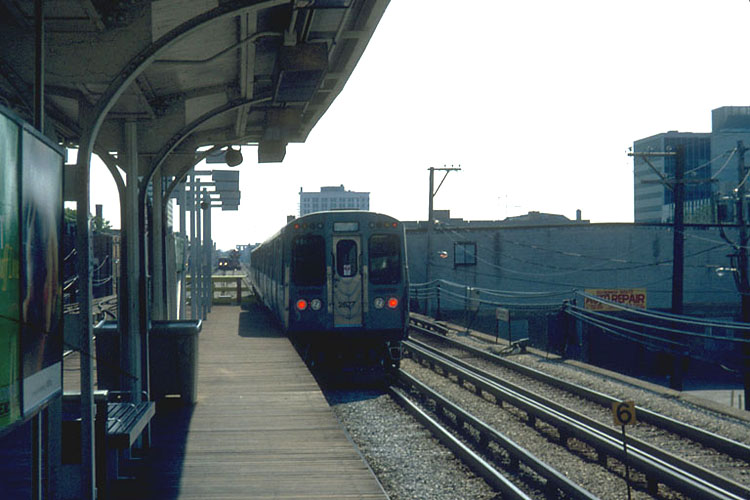
cta2677.jpg
(88k)
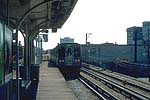
Car 2677 trails a southbound Red
Line train as it pulls out of Berwyn station on its way
to 95th/Dan Ryan on September 26,
1999. (Photo by Mike Farrell)
|
|
berwyn05.jpg
(200k)
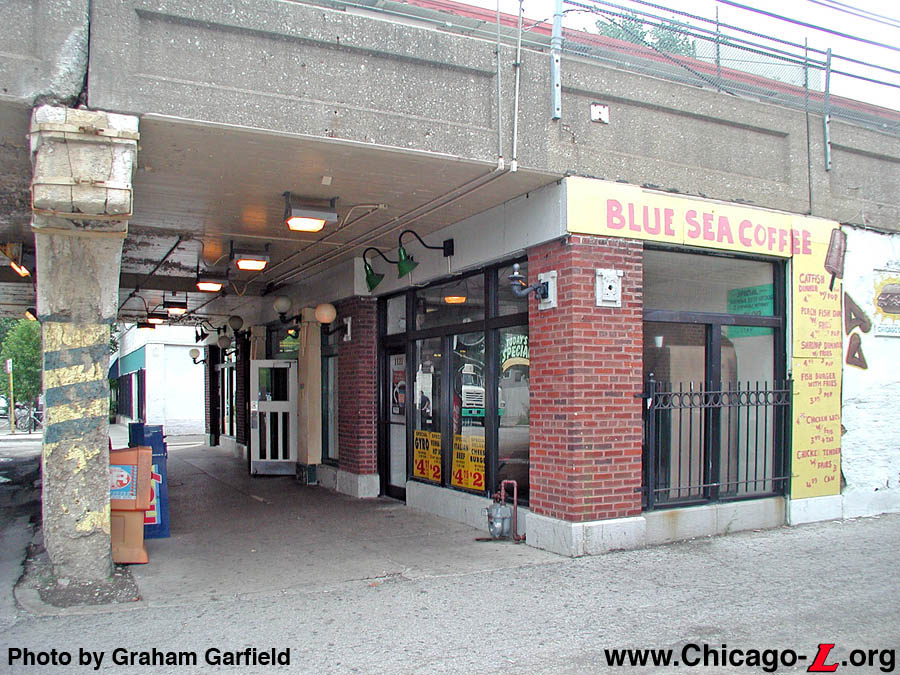
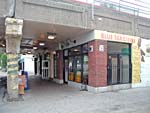
The exterior of Berwyn station is seen looking
east on July 21, 2005. The retail spaces flanking the
station entrance -- the one in the foreground is occupied by
a short-order restaurant at the time of the photo -- are
seen filling out the width of the embankment.
(Photo by Graham Garfield)
|
 |
berwyn06.jpg (173k)
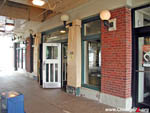
The Berwyn station entrance is seen looking southeast on July 21, 2005. The station remains largely intact in its original condition, including its original brick and cast stone details on the exterior. (Photo
by Graham Garfield) |
|
berwyn07.jpg
(146k)
At the time of this July 21, 2005 photo, the
exterior of Berwyn station still had upturned light fixtures, with decorative cast
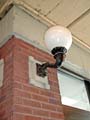
metal curved arms and globed lights, which were not original but which were similar in scale and shape to the original fixtures. (Photo
by Graham Garfield)
|
|
berwyn08.jpg
(172k)
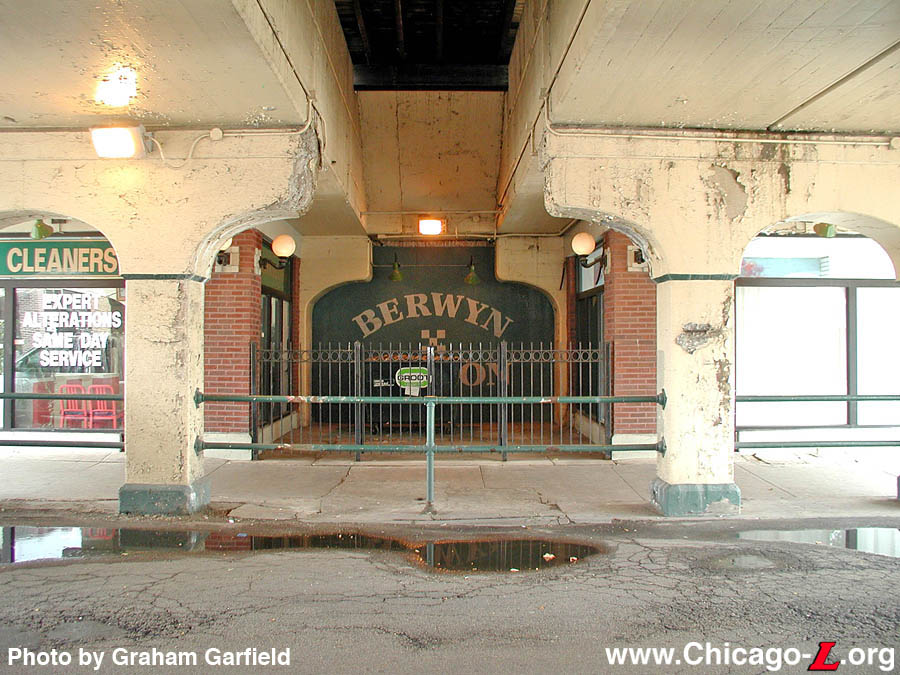
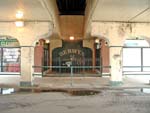
The north side of Berwyn Avenue, opposite the
station entrance, also had retail spaces built into the
embankment. Using extra space for rental commercial
properties provided extra income for the "L" companies, and
later for the CTA. The design of these spaces complimented
the station. As at other North Side stations, Berwyn
originally had an auxiliary exit here too. Nearly all of
these have been removed, with the vacated space at Berwyn
filled in by a decorative tile graphic, seen looking north
on July 21, 2005. (Photo by Graham
Garfield)
|
 |
berwyn10.jpg (197k)
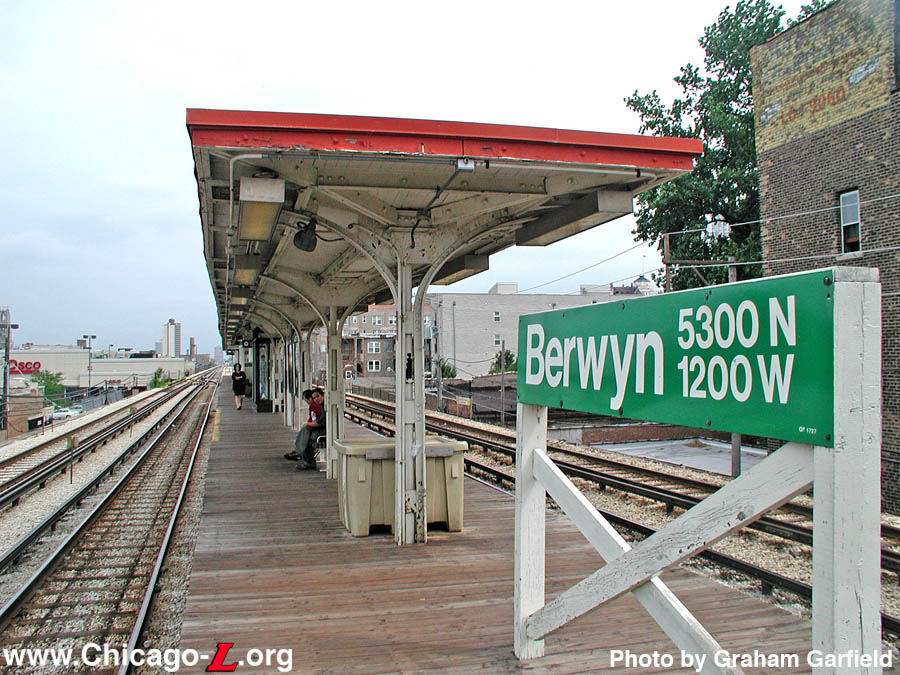
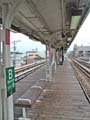
The island platform at Berwyn, looking north on July 21, 2005. The gull-wing canopy supports and roof structure all date from the construction of the station in the early 1920s.
(Photo by Graham Garfield) |
|
berwyn11.jpg
(195k)
Berwyn station's island platform is seen looking
north on July 21, 2005 under the gull-wing canopy.
(Photo by Graham Garfield)
|
 |
berwyn12.jpg (192k)
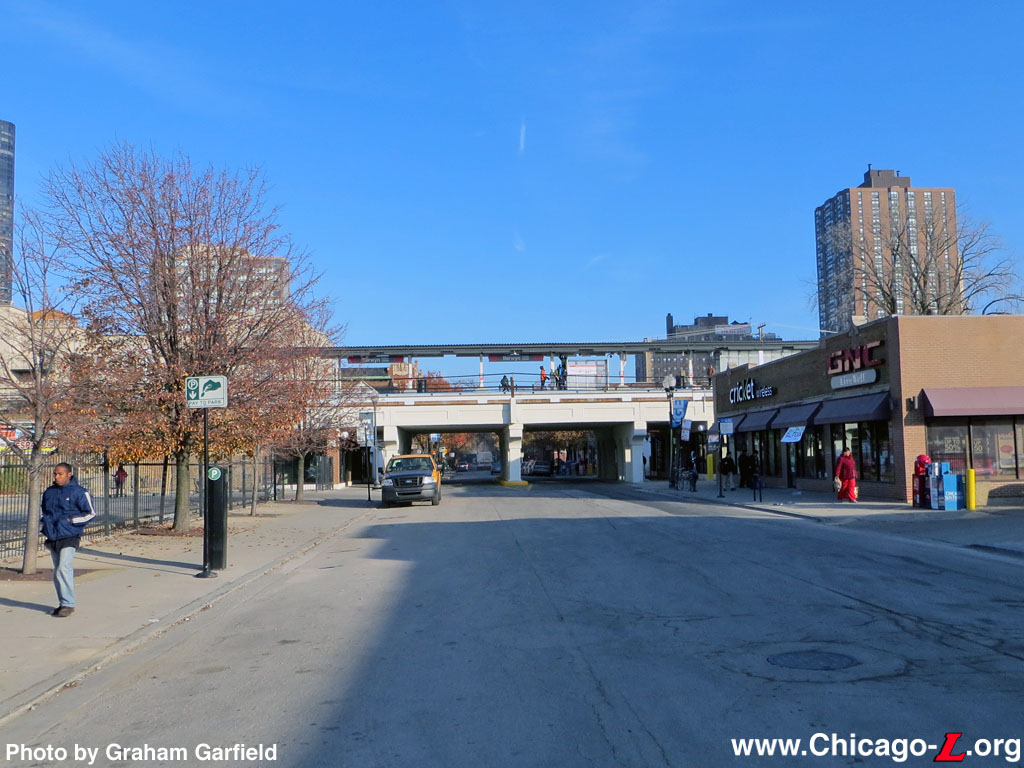
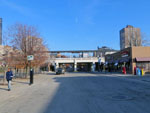
The "L" viaduct and Berwyn station are seen in the distance looking east on Berwyn Avenue on November 17, 2012. The concrete bridge deck spans supported by concrete piers on the sidewalk and in the center of the street are typical of the North Side track elevation completed in 1922. The Berwyn station platform is seen on top of the bridge. While the "L" infrastructure has changed little in 70 years, this circa 1940s photo above shows that commercial buildings formerly on the right and a coal yard formerly on the left have both given way to redevelopment. (Photo by Graham Garfield) |
|
berwyn13.jpg (176k)
The front entrances of Berwyn station, looking southeast on November 17, 2012, the first full day the station was open after renovation. The station house's exterior masonry was refurbished and a new storefront of doors and windows was installed, including on the portions which were formally separate retail spaces but which are now part of the station. The pilasters framing the center doors and the ornamentation around the light fixtures convey the station's Prairie School influences. (Photo by Graham Garfield) |
 |
berwyn14.jpg (186k)
The front entrances of Berwyn station, looking southeast on November 17, 2012, the first full day the station was open after renovation. The pilasters framing the doors and the ornamentation around the light fixtures convey the station's Prairie School influences; the design is typical of the stations Charles Rawson designed for the North Side elevation between Argyle and Howard. In the 2012 renovation, the wood-framed doors and windows were replaced with an aluminum-frame storefront. The station's main entranceway was reconfigured from having three doors to having two doors flanked by sidelights. Additional entrance doors are provided to the left and right in the spaces formerly occupied by retail stores. (Photo by Graham Garfield) |
 |
berwyn16.jpg (155k)
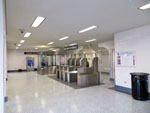
The interior of the renovated, expanded Berwyn station is seen looking southeast towards the fare controls from the unpaid area on November 17, 2012. The new white tile walls with a new base molding of dark precast terrazzo, new light gray terrazzo floors, and new cement-plaster ceiling with recessed lights are all evident. The areas in the immediate foreground and in the background where the farecard vending machines are located were formerly in retail spaces separate from the station area. (Photo by Graham Garfield) |
 |
berwyn17.jpg (156k)
The renovated interior of the Berwyn station house is seen looking west in the unpaid area on November 17, 2012. This view shows the expanded footprint of the station interior -- the foreground and the area beyond the turnstiles were formerly separate retail spaces whose common walls were removed so the station could expand into those areas, nearly doubling the footprint of the unpaid area. The interior features new terrazzo floors, tile and plaster walls, plaster ceilings, a new Customer Assistant kiosk, security cameras, and new signage and other fixtures. (Photo by Graham Garfield) |
 |
berwyn18.jpg (167k)
This November 17, 2012 view looks south into the Berwyn station house from the front entrance way. The space seen in this view encompasses the area of the original station house, but additional interior space is now offered (out of view) to the right and to the left, which the new Customer Assistant booth partially occupies. The middle sections of the center arches were removed in the renovation, as were their columns' tiling, with the surface of the arches and columns refinished in smooth cement-plaster. The rehabilitated interior also features a new plaster ceiling with recessed lights, new tiling on the side walls, new terrazzo floors, and new signage. (Photo by Graham Garfield) |
|
berwyn20.jpg (228k)
The Berwyn island platform, looking north on November 17, 2012, following renovation. The gullwing canopy is original to the 1921 station, but the recent rehabilitation replaced the wood platform deck with precast concrete, refurbished the canopy structure, and provided new platform signage and furniture. (Photo by Graham Garfield) |
 |
berwyn21.jpg (249k)
The renovated Berwyn station platform is seen looking north from the far south end on November 17, 2012. The refurbished platform includes new precast concrete decking with tactile edging tiles, new free-standing light standards and luminaires outside of the canopy, and new signage. The large angled concrete bases where the light poles and canopy columns meet the new platform result from work to shore up the platform structure and create new support footings. (Photo by Graham Garfield) |
 |
cta2893-HolidayTrain2013a.jpg (250k)
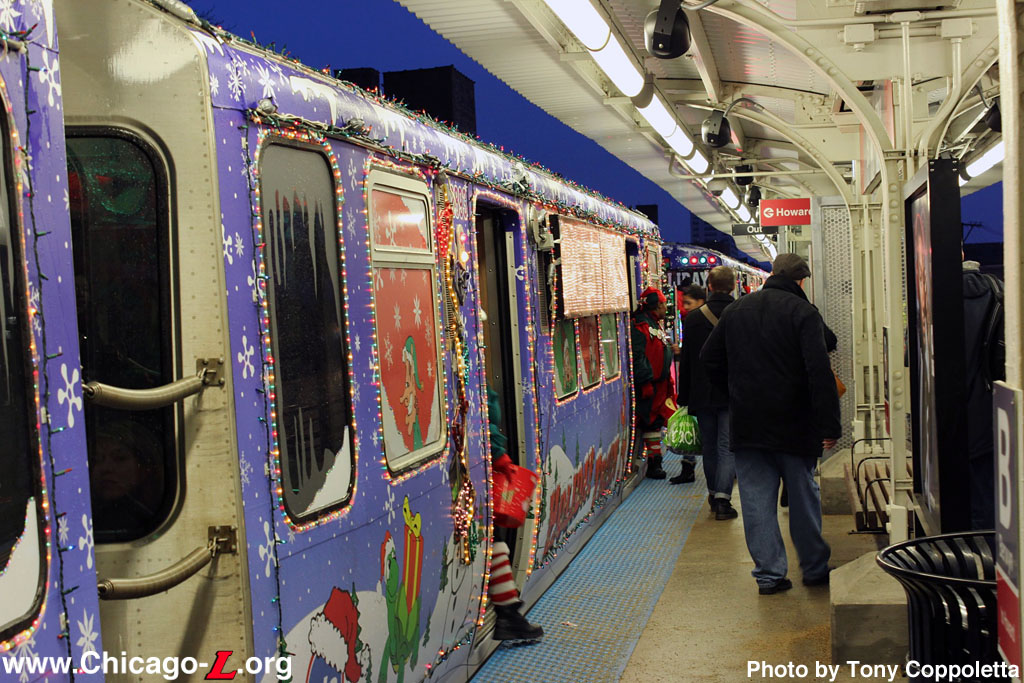
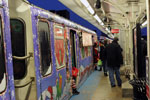
On an evening trip on the Red Line, the Holiday Train stops at Berwyn on December 21, 2013. Elves in each car are ready to greet boarding passengers and hand out candy canes. (Photo by
Tony Coppoletta) |
(Thanks to LeRoy Blommaert for information regarding the
station's opening date.)
Notes:
1. Blommaert, LeRoy. "Edgewater's "L" stations", Edgewater Historical Society, Vol. XXVI No. 1, Spring 2015.
2. "3 NEW STATIONS ON NORTH SIDE "L" READY JAN. 1." Chicago Daily Tribune, 1920 Dec. 1, pg. 21.
3. "Fifty-Eighth Annual Report of the Chicago, Milwaukee & St. Paul Ry. Co." Railway Age. June 9, 1923, pg. 1396.
4.
Red North Station Interim Improvements webpage. Chicago Transit Authority, retrieved 25 March 2012.
5. Hilkevitch, Jon. "$57.4 million facelift program OK'd for 7 North Side stops on CTA's Red Line." Chicago Tribune. 8 February 2012.
6. Roberts, Bob. "Major Renovations Coming To Multiple Red Line Stations." CBS Chicago. 9 February 2012.
7. Woodard, Benjamin. "Dorothy Hughes' Tile Mural Installed at Berwyn 'L' Station." DNAinfo Chicago, 28 January 2015.