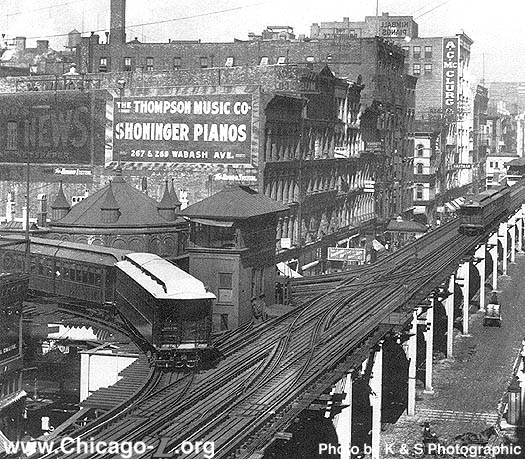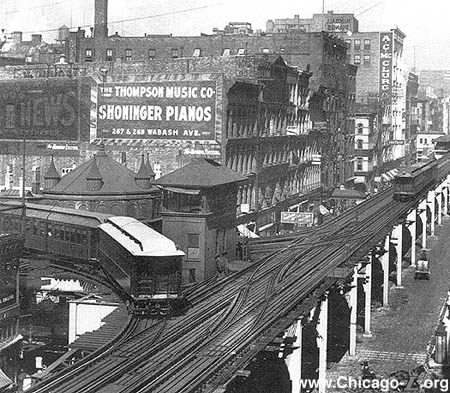
Tower 12, as it looked just
after the turn of the century. A South Side Elevated train
(left) has just completed a circuit of the Loop and is
turning south on its way back to Jackson
Park terminal.
Meanwhile, A three-car Northwestern Elevated train (right)
waits to turn west onto Van Buren from Wabash. For a larger
view, click here.
(Photo by K & S
Photographic)
|
Tower
12
Van Buren Street and
Wabash Avenue, Loop
Service
Notes:
|
Services:
|

|
Green Line:
Lake-Ashland-East 63rd
|

|
Brown Line:
Ravenswood
|

|
Orange Line:
Midway
|

|
Purple Line:
Evanston Express
|

|
Pink Line:
54/Cermak-Loop
|
Quick Facts:
Established: October 3,
1897
Original Line: Union Elevated Railroad
Rebuilt: 1969, 1992-93
Status: In Use
Profile:
The location that is now home to Tower 12 and its associated
junction was placed in service on October 3, 1897 to connect the
South Side Elevated to the
Loop Elevated. Tower 12 is located
at the southeast corner of the Loop
and controls a T-shaped junction, with the short two-block connector
along Wabash and Harrison built in 1897 to connect the Loop
and the old South Side main
line connecting from the south.
So, why is Tower 12 called "Tower 12"? For administrative reasons
that have now become unclear, the 11 stations and and three junctions
on the Loop were assigned numbers beginning at the Van Buren &
Fifth junction and counting up going counterclockwise around the
Loop. The scheme progressed as follows:
|
8 - Fifth & Van Buren junction
|
|
9 - Pacific (LaSalle) & Van Buren station
|
|
10 - Dearborn & Van Buren station
|
|
11 - State & Van Buren station
|
|
12 - Van Buren & Wabash junction
|
|
13 - Adams & Wabash station
|
|
14 - Madison & Wabash station
|
|
15 - Randolph & Wabash station
|
|
16 - State & Lake station
|
|
17 - Clark & Lake station
|
|
18 - Lake & Fifth station (junction, after 1899)
|
|
19 - Randolph & Fifth station
|
|
20 - Madison & Fifth station
|
|
21 - Quincy & Fifth station
|
No records have survived that indicate what numbers 1-7 were to be
used for, although they may have been assigned to the Union
Consolidated line west of Market Street, for which the company
received a franchise but had no real intention of constructing.
Another theory is that they were for the various stub terminal
stations and junctions, and for the Met's Franklin
& Van Buren station. In any case, these administrative
numbers survive today only in the names of the two remaining original
junction towers: 12 and 18.
The tower itself was a two-story affair set inside the junction
between the various intersecting and diverging tracks, adjacent on
the west of the southbound straight track. Its architecture was more
practical than of any particular style, but did feature decorative
window frames and sills, belt course moldings, and a hipped roof with
a small chimney for the coal-burning stove inside. Entrance to the
first floor was through a door at track level. Access to the second
floor was also from outside, via a stairway on the exterior of the
tower. The interior space was tight. With windows on all sides for
maximum visibility, the tower was heated only by a small iron
potbelly stove in the corner of the room. The junction was equipped
with a hand-operated lever form of switch and signal control. This
made the interior a dizzying array of levers and switches, all of
which had to be precisely aligned by a vigilant towerman.
From 1900 to 1913, the track configuration of the junction
remained largely the same. The Loop was operated as a railroad with
left-hand running -- a very unusual practice in America -- a trait
shared by two other "L" routes: the Northwestern Elevated and Lake
Street Elevated. The Metropolitan and South Side elevateds started as
and remained right-hand railroads, making the changeover to left-hand
operation upon their entrance to the Loop at Towers
8 and 12, respectively.
In 1913, the Chicago Elevated Railways instituted crosstown
service. With many North-South trains now through-routed, the
configuration of Tower 12 would need to be changed. All Lake Street
and Metropolitan trains still terminated around the Loop, as well as
some night and off-peak Northwestern and South Side trains. Most
North-South trains, however, went through and this required an
extensive reworking of not only the Tower 12 interlocking but also
Loop operating procedures. Just after midnight on November 3, 1913,
all trains began operating in a counterclockwise, unidirectional
manner, with Northwestern and South Side trains on the outer track
and Metropolitan and Oak Park (Lake Street) trains on the inner
track. North-South trains operated northbound via Wabash Avenue and
Lake Street, while southbound they operated via Fifth Avenue (now
Wells Street) and Van Buren Street. At the same time, the
Northwestern and Chicago & Oak Park lines changed from left- to
right-hand running to reduce switching delays at Tower
18.
The configuration of Tower 12 remained the same for the next 56
years, despite another crosstown route revamp in 1931 and the opening
of the State Street Subway
in 1943. Only small routing changes occurred. By 1936, the straight
southbound track, not needed for revenue service, was removed, with
only the eastbound-to-southbound track curving from Van Buren onto
Wabash giving access to the southbound South Loop connector tracks.
In 1943, Jackson Park-Evanston, Jackson Park-Howard, and
Englewood/Normal Park-Ravenswood trains were rerouted into the
subway, leaving the
Kenwood-Wilson and Wilson-Loop rush hour trains as the only
North-South trains running through Tower 12. In 1949, the
CTA's North-South
service revision brought some of these services back, with all
Ravenswood and rush hour Evanston Expresses terminating on the Loop
again. In the 1950s, Metropolitan Division trains were slowly
siphoned off as well. Logan
Square trains were taken off the Inner Loop in 1951 with the
opening of the Milwaukee-Dearborn
Subway. In 1958, Douglas and
Garfield trains were removed
from the Loop entirely and placed in
a subway as part of the West-Northwest
Route.
With only Lake and Ravenswood
services left on the Loop at all times, supplemented by Evanston
Express trains in rush hour, the Loop
Elevated reached a low point in terms of intensity of
CTA service. The
CTA decided to begin removing
some of the unneeded infrastructure in the 1960s. The North Shore
Line interurban, which also used the Loop,
abandoned service on January 21, 1963. Without North Shore Line
trains continuing south from the Loop
to Roosevelt Road
station via the South Side
Elevated, the elevated tracks that continued over Wabash south of
the Loop were abandoned except for
occasional nonrevenue moves. As a result, Tower 12 was removed from
service on November 1, 1963, with the junction replaced with
hand-throw switches. The tracks remained in place, however, and as of
June 1964 the old interlocking tower still stood.
Only about five years later, the Loop
experienced a renaissance with the opening if the Dan
Ryan Line in 1969. The new Ryan
line was through-routed with the Lake
route, bringing a surge to the number of trains that would be using
the Loop. The Lake-Dan
Ryan trains would also only use the Lake and Wabash legs of the
Loop, requiring some new track
configurations at Towers 18 and 12,
reactivation of the South Loop connector from Tower 12 to 17th,
and the need to once again differentiate trains at Tower 12.
On September 28, 1969, concurrent with the beginning of West-South
Route (Lake-Dan Ryan) service, the new Tower 12 interlocking was
placed in service. Several aspects of the Loop
operations also changed. The Loop returned to a bi-directional
railroad, but used right-hand operation this time. Ravenswood
trains operated counterclockwise on the Outer Loop at all times and
Evanston Express
trains operated clockwise on the Inner Loop during weekday rush
periods. Lake-Dan
Ryan trains took a straight route through the Tower 18
and 12 interlockings. This required a new southbound track straight
through Tower 12 interlocking on Wabash to be laid. At the same time,
the old eastbound-to-southbound curve from Van Buren onto Wabash was
removed, terminated in a stub. It is likely that it was amidst these
changes that the old two-story wooden tower was demolished, replaced
with a simple relay house with a tower panel in the middle of the
interlocking, adjacent to the southbound Lake-Dan
Ryan track, where the old tower building was.
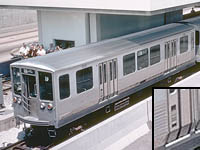
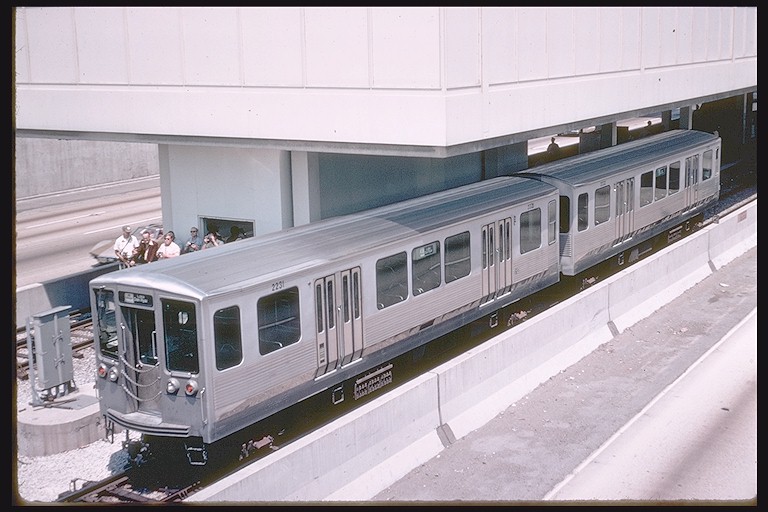
The black-and-white bar
code-like ACI stripe (inset) is visible on Lake-Dan Ryan car
2231 at the 95th
Terminal on July 4,
1971. For a larger view, click here.
(Photo from the Joe Testagrose Collection)
|
With the addition of Lake-Dan
Ryan Line, trains now needed to be differentiated from one
another since they took different routes through the interlocking.
Ravenswood and northbound Lake-Dan
Ryan trains converged at Tower 12, but this could be easily
accommodated by automatic operation of the interlocking aligning the
switches for whichever arrived first. But Evanston
Express and southbound Lake-Dan
Ryan trains took diverging lineups at Tower 12 and had to be
differentiated from one another. This situation only existed during
rush hour, however, as the Evanston Route didn't otherwise come
downtown leaving only Lake-Dan Ryan trains going south thorough Tower
12. Rather than staff the tower during rush hours, the
CTA decided to fully automate
the interlocking. This was accomplished by means of a device carried
by the trains that identified to the interlocking equipment what
route to set. The device was a flat panel called an "ACI stripe", a
vertical reflective stripe with black and white horizontal striping
pasted onto the door leaf of the first door of the front of both
sides of each Lake-Dan
Ryan car. The black and white stripes were, in essence, a bar
code that was read by the wayside scanner, which transmitted the
identity of the approaching train to the interlocking and set the
switches accordingly. If an ACI stripe was detected, the interlocking
knew it was a Lake-Dan
Ryan train. If no ACI stripe was detected, the interlocking set
the switches for the default routing: Ravenswood
northbound and Evanston
Express southbound. If the stripe was not detected and the lineup
was incorrectly set by the interlocking, a manual route selector
mounted at cab height next to the track at the junction allowed the
motorman to lean out his cab window and manually set the switch.
In later years, the ACI stripes were supplanted by the use of
transponders, which emit a radio signal identifying the trains.
Unlike the ACI stripes, the transponders were put on the Evanston
Express trains and the straight-through route now became the
default lineup. A transponder reader was located north of Tower 12
and let the interlocking know what type of train was coming. If no
transponder was detected, then the switches are set for the default
routing, which was for the Lake-Dan
Ryan. If a transponder was detected, the route was set for the
Evanston Express.
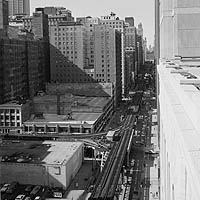
This 1971 view looking north
on Wabash Avenue shows Tower 12 at center. Visible in the
photo is the relay house in the middle of the interlocking
and the remnants of the removed Van Buren-to-Wabash curve.
For a larger view, click here
[off-site link]. (Photo by
Jet Lowe, courtesy of the Historic American Engineering
Record, Library of Congress)
|
Few other changes were made to Tower 12 for many years. On November
24, 1981, the east-to-south connecting track from Van Buren onto
Wabash, which had been removed in 1969 as part of the work to ready
the junction for Dan Ryan
service, was put back and placed in service. As the years went on the
transponder system for the Evanston
Express trains fell into disrepair and, with limited funding
availability, CTA chose not to
repair it. At that point, a towerman was assigned to staff Tower 12
during weekday rush periods when the Evanston
Express was running. Otherwise, the interlocking plant could be
left on automatic, as there was no need to sort diverging routes when
the Evanston Express
wasn't running.
The next change to Tower 12 came when the Orange
Line was being readied for service in the early 1990s. A new
switch had to be added to the Tower 12 junction to allow northbound
Orange Line trains on Wabash onto
the Inner Loop westbound on Van Buren. This new switch was placed in
service on April 22, 1993. This presented a new set of alternate
routings that would take place at Tower 12 -- northbound Orange
Line trains diverging west while northbound Green
Line trains continued north -- that would need to be sorted out.
It was still desired not to have to staff the tower at all times the
Orange Line was operating, so a
new set of transponders were installed. This set controlled the
northbound routings from Wabash Avenue. The Orange
Line trains carried transponders and a receiver was placed north
of Roosevelt
station. When the receiver detected a transponder, Tower 12
automatically aligned the switches for the Inner Loop. The default
route was for the Green Line, which
would be set to continue north on Wabash if no transponder was
detected. Southbound Orange and
Green line trains took the same
lineup through Tower 12, so no sorting was necessary there.
Southbound Purple Line
(Evanston) Express trains did still need to be sorted out,
but their transponder system was left disabled and a towerman
continued to be assigned during weekday rush periods. The new Tower
12 interlocking, which also controls the diamond crossover south of
Tower 12 at Congress/Wabash, was placed in service on March 14, 1994.
As part of the new interlocking, a new "tower" was constructed on the
east edge of the junction, cantilevered over the corner of Wabash and
Van Buren. Actually just a small hut on an elevated platform, the
higher location gave the towerman a better view of the approaching
lines. The old relay house between the switches where the old tower
panel had been remained in place as well.
Tower 12 saw a surge in traffic when the Pink
Line service was inaugurated on Sunday, June 25, 2006. Pink
Line trains operated clockwise around the Inner Loop and ran
during all but owl hours. This meant that for the first time in
decades, an "L" line would be taking the Inner Loop-around route at
Tower 12 during all day and evening hours. Because of the increased
number of trains trough the junction and the need to have a measure
of human decision-making when routing trains, especially during rush
periods, the CTA began
staffing Tower 12 full-time concurrent with the beginning of
Pink Line service.
Loop Signal Replacement Project and Track Renewal
On January 10, 2007, the Chicago Transit Board approved a $48.2 million contract to replace the signal and train control systems along the Loop Elevated tracks. The new train control system replaced a system that was 31 years old and enhanced CTA's ability to operate trains through Tower 12 and Tower 18 junctions. The new systems help to improve the reliability of service by regulating train movement, speed and intervals at those junctions.
Divane Brothers Electric Company was selected following a competitive bid process. Funding for the project came from the Federal Transit Administration (FTA), the Regional Transportation Authority (RTA) and CTA bonds.
Work was expected to begin early in 2007 and be completed in 2009.1 However, problems with the contractor's performance2 3 4 and the broadening of the project scope to include track renewal on the Lake and Wabash sides of the Loop delayed the project, which was not substantially completed until July 2011.5 In addition, the total contract value increased to $67.9 million, with a total project budget of $103.2 million.
The Loop Signal Project included a new bidirectional cab signal system for the Loop Elevated, a new Tower 18 at Lake and Wells, a new interlocking at Jefferson on the Lake branch, a signal facility building for Tower 18 where the old Randolph/Wells station platforms were, and a new Tower 12 relay house, plus new control panels for Tower 12 and Jefferson Crossover. A portion of the bridge control system that operates the Lake and Wells Street bridges was also upgraded.
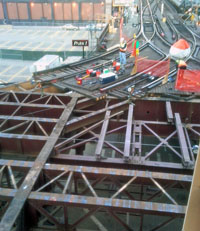
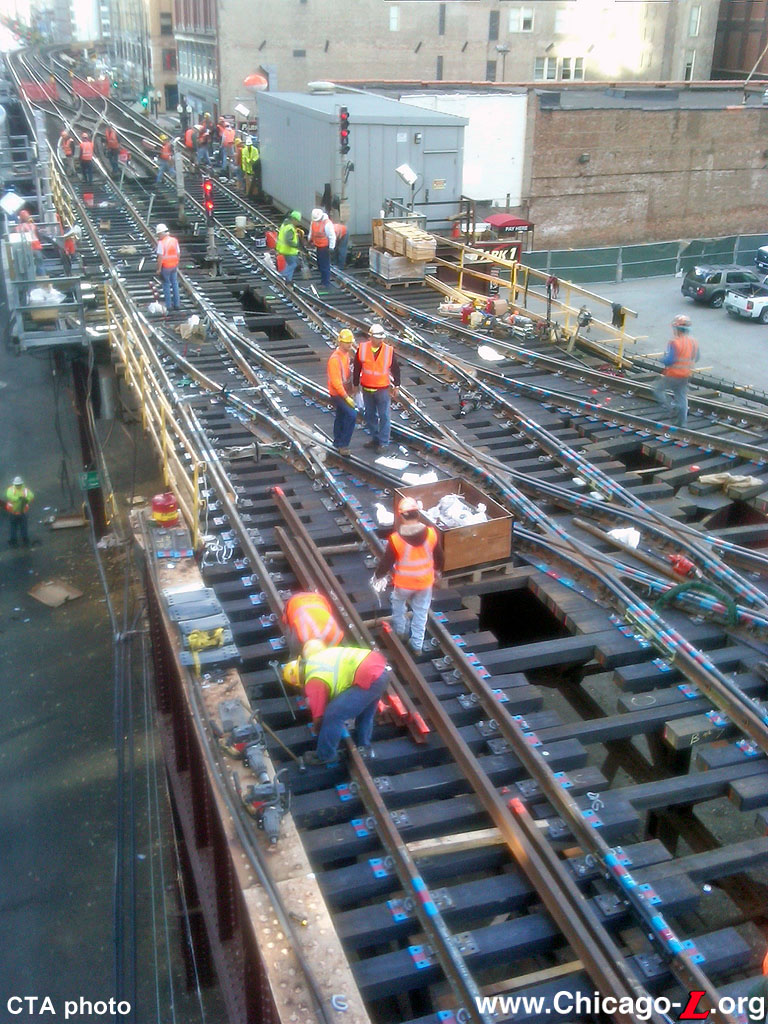
On September 29, 2012, most of the Tower 12 interlocking has been completely stripped for new ties, tracks, switches and other components to be installed, seen looking west. For a larger view, click here. (CTA photo) |
On July 15, 2011, the Chicago Transit Board approved a $33.8 million contract to begin work on the second half of the Loop Track Renewal project, which will involve the replacement of deteriorated track and rail ties along the Wells and Van Buren elevated tracks. Portions of the Loop Elevated system that will undergo renewal work in this next phase of work include the Tower 18 and Tower 12 junctions. The project also will include replacement of other rail system components including foot walks, traction power and signal cabling, signal panels, switch machines, and rail lubricators.
Ragnar Benson Construction, LLC was awarded the contract through a competitive bid process. Funding for the Loop Track Renewal project is provided by a state grant through the RTA. Work began in late 2011 and was completed in late 2012.
Track renewal on the Loop Elevated required weekend closures of half of the Loop at a time, with all trains rerouted to the other half. During the closures, new ties, rails, fasteners, and other components were installed, typically by completely stripping and rebuilding a section of track at a time.
The first reroute took place the weekend of April 20-23, 2012, with the Wells and Van Buren sides of the Loop closed. Subsequent Wells-Van Buren closures occurred over the weekends of May 11-14, June 1-4, June 15-18, June 29-July 2, July 20-23, Aug 10-13, Aug 24-27, Oct 26-29, Nov 2-5. These closures resulted in Brown and Orange line trains being through-routed via Lake and Wabash and Pink Line trains terminating at Roosevelt operating via Lake and Wabash.
Over the weekends of Sep 7-10, Sep 21-24, Oct 12-15, the Lake and Wabash legs of Loop 'L' were closed. Brown and Orange lines through-routed via Wells and Van Buren sides of Loop, Green Line service operated via Wells and Van Buren sides of Loop, and Pink Line service operates between 54th/Cermak and Roosevelt via Wells and Van Buren sides of Loop.
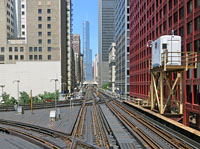
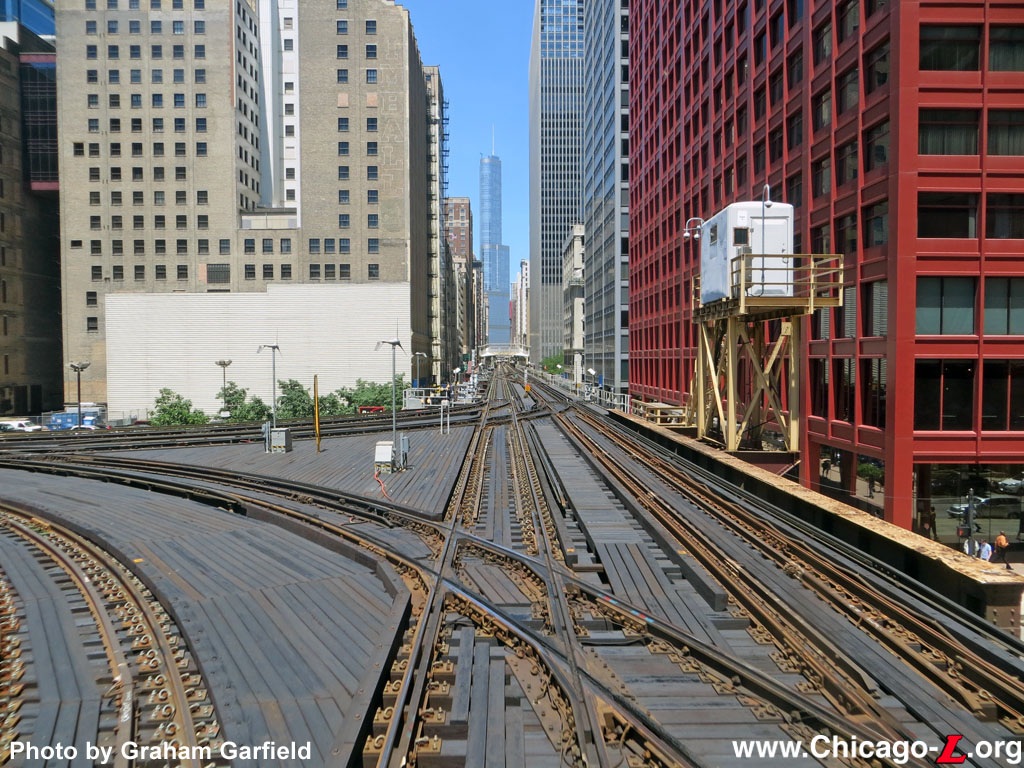
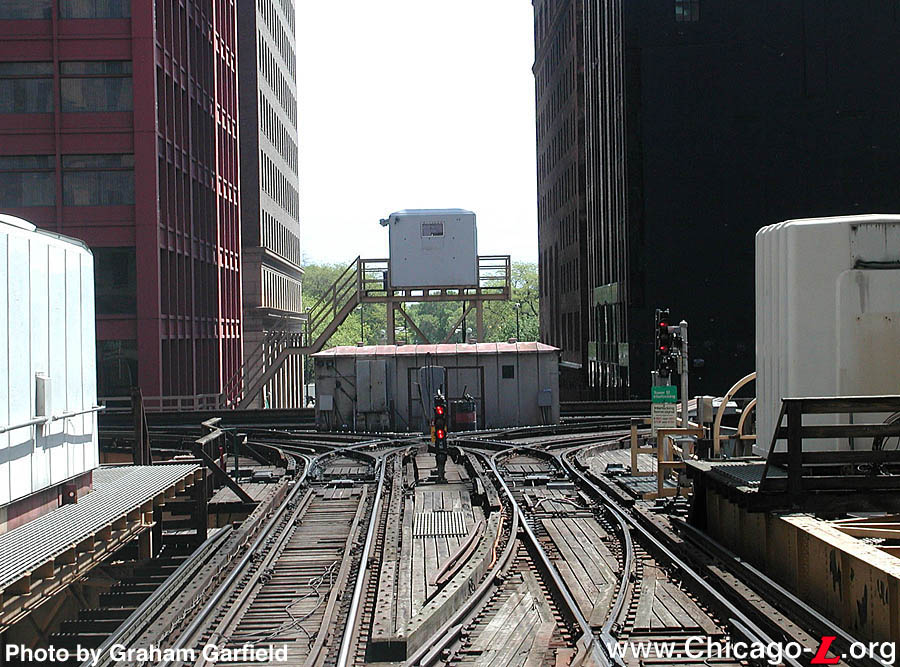
Looking north across the Tower 12 interlocking on June 19, 2013, the propeller-topped mini-wind turbines that provide backup power to the rail lubricators are visible. For a larger view, click here. (Photo by Graham Garfield) |
In order to replace the trackwork and components at Tower 12, for one weekend a large portion of the junction had to be closed. That work occurred over the weekend of Sep 28-Oct 1, during which no 'L' service was provided between Tower 12 and Roosevelt station. Orange Line service operated between Midway and Roosevelt only, Green Line service operated in two sections: between Harlem/Lake and the Loop, via Outer Loop, and between Roosevelt and the 63rd Street terminals. A bus shuttle was provided between Roosevelt and the Loop. During that weekend, all of the tracks, ties and other components were stripped and replaced in the eastern and southwestern portions of the junction.
Track renewal wrapped up for 2012 with the November 2-5 reroute, during which the Outer Loop track was replaced at the Wells/Van Buren curve and additional work at Tower 12 was completed. Work at Tower 12 and the rest of the Loop was largely complete by the end of 2012, but work at Tower 18 and on the Brown Line north of Merchandise Mart at Hubbard Curve that was part of the original scope was postponed to be undertaken concurrently with CDOT work in the same area in spring 2013.
An interesting component included in the new infrastructure installed during the track renewal were a series of windmill-type devices, propellers on poles not unlike an anemometer (a device for measuring wind speed), throughout the interlocking. These devices are intended to use the wind to generate small amounts of power that are stored in battery backups for the rail lubricators on the curves. Normally powered by the same AC electricity that powers the signals and other components, the rail lubricators typically have solar panels to provide backup power, but these do nor work well in the Loop because of the tall buildings blocking the sun.
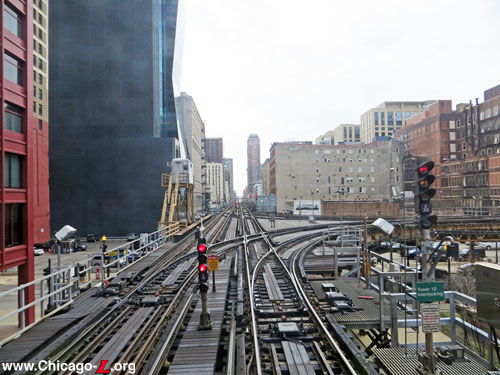
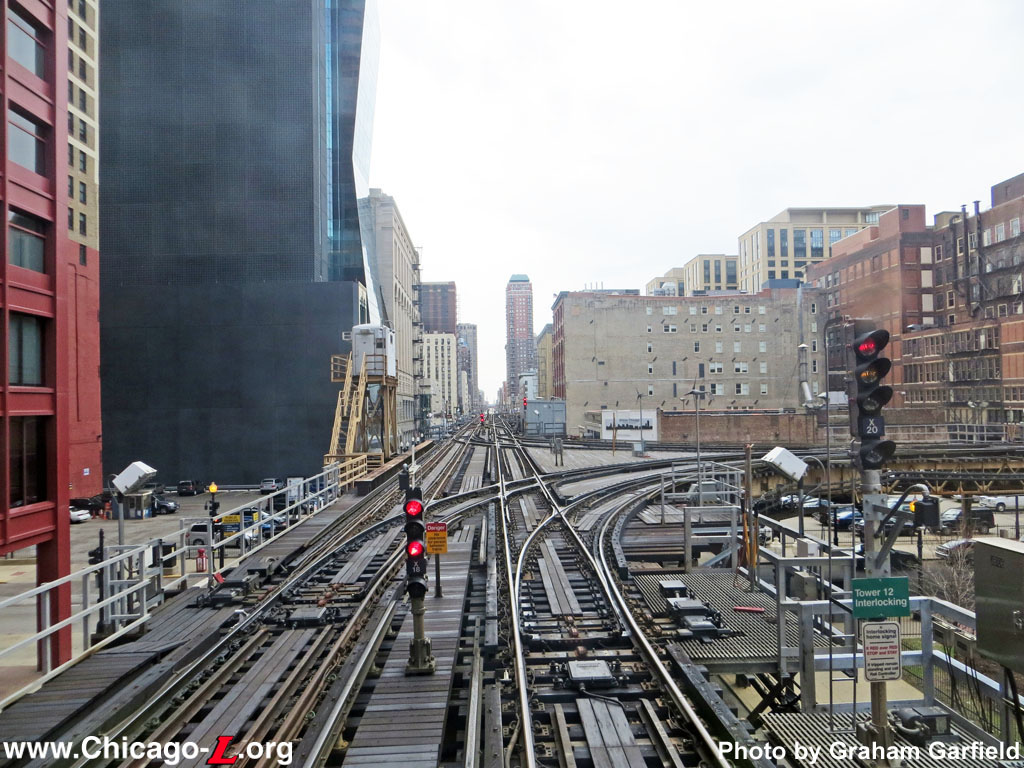
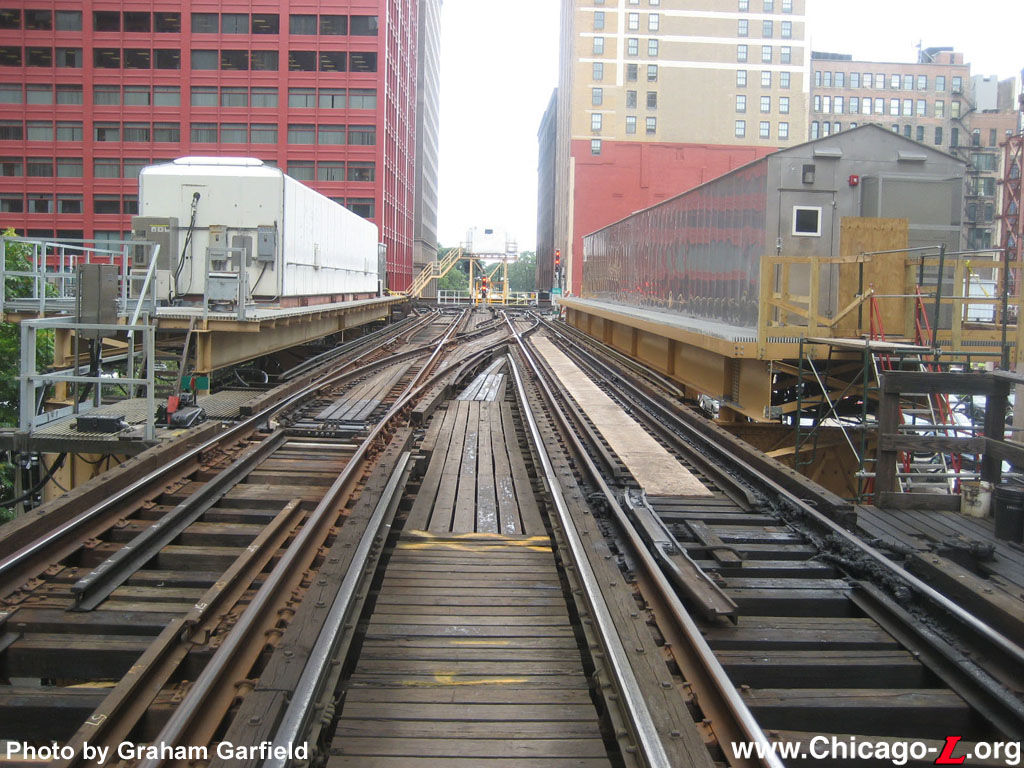
Tower 12 junction is seen looking south on Wabash Avenue on April 14, 2013. The tracks to the right are the Van Buren leg of the Loop Elevated, while those continuing ahead connect to the old South Side Elevated, Chicago's first "L" line.
For a larger view, click here.
(Photo by Graham Garfield) |

|
tower12b.jpg
(68k)
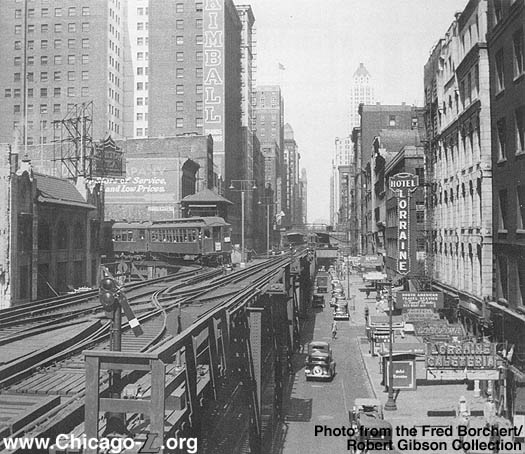
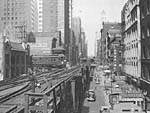
A view of Tower 12, looking north from the Congress
& Wabash station circa the 1920s. A North-South
train led by an 1100-series wooden control trailer turns off
Van Buren on its way to the South Side. Note the differences
from the photo at the top of the page: the surrounding
buildings are taller and tall lampposts have been added to
the elevated structure north of the tower. The similarities
are just as telling.
(Photo from the Fred Borchert/Robert
Gibson Collection)
|
|
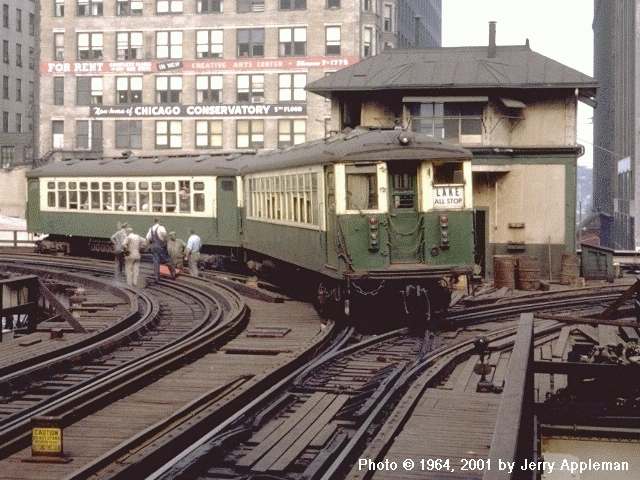
cta4365.jpg
(50k)
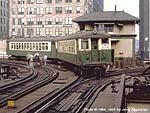
A two-car Lake Street All-Stop train made up of 4000-series
cars 4365 and 4366 passes through Tower 12 and turns north onto Wabash Avenue after leaving
State/Van
Buren station in June, 1964. Normally, Lake Street
trains operated counterclockwise on the Inner Loop, but here
the train is detoured onto the Outer Loop due to track work.
(Photo by Jerry Appleman)
|
|
060824pv.jpg
(125k) [Off-site link]
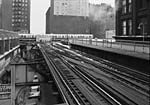
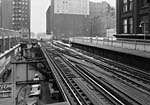
This 1971 view looks east from State/Van
Buren station at Tower 12 and the curve from Van Buren
onto Wabash as a Lake-Dan
Ryan train crosses from the Loop
into the South Loop
Connector en route to the Dan
Ryan Line. (Photo by Jack Boucher,
courtesy of the Historic American Engineering Record,
Library of Congress)
|
|
|
060792pv.jpg
(128k) [Off-site link]
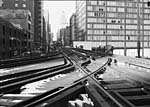
Tower 12 is seen looking east from State/Van
Buren station in 1971. (Photo by Jack
Boucher, courtesy of the Historic American Engineering
Record, Library of Congress)
|
|
060793pv.jpg
(129k) [Off-site link]
The curves in Tower 12 junction connecting Van Buren Street
and Wabash Avenue is seen looking north in 1971 with the
Adams/Wabash
station visible in background. (Photo by
Jack Boucher, courtesy of the Historic American Engineering
Record, Library of Congress)
|
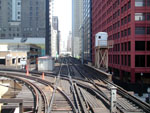 |
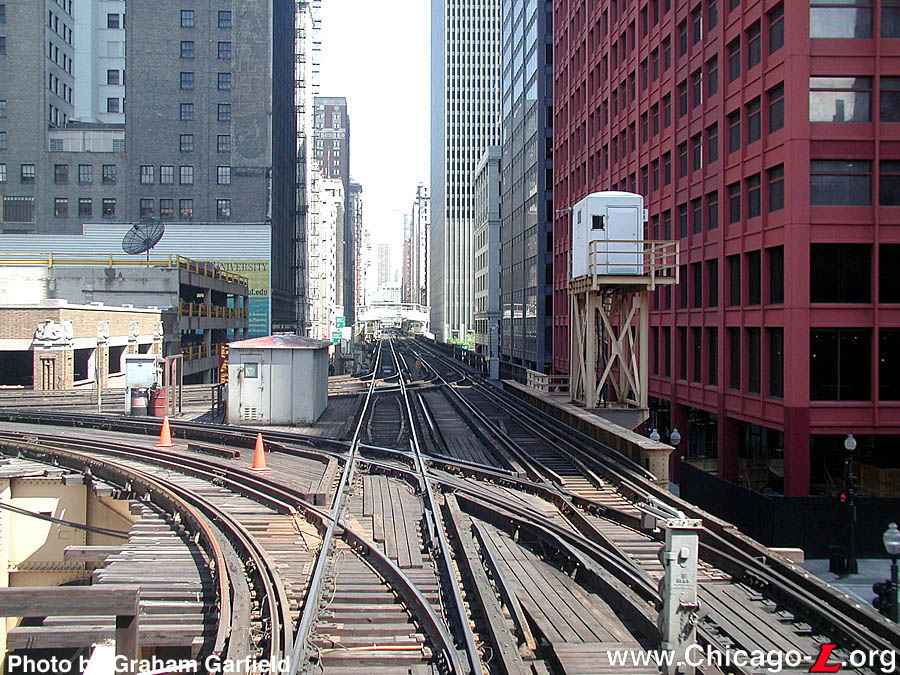
tower12c.jpg (231k)
Tower 12 junction, looking north on Wabash Avenue on May 20, 2003. The elevated hut is the current tower, while the silver hut set between the switches was the relay house and local tower during the Lake-Dan
Ryan days from 1969 to 1993. (Photo by
Graham Garfield) |
|
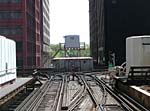
tower12d.jpg
(188k)
Tower 12 junction is seen looking east on Van Buren Street
on May 20, 2003. The elevated hut in the background houses
the tower. The prefabricated buildings on the left and right
house relays and other interlocking
circuitry. (Photo by
Graham Garfield)
|
 |
tower12e.jpg (262k)
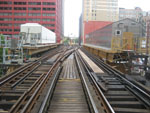
The new signal and relay house installed as part of the Loop Signal Replacement Project for Tower 12 is seen on the right, looking east on July 22, 2010 on the tracks over Van Buren Street. Tower 12 and the junction are in the background. (Photo by
Graham Garfield) |
 |
tower12g.jpg (285k)
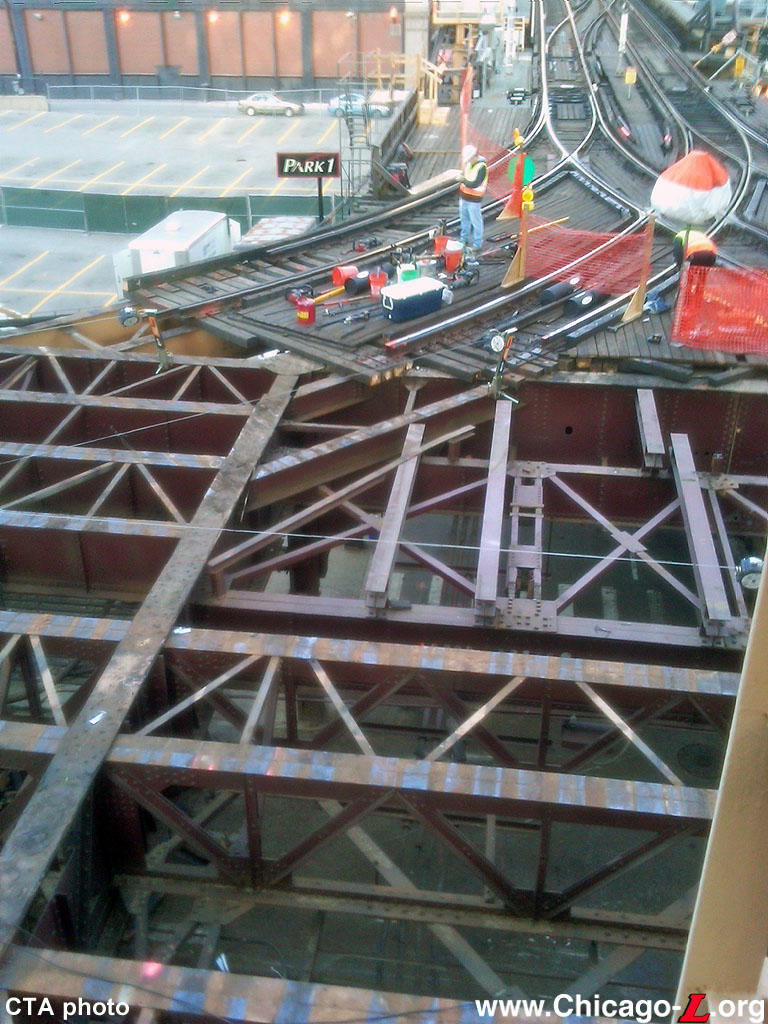
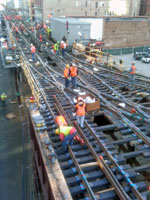
Construction contractors are busily installing new ties, tracks, switches, and other components on September 30, 2012, during a weekend closure of most of the Tower 12 interlocking to allow the work to take place. The trackwork was completely stripped off and replaced in full over one weekend of around-the-clock work. This view looking south toward the Congress Interlocking diamond crossover and the South Side elevated. (CTA photo) |

|

|
Notes:
- "Construction Project Briefing." Report to the Chicago Transit Board. 2011 July 15, pg. 7.
- "Problems in Loop could further delay CTA project." Chicago Tribune. 2008 September 11.
- "Loop L signal work delayed." Chicago Sun-Times. 2008 September 11.
- "CTA work may be delayed by year." WLS-TV Chicago online. 2008 September 11.
- "Construction Project Briefing." Ibid.