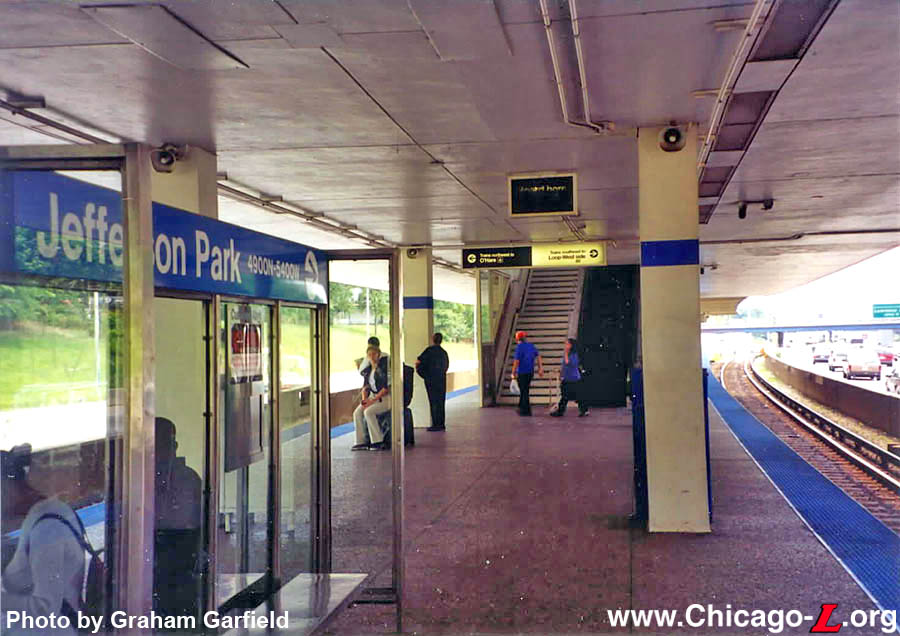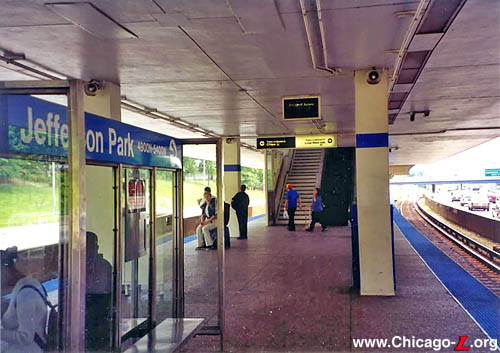
The Jefferson Park platform,
looking southeast in July 1999. The staircase in the
background leads up to the station fare controls. The sign
on the left was the last original KDR-style sign left in the
station. It was removed in November 2002. For a larger view,
click here.
(Photo by Graham
Garfield)
|
Jefferson Park
(4900N/5400W)
Milwaukee Avenue and Gale
Street, Jefferson Park
Service
Notes:

|
Blue Line:
O'Hare
|

|
Accessible
Station
|

|
Transfer to
Metra: Union Pacific - Northwest Line
|

|
Owl
Service
|
Quick Facts:
Address: 4917 N. Milwaukee
Avenue
Established: February 1, 1970
Original Line: West-Northwest Route, Milwaukee branch
Previous Names: none
|
Skip-Stop Type:
|

|
Station
|
Rebuilt: 2000-01 (elevator added, minor renovations)
Status: In Use
History:
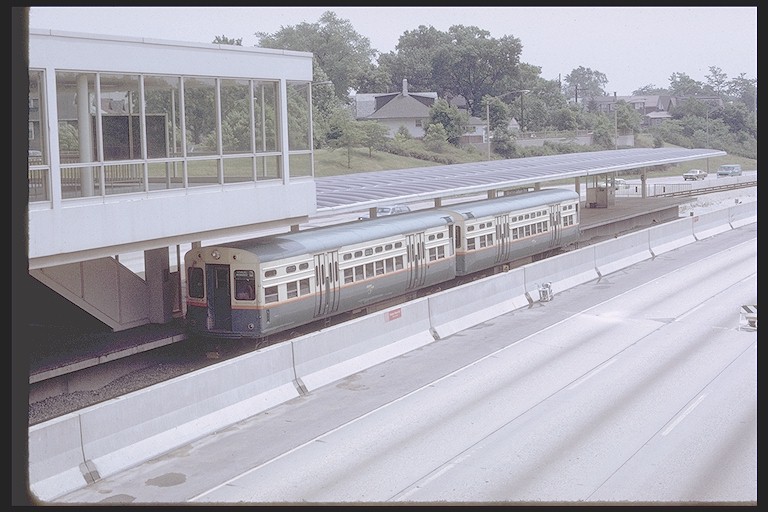
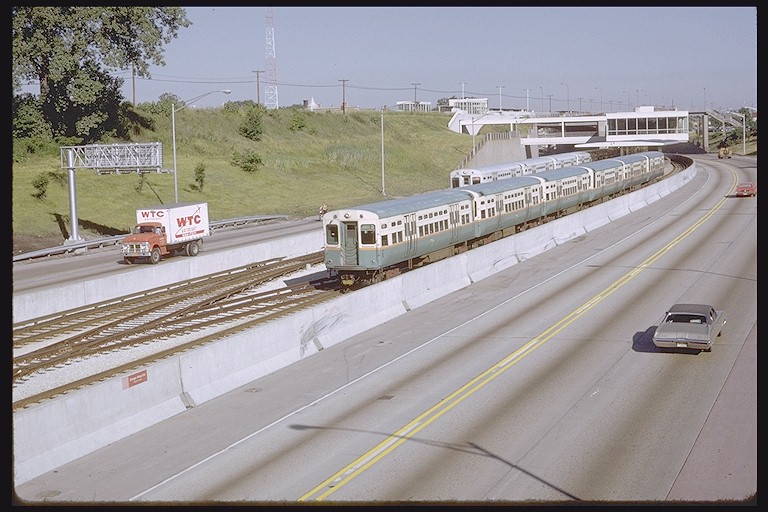
A four-car
Douglas-Milwaukee "B" train, including car 6567 at
the rear, pulls into (or possibly out of) Jefferson
Park station on July 8, 1971. For a larger view,
click here. (Photo by Joe
Testagrose) |
In the late 1960s, it was decided the Milwaukee Line was to
be extended passed the Logan
Square terminal. The original proposed route of this
extension was quite different than the one adopted. As
proposed in December 1962 by consulting firm of Parsons,
Brinckerhoff, Quade & Douglas, the 10-mile extension
would have continued northwest from Logan
Square to the proposed Crosstown Expressway, then north
in the median to the Northwest Expressway and thence
northwest in the median to a terminal at Cumberland
Avenue (8400W) near Higgins Road with an additional
extension to O'Hare Airport later.
This extension was projected to attract 9,700,000 riders
annually and cost $36,000,000. The cancellation of the
Crosstown Expressway project was no doubt one of many
reasons this alignment was rejected in favor of continuing
north from Logan Square via a
subway to the Kennedy Expressway, then northwest to
Jefferson Park via the median with four intermediate
stations.
The Kennedy Extension was planned and funded
coincidentally with the Dan Ryan Line and the two started
under design and construction together. Though its
end-to-end length is actually shorter than the Dan Ryan
Line, the Kennedy project was far more complex and
time-consuming, including a substantial length of subway and
an expressway overpass that was constructed without
interrupting traffic. The project cost $50 million.
The extension and station opened February 1, 1970. The
line and station are described in these paragraphs from the
brochure the city issued to commemorate its
construction:
"The Kennedy rapid transit line
extends 5.2 miles beyond the old Logan
Square 'L' Terminal. At
Sacramento Avenue, south of Logan
Square, the tracks descend
from the elevated structure and go into subway,
proceeding in a northwesterly direction beneath Milwaukee
Avenue, turning north in Kimball Avenue, then crossing
under the eastbound and express lanes of the Kennedy
Expressway and continuing northwest nearly four miles
farther to a new terminal in the expressway at Jefferson
Park near Milwaukee Avenue.
"Along the way... three ultramodern
stations are provided in the median - at Addison, Irving
Park-Pulaski, and Montrose. In the mile and a quarter
subway section there are two stations... the Logan
Sqaure-Diversey station, with
entrances on Milwaukee at Kedzie and Spaulding near
Diversey, and the Belmont-Kimball station.
"Subway construction... was carried
out by the open cut method in three main stages to
minimize inconvenience to residents and
businesses...
"Coinciding with the start of
operations, CTA bus routes serving the northwest section
of the city and adjacent suburban communities are being
revised for maximum coordination of connecting service at
each station...
"The major portion of the new line is
designed for speeds up to 70 mph, although the actual
maximum operating speed will be 58 mph..."
Among the bus routes instituted to serve the Jefferson
Park station was the #40-O'Harexpress route, operating
nonstop between the "L" terminal and O'Hare International
Airport, setting the stage for the rapid transit extension
to the airport 14 years later.
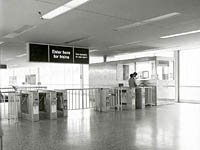
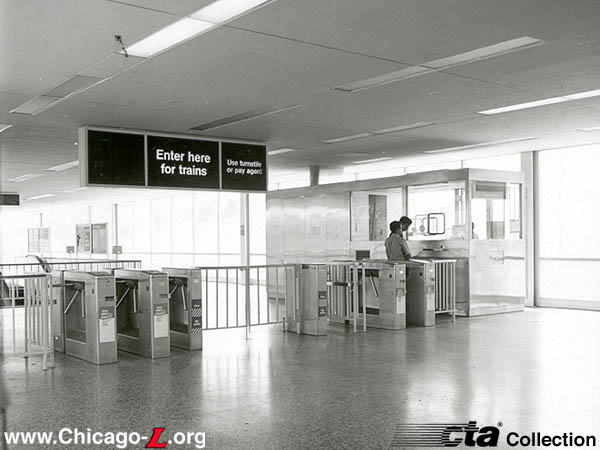
The rectilinear
form used by Skidmore in the Kennedy stations is
clearly espoused in the squared-off stainless steel
agent's booth, turnstiles, fare control barriers,
and overhead illuminated sign box at Jefferson park
station, looking south in the unpaid area on August
10, 1970. For a larger view, click here. (Photo from the CTA
Collection) |
The design of Jefferson Park and the other three median
stations of the Kennedy extension -- as well as the two
subway stations that were part of the project -- were
carried out by Skidmore, Owings & Merrill under the
direction of Myron Goldsmith, who developed a modern,
functional form in the late International style popular at
"open plan"
concept, built of white steel and glass panels for maximum
illumination and visibility through the station frame and
skin. Improved visibility and security, ease of cleaning and
more comfortable working conditions for
CTA employee were design goals. Skidmore took the Kennedy-Dan
Ryan ("KDR") project in a unique direction, designing all
aspects of the new lines to harmonize in both shapes and
materials. All windbreaks, dividers, and ticket booths were
stainless steel. The supports of the transparent platform
canopies and the structures of the station enclosures are
white-painted steel frames, and the enclosures themselves
are glass. The formal and functional criteria were expressed
in several ways: open, uncluttered, brightly lit interior
spaces; durability, safety, maximum efficiency of movement;
lightness and purity of structure. The shape of everything,
from the buildings to the agents' booths, to the trashcans,
followed together into a seamless design philosophy, which
perfectly captured the boxy, purely functional International
Modern style for which Skidmore is so well known.
The stations' design even formed a harmony with the 150
rapid transit cars, the 2200-series units, that were ordered to serve the new Kennedy and Dan
Ryan lines, which used the same design philosophies and
basic shapes, and an entirely new system of signage with a
redesigned typeface and clean graphic style (still used by
CTA today, in a modified form), making a fully integrated design
throughout the entire project.
The platform is long enough to accommodate an 8-car train
and a steel-framed canopy extends beyond the center line of
the tracks, partially covering the trains. The off-street
bus transfer facility is provided with a direct connection
to the station. The station house has a good deal of open
space for waiting passengers. The back of the facility
contained a trainroom and office for the terminal. The
corridor leading to the fare control area from the bus
terminal has a direct connection to Metra's Jefferson Park station on what is now the Union
Pacific-Northwest Line (originally the Chicago & North
Western's Northwest Line).
Because the line is confined to the median of an
expressway, a conventional multitrack yard was not feasible
beyond the station. However, there was sufficient room to squeeze a three-track yard to store 108
cars into
the median, stretching to Foster Avenue, plus a two-car inspection facility.
In summer 1969, Greyhound Lines and CTA entered into an agreement allowing Greyhound intercity buses to use three CTA rapid stations as "satellite" terminals. Under terms of the pact, Greyhound coaches from and to Chicago would stop at the Dempster Street Skokie Swift station, the Jefferson Park station on the Kennedy rapid transit line and the 95th station on the Dan Ryan line. Greyhound service began in early August 1969 at the Dempster station, and upon the opening of the 95th and Jefferson Park terminals (September 1969 and February 1970, respectively). A Greyhound ticket office was located at each outlying "L" station, and was initially staffed and sold a complete line of Greyhound tickets at no extra cost. The ticket office at Jefferson Park occupied one of the concession spaces included in the station house's original design.
In operation, Greyhound buses departing from the company's Loop terminal on Randolph Street stopped at the three stations as they leave Chicago. Coaches going north would tie in at Dempster, those going generally west would stop at Jefferson Park, while coaches bound for the east and southern United States would link up with the CTA at the 95th Street station. Greyhounds arriving in Chicago would also use the stations as a stop on their way to the Loop. The idea was for Chicagoans to be able to board Greyhounds bound for outlying cities around the United States without traveling into the busy Loop area. The number of Greyhounds using the rapid stations daily was extensive at the outset. Greyhound scheduled 24 arrivals and departures daily at 95th, including Scenicruisers to and from Detroit, Pittsburgh, Memphis, St. Louis, New York City, and numerous other key cities. Jefferson Park was serviced by 10 arrivals and departures daily while Dempster accommodated 11 arrivals and departures. The number of intercity buses serving the outlying "L" terminals declined over time, however.
Favorable ridership eventually allowed the line to be
extended to O'Hare Airport, with service to beyond Jefferson
Park to River Road starting
February 27, 1983 and reaching its terminal at O'Hare September 3, 1984. The modest yard was removed and the
tracks easily extended beyond Jefferson Park. Now a
through-station, it remains one of the
CTA's most
heavily-patronized facilities. Once the line was extended
and a new trainroom was built at O'Hare,
the Jefferson Park trainroom became a
CTA training and
instruction facility. The Greyhound station also moved from Jefferson Park to Cumberland,
leaving the former ticket office to house another
concession.
Jeff Park Gets Renovated
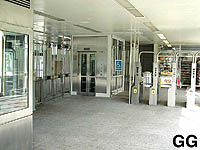
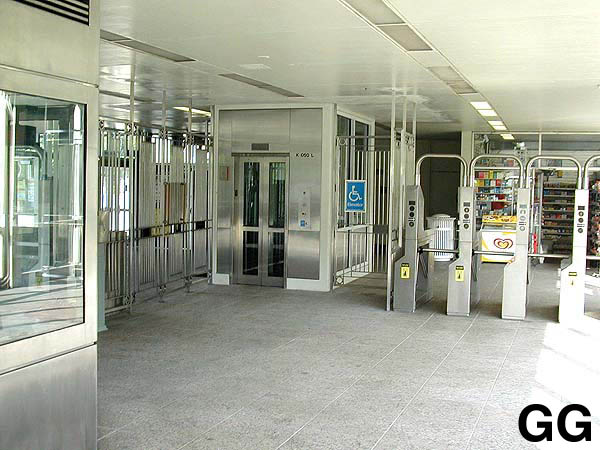
The new
mezzanine-to-platform elevator, fare controls, and
CA booth (left; the latter of which were relocated
due to the new elevator), looking northwest in the
paid area in August 2001. For a larger view, click here. (Photo by Graham
Garfield) |
In 2000, the CTA began construction at Jefferson Park that included a new
elevator for ADA compliance, new granite flooring, and six
additional maintenance rooms. By the end of April 2001,
installation of new hand- and guardrails and 90% of the
flooring replacement work was complete. The elevator tube
frame was installed and flooring replacement work at the
pedestrian bridge was also complete. Construction of the
elevator, which is located in the center of the platform in
between the north and south stairways, got underway. The
flooring replacement and mechanical rooms was completed in
May. By July 2001, work at Jeff Park was substantially
complete. Installation of plumbing fixtures and wiring for
the ceiling heaters and other electrical devices had been
completed. A new CA booth had been installed in the station
house and stainless steel high barrier gates had been
installed to form a pathway to the elevator. The floor in
the passageway from the bus bays and Metra station to the
fare controls had also been replaced. New signage for the
passageway (and for the Metra station, which still says
"C&NW to Harvard", even though Union Pacific took over
the Chicago & North Western operation many years ago...)
was being prepared and was installed in Fall 2001. The
elevator was not officially in service until late Summer
2001.
New station name signs, following the Green Line
Graphic Standard, were installed at four Blue Line
stations in late 2002/early 2003, including Jefferson Park.
The fabrication and installation of these signs was actually
the continuation of the renovation work that was completed
here in 2000-01. Jefferson Park received the new signs back
in November 2002. The initial installation of the signs was
on new white steel poles and brackets mounted on the median
wall between the tracks and the Kennedy Expressway traffic
lanes (identical to those previously installed at Sox-35th and 95th/Dan Ryan), thus placing
them facing the platforms rather than on them. A few days
later, additional signs were installed on the platform
itself. New brackets were installed along the centerline of
the island platform in the spaces between the columns,
suspended from the canopy frame. These signs replace the
original KDR station name signs, most of which have been long missing
from the station. At the time the new signs were installed,
only one set of the original KDR station name signs (which were mounted along the tops of the
stainless steel windbreaks) remained, in a windbreak beyond
the north stairs from the platform to the mezzanine. That
windbreak and the two original 1970-vintage station name
signs were removed when the new signs were installed. The
remaining symbol signs were left in place.
Recent Developments
At its June 4 , 2003 monthly meeting, the Chicago Transit
Board approved a $569,973 contract for Chicago-based Camp
Dresser & McKee, Inc. to design and prepare construction
bid documents for the
CTA's "Front Door
Program" that will add amenities to station entrances
throughout the rail system. The "Front Door Program"
includes making improvements to station entrances, enhancing
connections to bus routes and improving bicycle access and
storage facilities. Seven stations are scheduled for
entrance upgrades as part of the initiative, including
Jefferson Park. Funding for this contract is provided by the
FTA and the Regional Transportation Authority (RTA).
On June 6, 2005, the
CTA launched a pilot
program at eight rail stations (as well as on 10 of its
wide-door Nova buses) to help speed boarding for customers
by dedicating one turnstile as an express fare payment lane
(called a "Go Lane") for those paying with either Chicago
Card (regular or Plus) smartcard fare media. The dedicated
lanes are identified by signs over the turnstile and on the
floor in front of it. The eight selected rail stations in
addition to Jefferson Park were Howard, Chicago, 79th and 95th/Dan Ryan on the Red Line;
and both the Thompson Center and 203 N. LaSalle entrances to Clark/Lake, the
Randolph-Washington mezzanine of Washington/State,
and the Randolph-Washington mezzanine of Washington/Dearborn downtown. CTA chose
these stations because they are geographically balanced and
serve a high volume of customers who transfer between bus
and rail.
The pilot was conducted to determine if providing a
dedicated turnstile at stations would help to speed boarding
and, therefore, speed service. The pilot also provided an
additional incentive for customers to switch to Chicago Card
fare options. The faster and easier the boarding process,
the more the transit experience is improved for existing
customers. Faster boarding also helps to attract new
customers.
CTA monitored the
Go Lane boarding times during morning and evening rush
periods to measure time saved during boarding, as well as
the ratio of customers using electronic fare media compared
to cash or transit cards. Customer reaction and ease of use
were also evaluated as part of the pilot to determine
whether use of Go Lanes should expand.
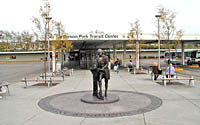
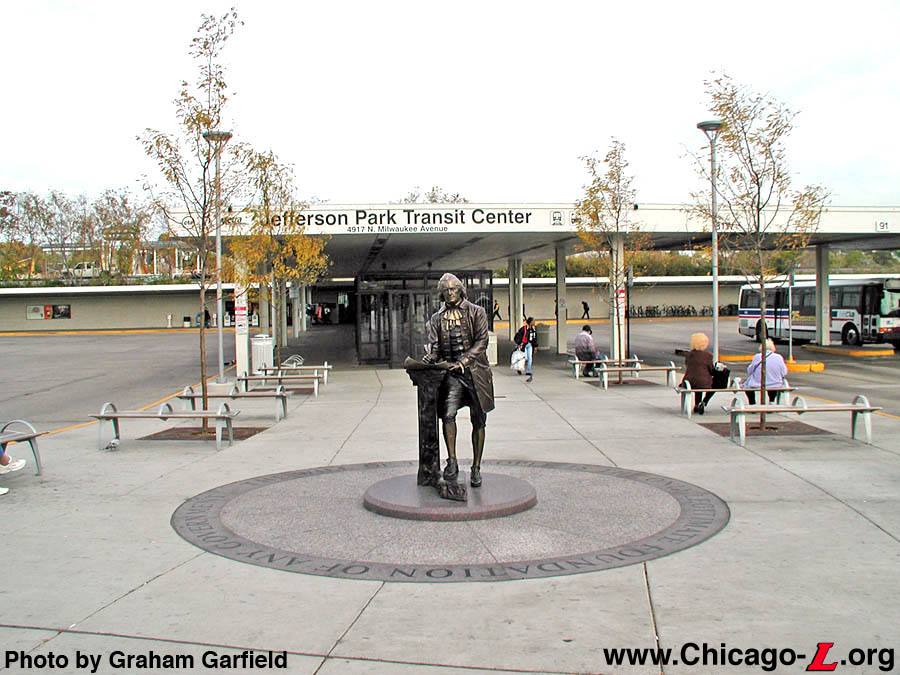
In 2005, a statue
of Thomas Jefferson was added to the plaza in front
of Jefferson Park Transit Center, seen looking east
on November 3, 2005. The statue, standing at a
podium with the Declaration of Independence, was
paid for with donations ranging from $1,000
contributions from business owners to nickels
raised through a "Nickels for Jefferson"
campaign. For a
larger view, click here. (Photo by Graham
Garfield) |
In 2005, the Jefferson Park intermodal facility received a
number of improvements. The $4 million project, half of
which was funded by an Illinois FIRST grant secured by State
Rep. Joe Lyons, D-19th, was a joint project between the
CTA , Metra, the Union
Pacific Railroad (owner of the Metra line), the Illinois
Department of Transportation and the Chicago Department of
Planning and Development. Lyons said individual projects
already in planning stages at each of the agencies were
combined into one large operation which resulted in
significant savings and better coordination.
The plaza in front of the bus terminal, facing Milwaukee
Avenue, received a facelift, including new benches,
landscaping, lighting,and station identifiers. The plaza,
which attracts a large number of pigeons, also received a
sound system which broadcasts the bird calls of the pigeons'
natural predators to try to reduce the nuisance of the
birds. At the center of the plaza, a new life-sized statue
of President Thomas Jefferson (for whom the Jefferson Park
neighborhood, and thus by extension the station, was named)
was installed. The statue depicts Jefferson standing at a
podium as he signed the Declaration of Independence. The
statue stands on a circular granite base, divided into 13
wedges representing the 13 original colonies. One of
Jefferson's quotations -- "The will of the people is the
only legitimate foundation of any government" -- is
imprinted around the outer edge. A time capsule, which
includes essays from the children from schools in the
surrounding area, was buried at the statue's feet. The
statue was made possible through a fund drive organized by
the Jefferson Park Chamber of Commerce. The half-block of
shops on the eastern extension of Gale Street -- really the
north end of the North Terminal bus bay more than an actual
street -- will get a new, tree-lined sidewalk. The
CTA also installed
new graphics on the facia of the bus terminal canopy, naming
the facility, providing its address, and marking it with the
logos of the three tenant transit agencies.
The pedestrian tunnel that connects that bus terminal
with the "L" and Metra stations is also programmed for
improvements. The walls of the tunnel are to get new
lighting and a display case to exhibit artwork done by local
grade school students, with the goal of adding color to the
otherwise plain tan brick as-built walls and provide
customers a sense of spaciousness.
The Jefferson Park Metra station, which sits atop the
pedestrian tunnel, is also being renovated. The last
significant improvements to the station were the headhouse
on the inbound platform built circa the 1950s and the stairs
and escalators installed at the south end of the station
when the CTA intermodal facility opened in 1970. The Metra station is
also accessible from the east from the headhouse and
ground-level parking lot along an eastern extension of
Northwest Highway or a bridge over the Kennedy Expressway
near Argyle Street, and from the west by a bridge over the
Kennedy Expressway and tunnel under the tracks north of Gale
Street. The 1950s headhouse is located at the north end of
the station, at the opposite end from the intermodal
facility.
The Metra improvements include a new headhouse on the
inbound side adjacent to the intermodal facility and
accessible from the pedestrian tunnel. The depot will
include a large, heated waiting area. Accessible access to
the platforms from the pedestrian concourse was originally
to be achieved with elevators, but the installation process
was deemed to be too disruptive. It was instead decided to
install a ramp. However, because of the high elevation of
the Metra track level above the tunnel, and the requirement
for the slope of the ramp to be shallow enough to comply
with the Americans with Disabilities Act (ADA), the ramp
will have seven "switchbacks" as it makes it way up the 17
feet to the Metra station. The ramp will be fully enclosed
within the Metra depot building. The outbound platform will
also have a smaller enclosed depot building. A track-level,
pedestrian crossing will provide a connection from the
accessible inbound platform with the outbound side. The
existing stairs and escalators from the pedestrian tunnel,
installed when the CTA station was built in 1970, will
remain and deposit commuters directly on the Metra platform
waiting areas.
Your New Blue: Station Improvements
On December 5, 2013, Mayor Rahm Emanuel and Governor Pat Quinn announced a comprehensive improvement plan for the Blue Line O'Hare Branch (including the northern portion of the Dearborn Subway), an overhaul that will provide faster travel times and updated stations while creating more than 1,300 jobs.
The $492 million plan, called Your New Blue, includes several track and station improvement projects along a 12.5-mile stretch of the Blue Line between the Grand and Cumberland stations, as well as upgrades to the signal system between the Jefferson Park and O'Hare stations. The overall Your New Blue program, beginning construction in 2014 and planned to last four years, is a package of several discrete projects ranging from station improvements to track renewal, signal replacement, traction power upgrades, and subway tunnel water mitigation efforts.
Jefferson Park is one of the stations planned to receive improvements under the program. The scope of these improvements includes work in the bus terminal, to the station house, and to the platforms. In the bus terminal, planned improvements include replacement of the canopy over the walkways and station entry with a new, architecturally significant design to highlight entrance leading to station, replacement of lighting with new LED lighting to highlight the station, installation of public art, and pavement replacement. The station house, pedestrian bridge and fare control area is to have the curtain walls replaced, repainting of the station exterior, replacement of the escalators and stairs, new lighting, and repairs and refinishing of all surfaces. The platforms are programmed to have the canopy skylight system replaced, new lighting, and repairs and refinishing of all surfaces.1
During the station renovation, a new crosswalk will be installed across Milwaukee Avenue, said Owen Brugh, Ald. John Arena's chief of staff. Plans for the crosswalk have been in the works since May 2013, when 45th Ward residents set aside $125,000 of Arena's discretionary budget for the project.2
The scope, design, and timeline for the station improvements under Your New Blue are still being finalized. Although conceptual renderings were released in February 2015, design work on the Jefferson Park project was expected to begin later in 2015. Construction schedules will be determined after contractors are selected.3
The renovation work at the Jefferson Park Transit Center is expected to cost $25 million. The Jefferson Park TIF district is expected to contribute $3 million and the Portage Park TIF is expected to contribute $2 million toward the project.
Demolition of the north bus terminal began immediately, the week of October 1, 2018.
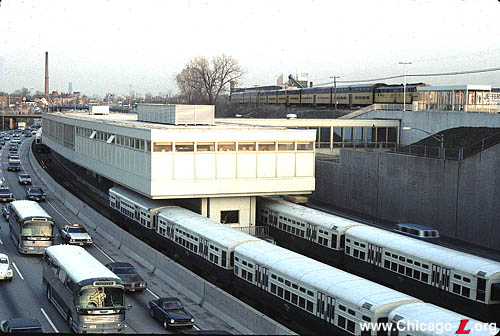
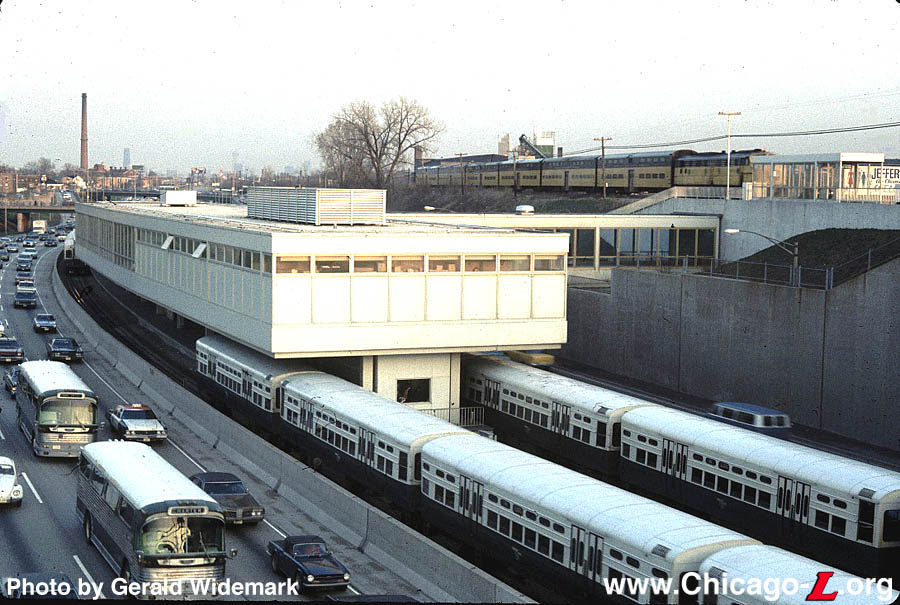
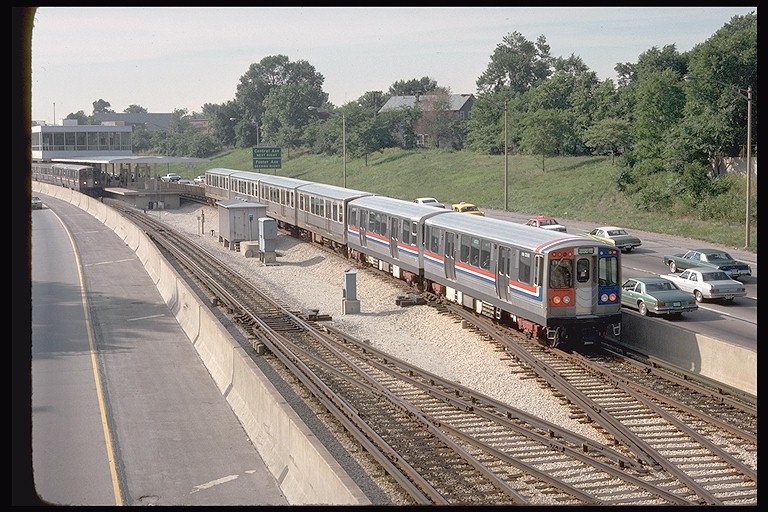
This view of Jefferson Park
looks south in 1973, three years after the terminal opened,
from the Argyle Street pedestrian bridge over the Kennedy
Expressway. 6000-series cars, seen on both tracks below,
were common on the line, along with the Budd-built 2200s,
which were designed specifically to service the Kennedy
Extension. Note the Chicago & North Western commuter
trains in the upper right, with the bi-level coaches and
locomotive in their old yellow and green livery. The Jeff
Park terminal featured an intermodal connection to the
C&NW station. For a larger view, click here.
(Photo by Gerald
Widemark)
|

 |
cta2256.jpg (167k)
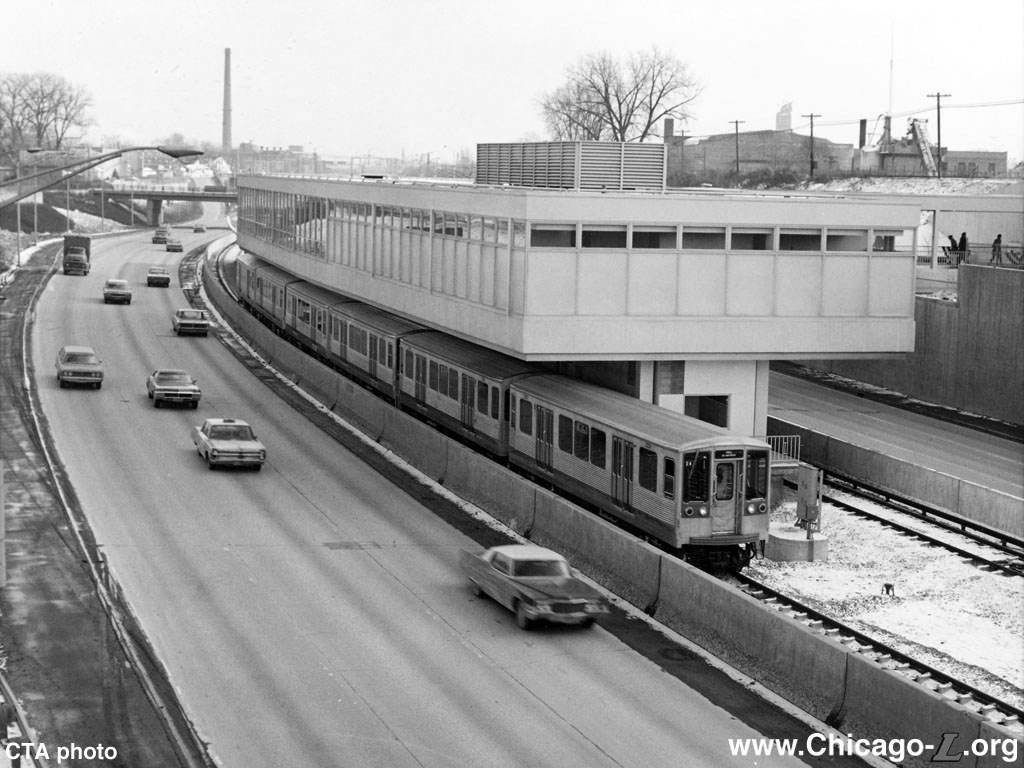
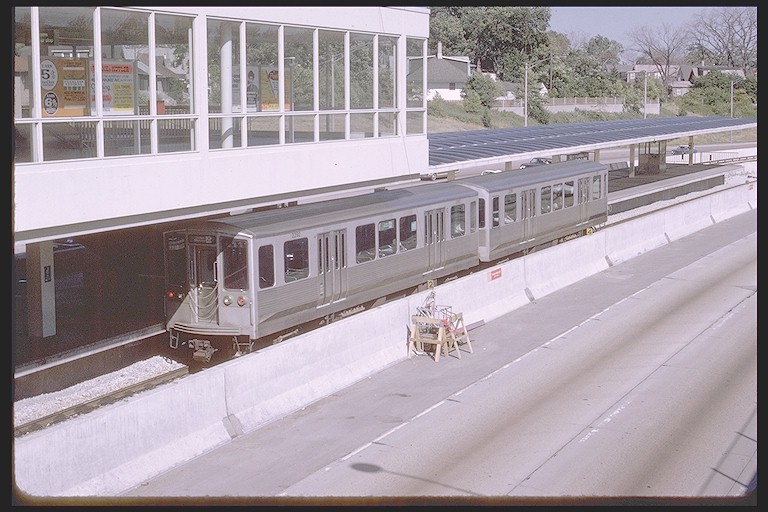
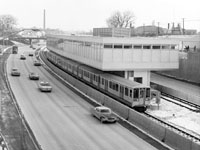
The six-car dedication train, with car 2256 at the head end, has made it to the end of the new Kennedy Extension at Jefferson Park, seen looking southeast on January 30, 1970. The boxy shape of the 2200-series railcars was designed to match the similar aesthetics of the new stations and facilities. The large rear portion of the terminal building with smaller windows near the roofline, closest to the camera, was originally a trainroom and clerk's office for when the station was the end of the line. Today, it is a Training & Instruction office. (CTA photo) |
 |
cta2277b.jpg (171k)
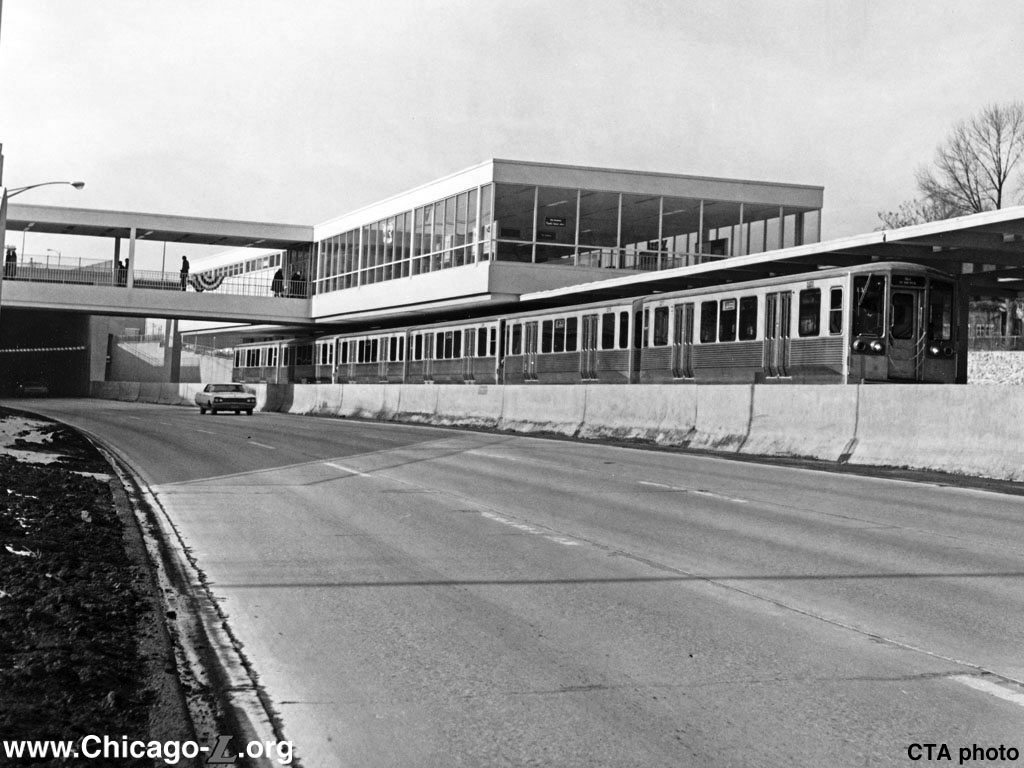
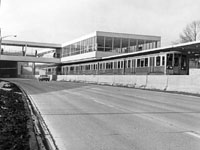
The six-car dedication train, now with car 2277 at the head end, is at Jefferson Park waiting for its next departure as part of the opening ceremonies for the Kennedy Extension on January 30, 1970. The rectilinear glass-and-steel street-level station house above the tracks, with full-height windows and an open floor plan for maximum visibility, was typical of the Modernist stations designed for the Kennedy and Dan Ryan extensions; the 2200s were designed to have the same aesthetic philosophy. Note that the pedestrian bridge over the expressway connecting the station to the bus terminal, Milwaukee Avenue and the C&NW commuter station is open, with just a railing for protection. It was later enclosed with full-height windows. (CTA photo) |
|
jeffersonpark02.jpg
(190k)
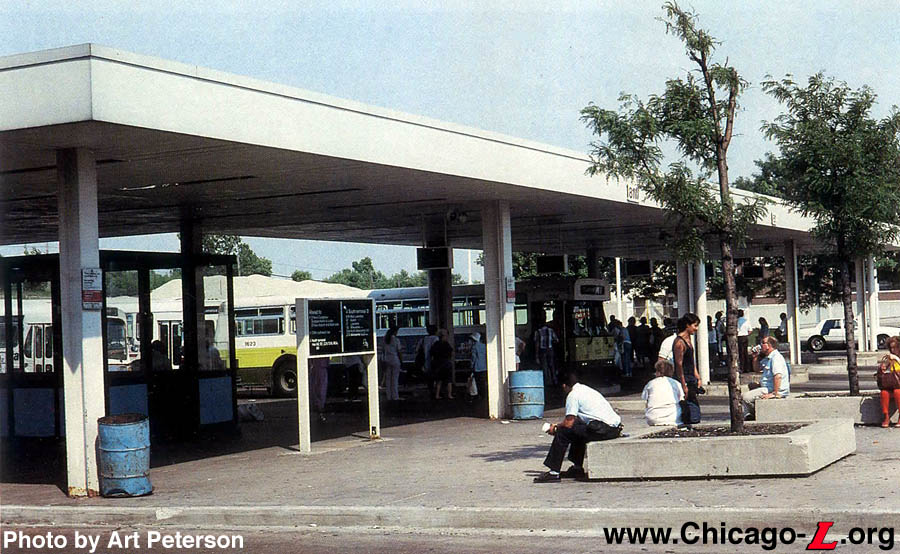
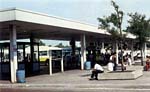
The Jefferson Park station was designed to be an intermodal
facility, with access to CTA buses, CTA rapid transit
trains, Pace buses and Metra's C&NW (now UP) Northwest
Line. The bus terminal, seen at left in June 1991, is shared
by 10 CTA bus routes, plus Pace routes. It was also once
used by Greyhound, until the intercity carrier relocated to
Cumberland when the O'Hare
extension opened. (Photo by Art
Peterson)
|
|
jeffersonpark04.jpg
(190k)
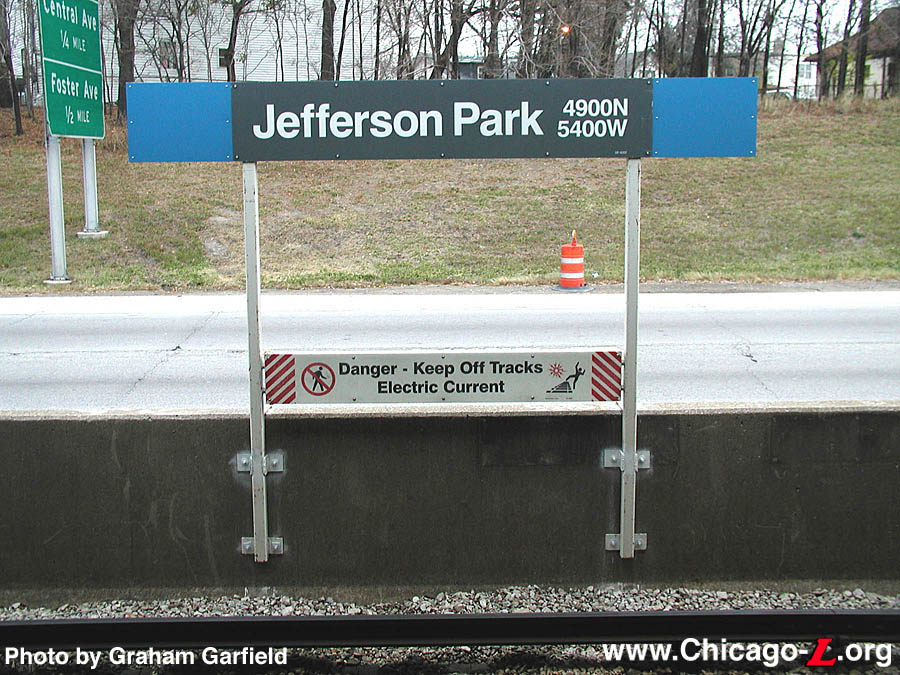
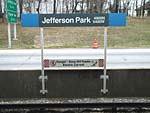
New station name signs were installed at Jefferson Park in
November 2002 in two sets. One group are on new white steel
poles and brackets mounted on the median wall between the
tracks and the Kennedy Expressway, facing the platforms. A
few days later, additional signs were installed on the
platform itself on new brackets installed along the
centerline of the island platform, suspended from the canopy
frame. One of the signs outside the tracks is seen here on
November 24, 2002, shortly after
installation. (Photos by Graham
Garfield)
|
|
cta6000s05.jpg
(122k)
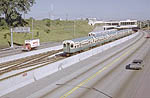
A Douglas-Milwaukee "B" train of orange/green/cream colored
6000s pulls into
Jefferson Park terminal as a Congress-Milwaukee "A" train of
Mint Green and Alpine White 6000s
begins its trip to Desplaines
on July 6, 1971.
(Photo by Doug Grotjahn, Collection
of Joe Testagrose)
|
|
cta2265.jpg
(115k)
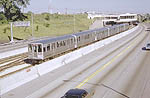
A six-car Congress-Milwaukee "A" train led by car 2265
leaves the Jefferson Park Terminal on July 6,
1971. (Photo by Doug
Grotjahn, Collection of Joe Testagrose)
|
|
cta2292.jpg
(120k)
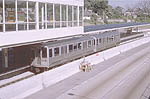
Unit 2291-2292 make up a Douglas-Milwaukee All-Stop train,
loading passengers at Jefferson Park Terminal on August 16,
1970. (Photo by Joe Testagrose)
|
|
cta2558.jpg
(157k)
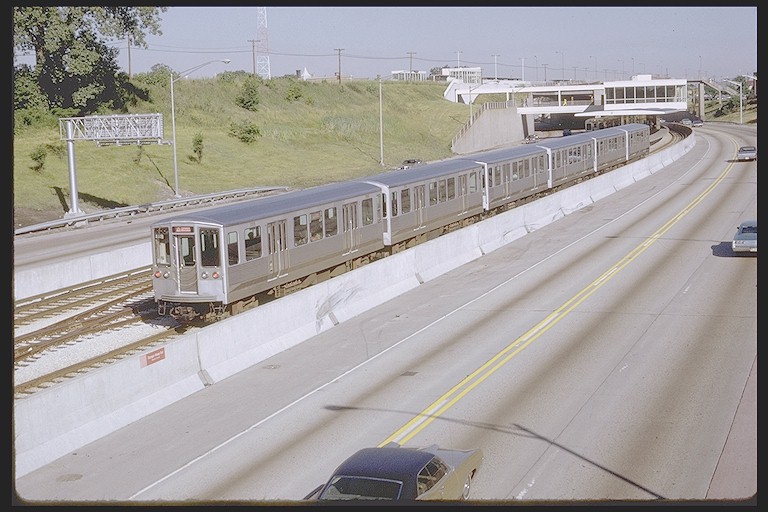
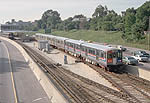
Cars 2557-2558 trail four 2200-series
units on a West-Northwest train approaching Jefferson Park
on August 17, 1978. A set of 2400s
leads sets of 2200s
on another train heading in the other direction.
(Photo by Doug Grotjahn, Collection of Joe
Testagrose)
|

|

|
Notes:
1. "Your New Blue." CTA website, accessed January 11, 2014.
2. Cherone, Heather. "Jefferson Park Transit Center Renovation To Get $5M from TIF Districts." DNAinfo Chicago, January 23, 2015.
3.
Swartz, Tracy. "Mayor: Use $9M in local funds for Blue Line stop fixes." Red Eye, January 21, 2015.