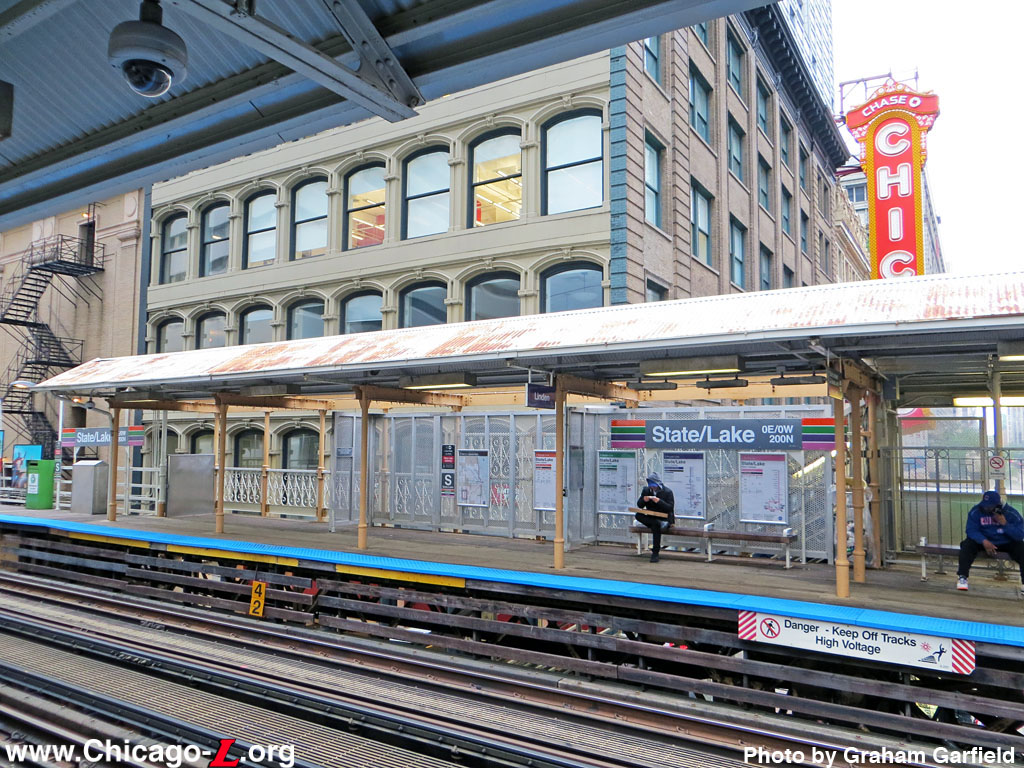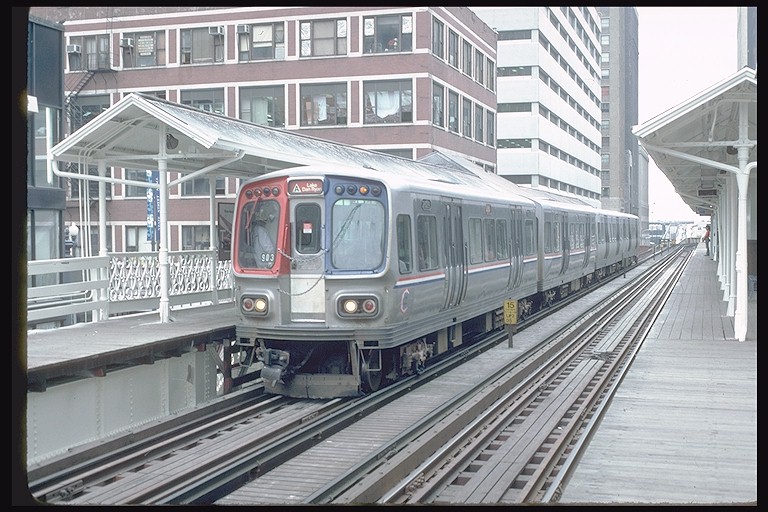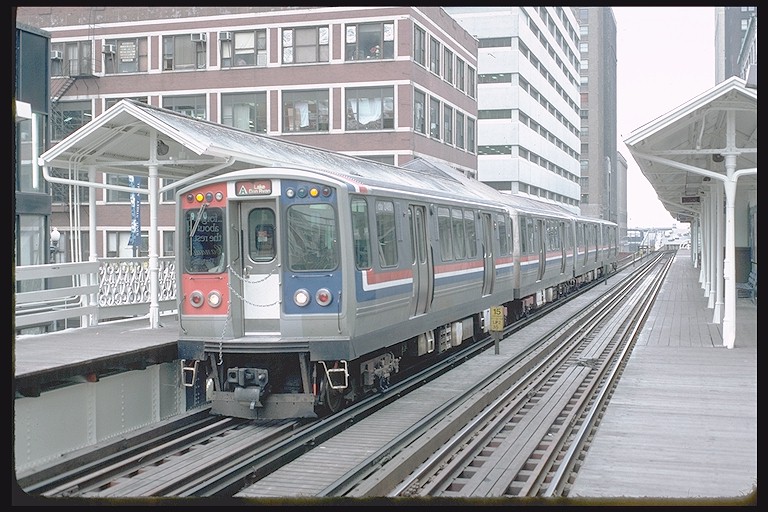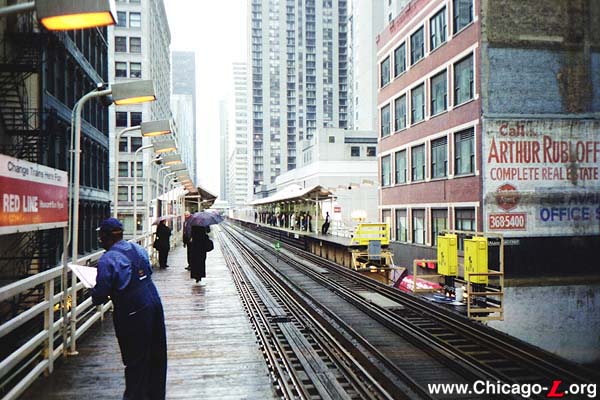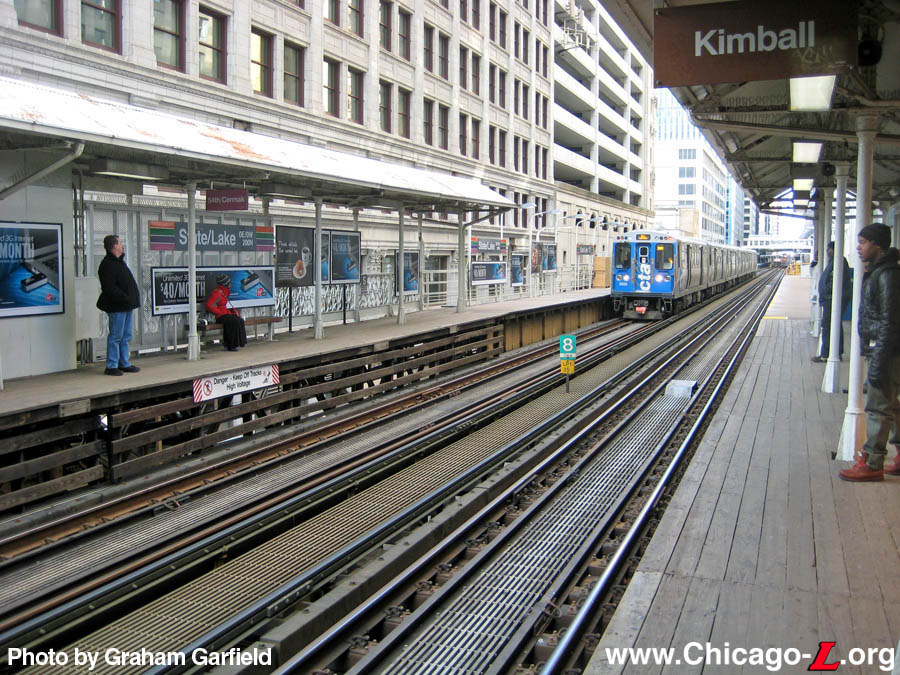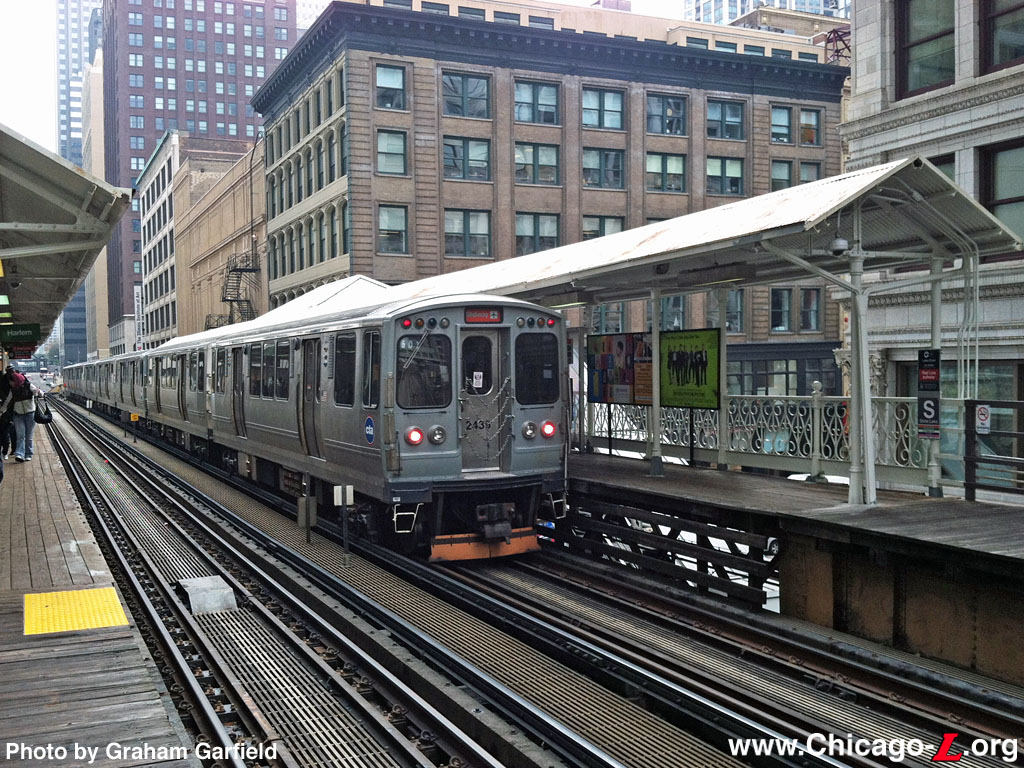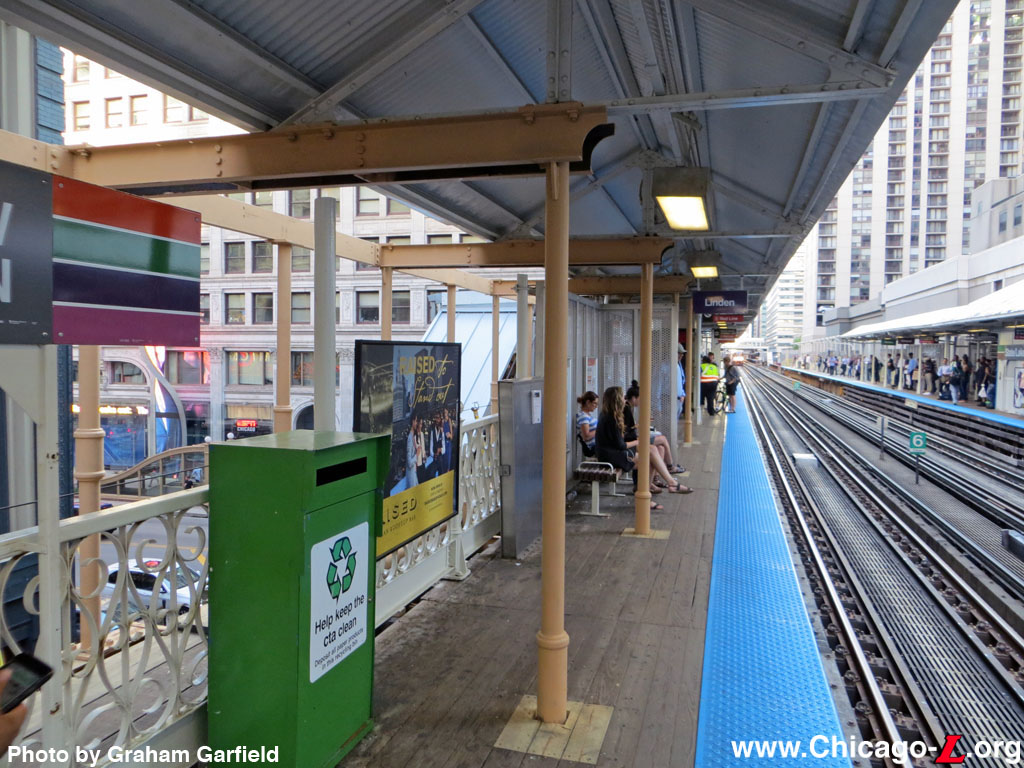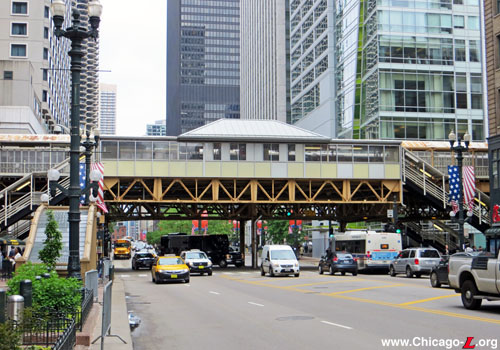
The State/Lake Inner Loop
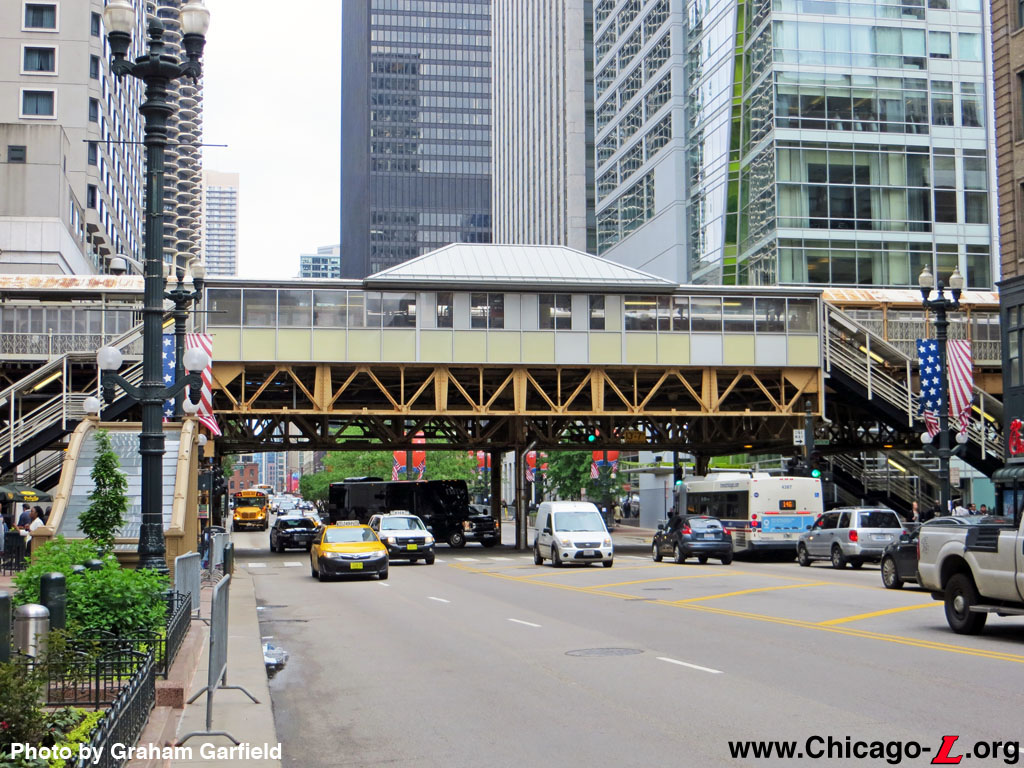
elevated station, looking north on State Street on May 25, 2017. Other than the steel structure, the peaked roof in the middle is the only
part of the original station house left (of course, the covering has been replaced, probably several times), and suggests how small the original building was. The current exterior curtain wall was installed in 2008; the lower panels under the windows can light up in different colors, and in different patterns, and are often programmed for various seasons and holidays. For a larger view, click here.
(Photo by Graham
Garfield)
|
State/Lake
(0E-W/200N)
State Street and Lake
Street, Loop
Service
Notes:

|
Loop Elevated
|
Quick Facts:
Address: 200 N. State
Street
Established: September 22, 1895
Original Line: Lake Street Elevated/Union Elevated
Railroad
Previous Names: none
|
Skip-Stop Type:
|

|
Station
|
Rebuilt: 2026-2029
Status: Closed for reconstruction
History:
Though the exact alignment of the Loop was debated and changed
several times, the use of Lake Street as the north leg was never
seriously questioned. This suited the Lake Street Elevated just fine,
making their connection to the Loop all the more simple. On December
28, 1894, LeGrand W, Pierce, president of the Yerkes-backed Union
Elevated Railroad, and Lake Street Elevated president Delancey H.
Louderback reached an agreement. The Union Elevated funded the cost
of five of the seven block north leg from Market to Wabash, but
ownership would stay with the Lake Street to pacify some property
owners who still feared the presence of a Union Loop.
By late summer, 1895, the Lake Street extension was constructed to
Wabash Avenue with stations at Fifth Avenue (later called Wells
Street), Clark Street, and State
Street. No station was built at the end of the line at Wabash because
it was known that the east leg of the Loop would need to be able to
connect there. The Lake Street Elevated began service over this
extension September 22, 1895. The full quadrangle of the Loop, and
thus its usage by the other "L" companies, did not materialize until
1897. This represents a unique place in history for the State/Lake
station and the rest of the north leg, as it predates the rest of
the Loop by several years.
Original Station Design and Early Modifications
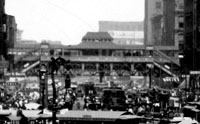
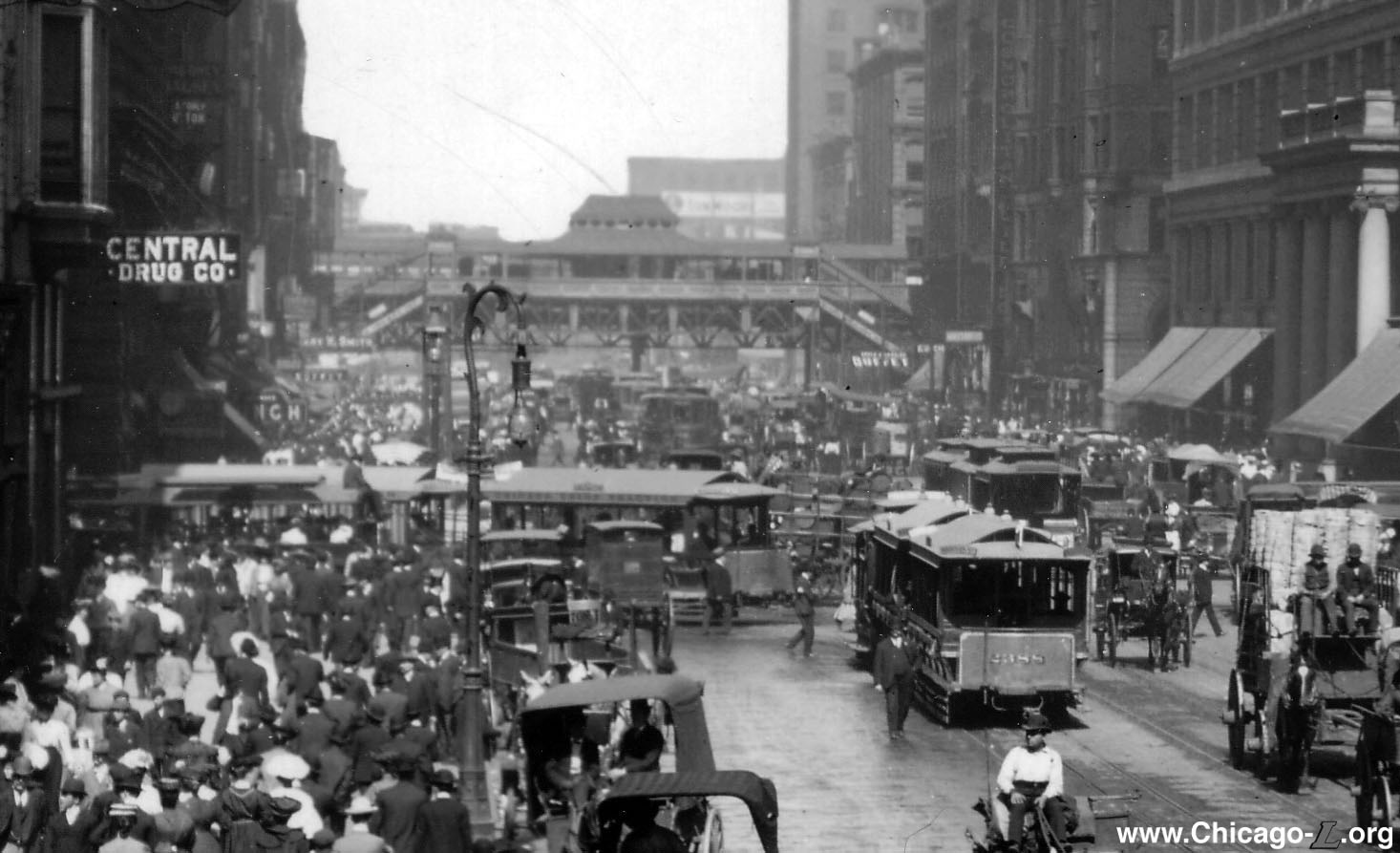
A view north on a lively and very congested State Street from Randolph Street circa 1902-06 shows the State/Lake station in its original configuration, including its unusual cupola. For a larger view,
click here. |
All four legs of the Loop employed a different, unique style for
its station houses and the Lake Street leg was no exception. The original station houses, a set with one on each platform at track level over State Street, were of an eclectic design. They were generally of revivalist Roman classical design, consisting of a small building clad in sheet metal with a hipped roof. Sitting atop the hipped roof was an unusual, elongated cupola, with a narrow band of clerestory windows topped by a hipped roof with a curved pitch, giving it an appearance reminiscent of a pagoda. This provided an unusual silhouette to the buildings, which as a result had an unusual height relative to their footprint. These cupolas and other elements gave the station houses a Mannerist influence, Mannerist architecture being characterized by playfulness, visual trickery and elements playing the symmetry, order, or harmony that challenge classical norms.
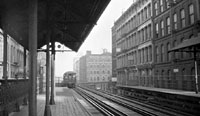
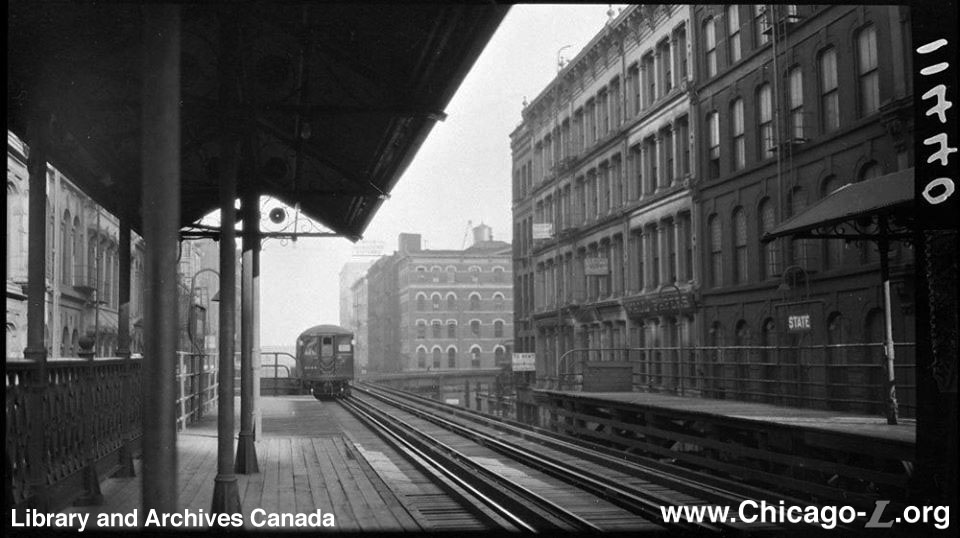
A train led by a 'baldie' 4000-series car enters the State/Lake station circa 1914. The platform sports its original ornate canopy supports and railings, though the recently-extended outer ends of the platforms use simpler pipe railings. For a larger view,
click here. (Photo from Library and Archives Canada) |
The station had dual side side platforms, with wood plank decking supported by steel stringers and joists and sheltered by metal-covered gabled-roof
canopies supported by a row of steel center posts. The canopy supports were ornate, with decoratively-cast metal top angle
brackets that supported the canopy braces and elegant metal scrollwork in the triangular space under the canopy roof. The canopies originally
covered the full length of the platforms, approximately four railcars
long, but as the platforms were extended to accommodate longer trains
the canopies only covered the original section of the platform
nearest to the station houses. The station also
originally had elaborate railings on the platforms, with panels of ornamental scrollwork supported by cast metal posts that alternated between extending up to meet the back edge of the canopy roof or terminating at the top of the railing with a large ball-shaped post cap.
The original station houses were modified early on. As early as 1903, drawings were prepared detailing proposed modifications to State/Lake and Clark/Lake (which was of the same design), including removal of the cupola and reworking of the street-facing facade, and modest expansion of the building footprint. However, these changes were not carried out for about a decade -- the original station remained as late as 1911, and the modifications appear to have occurred circa 1913, when a number of other station changes and improvements were made including the
construction of a new Randolph/Wells station houses.
Eventually, the trackside waiting rooms were removed and new
open ticket agent booths were installed. Left intact, however, were much of the
roofs, all platform canopies, posts, railings and many other
decorative features.
Changes in the CTA Era
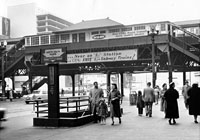
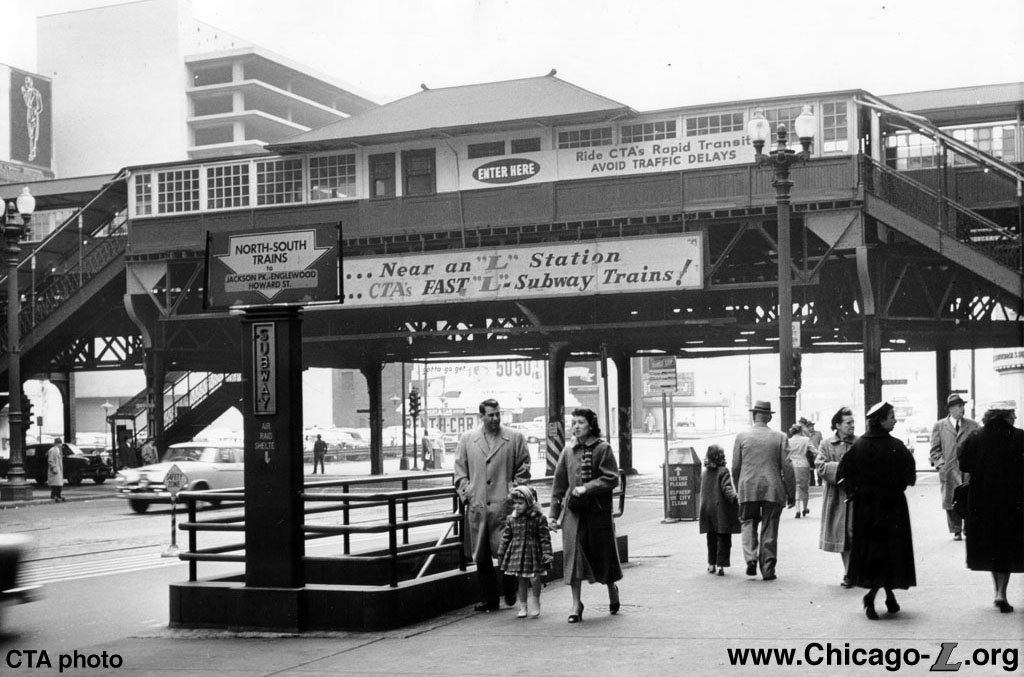
The State/Lake elevated station is seen looking northwest on December 11, 1957, with the northeast stairway down to the Lake-Randolph subway mezzanine also visible in the foreground. The elevated station had this appearance from around the 1920s to 1960s. CTA often used the high-visibility real estate of the station's facade over the street for ads promoting service. For a
larger view, click here.
(CTA photo) |
In 1958, with the opening of the new Congress
Line and the inauguration of West-Northwest service, "L"-to-subway transfers were revised. Free transfers between Randolph/Wells and Lake
Transfer and between State/Lake and Washington/State were discontinued. The "up" (subway-to-"L") transfer between Lake Transfer and Clark/Lake was maintained, but a new "down" only between State/Van Buren and
Jackson-Van Buren/Dearborn was initiated, as well as an "up" and
"down" transfer between State/Van Buren and Jackson-Van
Buren/State. The free transfers between State/Van Buren,
Jackson-Van Buren/Dearborn and Jackson-Van
Buren/State were discontinued in 1969 when the Dan Ryan Line
opened and West-South service was inaugurated. At this time, free
transfers between State/Lake and Washington/State
were reinstated. Because there is no physical connection between the
paid areas of these stations, riders had to exit the elevated station
after having their transfer stamped by a machine and enter the
Washington/State subway at the
Lake-Randolph mezzanine, presenting their stamped transfer
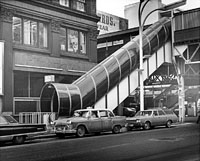
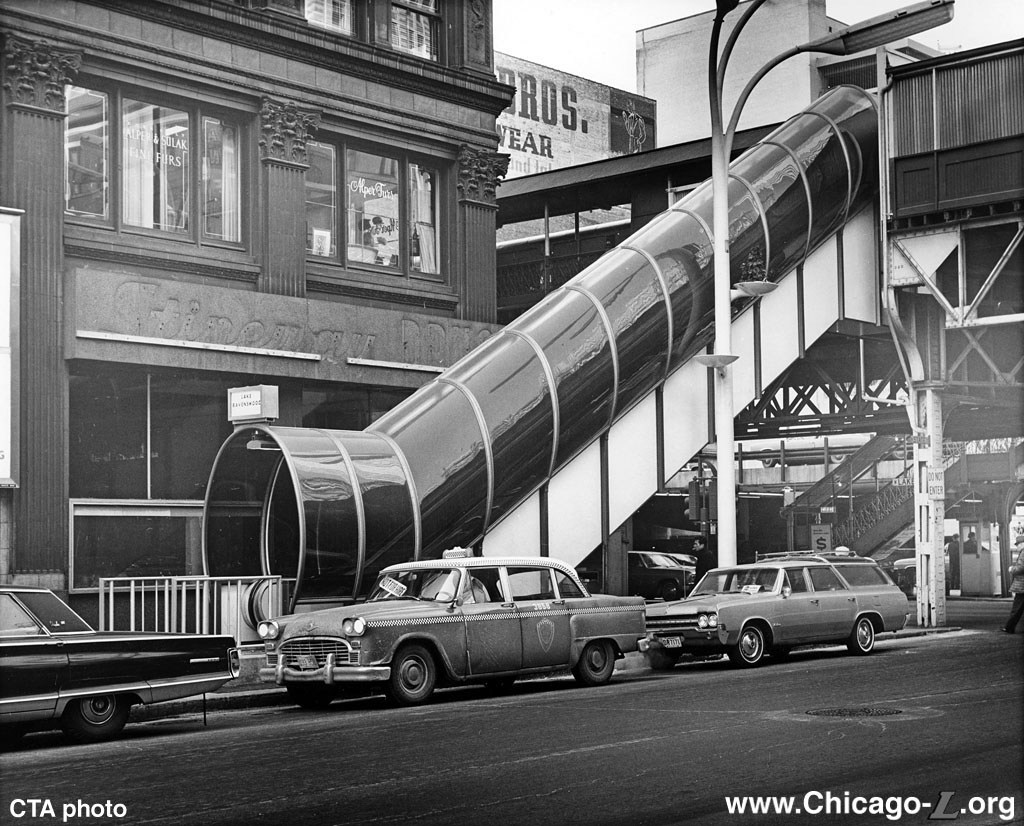
The new escalator to the State/Lake Inner Loop station, with its aluminum frame, plexiglas panels, and unique oval shape is seen looking northwest on January 18, 1967. For a
larger view, click here. (CTA photo) |
In 1966, State/Lake became the first Loop "L" station to receive an escalator for passenger convenience as part of a series of station improvements and renovations the CTA performed in the mid- and late-1960s. An escalator on the southwest corner of State and Lake was placed in service on December 23. Mayor
Richard J. Daley and CTA Board Chairman George L. DeMent both attended the opening ceremonies. The escalator, which operated in the "up" direction, was protected by an enclosure of plexiglas and aluminum construction and lit by fluorescent lighting. Infrared heaters were installed at the base of the escalator. Upon reaching platform level, the escalator arrived at a landing, which led into the Inner Loop station house. A second escalator was completed a few weeks later at State/Van Buren. The cost of installing the two escalators -- one each at State/Lake and State/Van Buren -- was $205,355. State/Lake's escalator remained in service until November 1990 when it was replaced with a set of
stairs.
The south facade of State/Lake was "modernized" with the installation of
a curtain wall in 1968. The design of the new facade, with an aluminum storefront-type frame with solid plexiglas light-color panels and window band, resembled the aesthetics of the escalator installed a little more than a year before.
State/Lake was the last of the three original Lake Street Loop stations to survive,
albeit in an altered form. The Wells/Lake station was
demolished only a few years after its construction. The Clark/Lake station was demolished and rebuilt by the
CTA in 1990. This left only
State/Lake remaining.
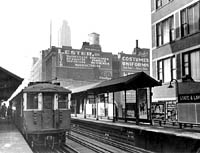
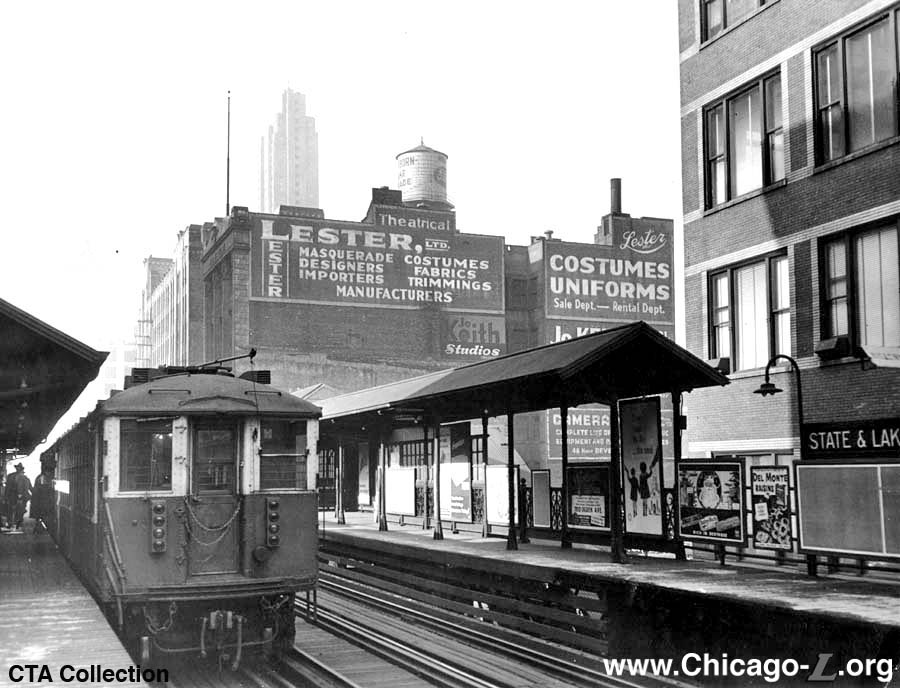
A 4000-series train, probably on the Lake Street route, is stopped at
State/Lake on its way to Forest Park, looking west in
the mid-1950s. Excerpt for newer railcars, advertisements, signs, and
lights, this scene still looked nearly identical 50 years later. For a
larger view, click here. (Photo from the CTA Collection) |
By 1981, compared to their original designs, the State/Lake station houses had been altered almost beyond recognition, with few original features remaining. The glass and aluminum facades on the south elevation completely obscured any remaining original characteristics. The north elevation still had wood siding and window sash, but they did not appear to be of the original designs. All but a small part of the trackside elevations of the original station houses had been removed. However, much of the original grillwork still remains on the platforms and stairways, though some had been removed and replaced with plain aluminum panels. Fiberglass and wood windbreaks and heated plexiglas waiting areas had been added to the platforms.
In 1993, the CTA installed
special turnstiles at State/Lake and at the Lake-Randolph mezzanine
of Washington/State that
dispensed transfers. Passengers transferring between the stations
received a transfer upon leaving through the special turnstile and
presented it to the station agent at the other station. In 1997, a
new machine was installed in the paid area at State/Lake that issued
free "L"-to-subway transfers, removing from service the special
transfer-issuing turnstiles. On June 22, 1997, electronic transit
card vending machines were activated at all Loop stations. Later that
summer, the Transit Card vending machines were activated at all Red Line stations
and shortly thereafter, transfers were granted between the Loop and
the Red Line
subway by using transit cards only, which did not deduct the 30
cent transfer when used.
The facades of both the Inner and Outer Loop stations over State Street were refurbished in 2008 by the City. Both the aluminum-frame and plexiglas panel facade from the 1960s on the Inner Loop (south) side, and the older (and far more piecemeal) facade on the Outer Loop (north) side that still included some wood exterior cladding and double-hung windows that dated from an earlier incarnation of the station house (perhaps from the 1910s or earlier) were removed, and replaced with new exterior curtain walls on both sides. The upper portion consists largely of windows, while the lower panels were semi-translucent and made to light up in different colors, and in different patterns -- these are often programmed to light up in different ways for various seasons and holidays. Only the peaked roof in the middle section on each side provides any remnant of where the original station houses were, and how small they were.
Inner Loop Platform
Expansion, Rearrangement
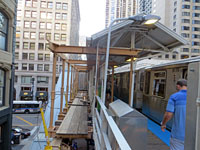
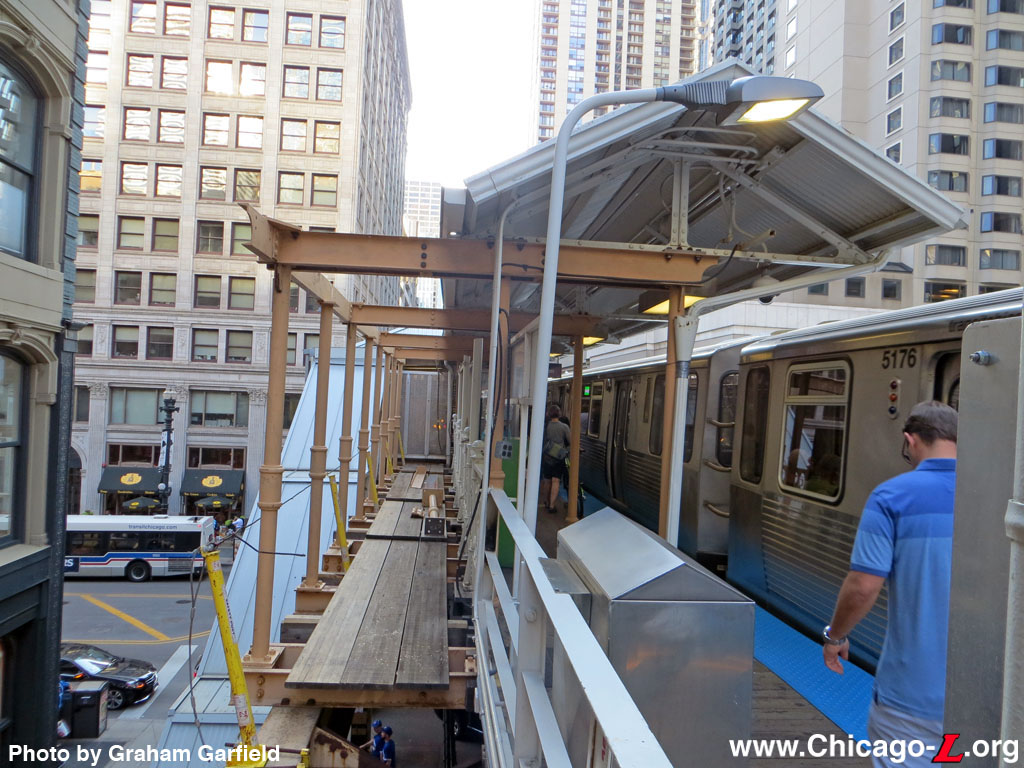
The structure for the widened platform and expanded canopy has been installed in this June 24, 2016 view, including new pillars along the back edge of the new platform and crossbeams to take the load off the pillars along the old back railing, which will be removed. For a larger view, click here.(Photo by Graham Garfield) |
Due to high ridership, narrow platforms relative to modern standards, and several piecemeal modifications over the years, by the early 21st century State/Lake commonly experienced problems with bottlenecks and crowding, particularly on the platforms. Both Customer Assistant booths were built as Ticket Agent booths -- Outer Loop booth dates from mid-20th century at least, and has a pentagon-shaped footprint with the angled faces on the unpaid side and the long, flat side along the platform edge; the Inner Loop booth is more recent, and was narrow but long (so two agents could sit next to one another), set perpendicular to the tracks. Both created an especially narrow space between the booth wall and the platform edge, with conditions compounded by passengers' tendency to pass through the turnstiles next to the booth and then stop and stand rather than spreading out down the platform, as well as by growing ridership -- average daily entries were 1.2 million annually by 2016, up nearly 40 percent since 2010.1
While State/Lake is planned to be completed reconstructed long-term (see next section), the CTA desired to make some short-term upgrades to alleviate some of the bottleneck and circulation issues to improve crowding and safety. The problems were somewhat worse Inner Loop platform, no doubt due to more services using the Inner Loop track including trains to Midway Airport, drawing customers with cumbersome, bulky luggage or who were less experienced riders, so the CTA prioritized this platform first for improvement.
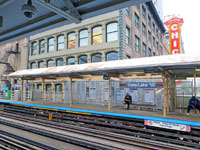
The widened portion of the State/Lake Inner Loop platform, just east of the fare controls, looking south from the Outer Loop platform on May 24, 2017, as the Chicago Theater marque peaks above the canopy. For a larger view, click here. (Photo by Graham Garfield) |
The CTA undertook the construction work entirely in-house, with about a half-dozen CTA departments collaborating on a much-needed station platform capacity expansion project in 2016. The goals of the project were to increase platform space, improve passenger flow and address workplace safety hazards on the Inner Loop platform.
The project took advantage of some structural steel that had already been installed several years prior, during the Loop Track Renewal Project, for an earlier planned platform expansion project. This structural steel, located to the east of the fare control area near the southeast corner of State and Lake streets, was utilized for the improvement program, and allowed this section of platform, where customers most commonly congregated, to be widened.
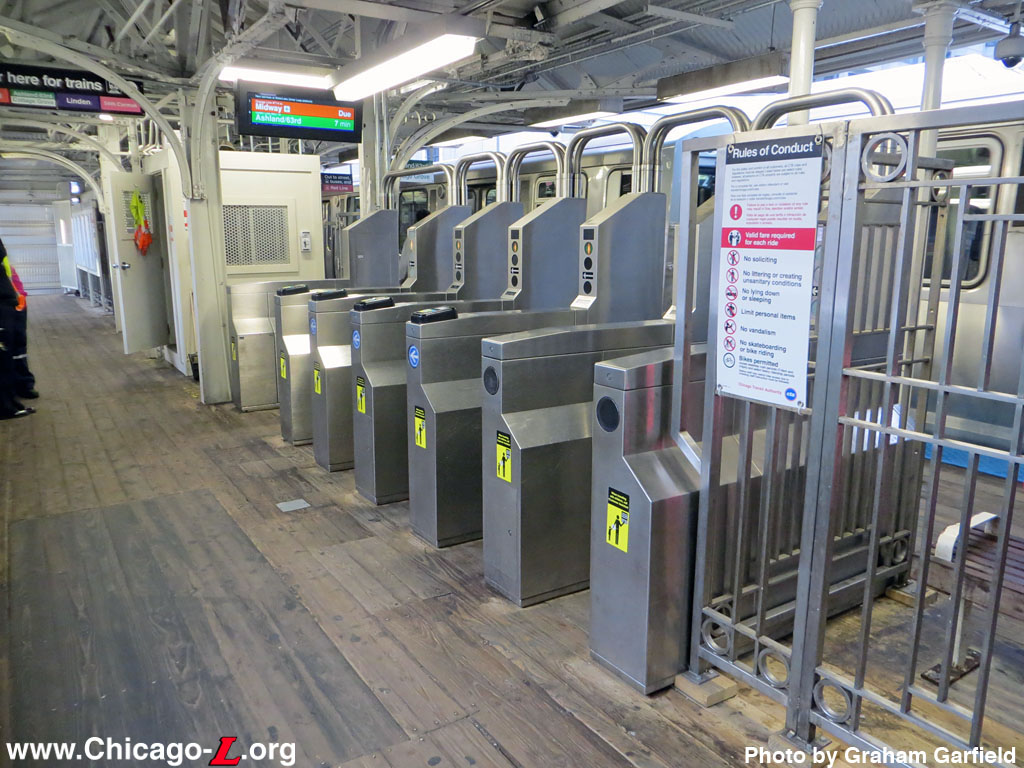
Between April and October 2016, crews performed improvements to the Inner Loop platform with minimal impact to riders by completing work at night and piggy-backing on other track closures for the Washington/Wabash station project, including a 54-hour weekend closure of the station. Improvements undertaken included replacement of worn and rotted platform decking; the aforementioned widening of the east end of the Inner platform; removal of several obstructions on the platform (i.e. a false wall, large janitor box, some original 1895 canopy posts); installation of a new, smaller CA booth; relocation of turnstiles and rotogates; the addition of new wide turnstile gate (commonly used for wheelchair/ADA access, but here intended for use by passengers with luggage and other large item) and exit-only turnstiles; lighting upgrades; and repositioning digital displays. In total, platform capacity was increased by 400 square feet and passenger flow improved enough to result in a reduction in train dwell times by up to 20 seconds.2
Similar work was planned occur soon after on the station's Outer platform2, but never took place and was evidently cancelled.
Plans for Renovation
There were several different plans for the renovation or reconstruction of State/Lake station, spanning several decades over the late 20th and early 21st centuries. About once a decade a new plan was put forward, some evolutions or revisions of previous plans, others radically different than the plan before. Finally, in the late 2010s a plan took hold that was carried forward, with design completed and construction initiated in the early 2020s.
Plan Development
Although there had been various modifications and improvements made to State/Lake since its opening nearly a century earlier, the concept of a complete reconstruction of the station originated with the Master Plan for the Loop Elevated Rehabilitation and Historic Preservation, published by the City of Chicago in September 1981. The Master Plan was a comprehensive scheme providing recommendations for various physical improvements to the Loop Elevated to assure the provision of safe, adequate, convenient and comfortable use of the infrastructure into the 21st century. The recommendations were based on an evaluation of the structural integrity of the existing facilities, current and projected ridership patterns at the time of the report (1981), and both then-current and projected future development (through 2020) trends throughout the central business district. The plan, developed through the coordinated efforts of the City's departments of Planning and Public Works, and the CTA, provided a scheme for rehabilitation of the Loop elevated structure and stations in compliance with the guidelines of the National Register of Historic Places, for which the Loop as a whole was determined to be eligible. The Master Plan remained the guiding policy document for improvements to the Loop Elevated into the 21st century.
Plans for a new State/Lake station in the Master Plan called for its development in either a new office structure constructed on the southwest corner of the intersection, or in the existing State and Lake Building at that location if this structure was to be retained in the North Loop Development plan. (At the time, that building housed the State-Lake Theater, a movie house, on the first floor and offices above, including those of WLS channel 7, Chicago's ABC affiliate.) The proposed station's placement in an office building adjacent to the elevated structure would provide the advantages of a "joint development station", as the planned called it, which the City and CTA were advocating for at the time. Joint development of stations in adjacent buildings was seen as desirable due to the resulting reduction of pedestrian congestion at street level, increased convenience for building occupants, potential for retail development to serve transit riders, and potential reduction in some maintenance costs by not being responsible for the overall building structure.
The station access and fare controls were to be housed in the building on the southwest corner, with the consolidated single fare control area providing operational efficiency and allowing one ticket agent to serve both platforms during slow periods. Stairs, escalators and elevators were intended to be provided inside the building to provide vertical access for passengers. Direct access was also intended to be provided to the Lake-Randolph mezzanine of the State Street Subway. Station platforms were to be relocated to the west to improve access to the proposed station entry on the west side of State Street, but would still span State Street and extended west to Dearborn Street.
The design scheme for State/Lake was, however, very conceptual in the Master Plan -- the document concedes that no design information other than the proposed location and general features of vertical access had been generated at the time of the plan -- as other stations such as Clark/Lake, Adams/Wabash, "Library Place", and Quincy were identified as higher-priority in the Plan and had more advanced design development at the time; State/Lake was projected for renovation at a later date. The State-Lake Theater closed in 1984, but the State and Lake Building was indeed retained, rehabilitated in 1984 and again in 2005-06 (without any "L" facility or connection), and still houses ABC7 among other tenants.
Although the 1981 Master Plan remained the guiding document for Loop station development and rehabilitation, specifics of various renovation projects developed over time. By the late 1990s, the City and CTA had shifted to a scheme to combine the State/Lake station with the Randolph and Madison stations on the Wabash side of the Loop (Randolph and Madison had been identified for consideration in the Master Plan). On September 11, 1998, the
CTA announced they planned
to permanently close the State/Lake and Madison/Wabash
elevated stations and replace the Randolph/Wabash
facility with a "super station." Supposedly combining function,
aesthetics and the need to replace "L" structures that date to the
1890s, the $29 million project would result in more streamlined
CTA operations, according to
officials.
The proposed new station, sporting main entrances and turnstiles on Randolph, Wabash and Washington and a full-length
covering to protect commuters from the elements, would have become the
third-busiest station in the
CTA's then-142-station system and
would have included a pedway connection to the Red Line subway one block
away, according to officials. The design of the station, which
at the end of the 1990s was undergoing final review by officials from the city, the
CTA and the Greater State
Street Council, was described as a
traditional, but modernized version of the Madison/Wabash
station. As part of the construction work, the entire elevated
structure was to be rebuilt from Lake to Washington Streets and the
supports down the middle of Wabash were to be replaced by columns
anchored along the curbs.

A design developed for State/Lake in the early 2000s used a clear span truss structure to create an airy design intended to function as modern 'gateway' to the State Street shopping and theater district. For a larger view and more images, click here. (Rendering from Coffey Group Architecture, LLC) |
By the early 2000s, the City had revised these plans and decided
not to consolidate all three stations -- State/Lake, Randolph/Wabash,
and Madison/Wabash -- into one.
Rather, Randolph and Madison
would be consolidated into a new Washington/Wabash station, while a
new independent State/Lake station would be built, located slightly
to the east between State and Wabash so that large station structures
would not block the vista up and down State Street. By the mid-2000s,
the City's plans for this station were under development.
Architects Daniel P. Coffey & Associates, who had a few years earlier designed the renovated Ashland/Lake station and the State Street Subway design theme first used at Roosevelt in 1995 and subsequently rolled out to other stations, created a design for this iteration of the renovation project. A clear span truss structure would eliminate six street and sidewalk obstructing columns and was designed to be a modern 'gateway' at the head of the famed State Street and its theatre and retail sub-districts. Planning for the airy structure included a detailed staging plan that allowed the new structure to be slid in place over a 3-day holiday weekend in order to minimize transit disruption. According to Coffey & Associates, "the design combines the celebration of movement, tradition, and sense of place to create a special station. Security issues, structural sophistication, ADA way-finding are particular concerns that are integrated into this design."3 Construction was not expected until some time later in the
decade, but in the end this version of the project was shelved and the design not pursued.
On October 12, 2017, the City announced that the reconstruction of State/Lake would be the next transit station project the Chicago Department of Transportation (CDOT) would take on, having just completed the Washington/Wabash project. The City stated that the new State/Lake station would be a modern, fully accessible station with wider platforms, built to 21st Century design standards, consistent with the new Washington/Wabash station.4 In October 2019, it was stated that the new station might include an elevator connection to the Red Line subway.5
In October 2017, a $56.9 million federal Congestion Mitigation and Air Quality Improvement Program (CMAQ) grant by the Chicago Metropolitan Agency for Planning (CMAP) allowed CDOT to accelerate work in collaboration with the CTA to launch the design process for a new station. The $56.9 million grant was in addition to existing design funding of $5.5 million. However, these grants do not cover the full cost of construction, and the City plans to seek additional federal funding for construction.6 In October 2019, the project was approved to get another $59 million.7
CDOT, which is managing the project for the CTA, expected to issue a Request for Proposals (RFP) before the end of 2017 for design services for Phases 1 and 2 of the new station, moving the City towards setting a timetable for construction.8
As of mid-2021, the project had been awarded $11 million in engineering and design funding and $119 million in construction funding through the federal Congestion Mitigation and Air Quality Program. The total estimated project cost is approximately $180 million, and the City of Chicago is seeking additional funding from various potential sources.9
State/Lake is the last remaining
example of 1895 Loop architecture from the State Street Leg, despite
its altered condition. The station still sports its original
decorative railings and canopies, among other remnants.
Station Design
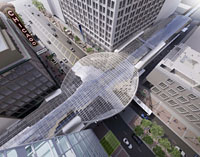
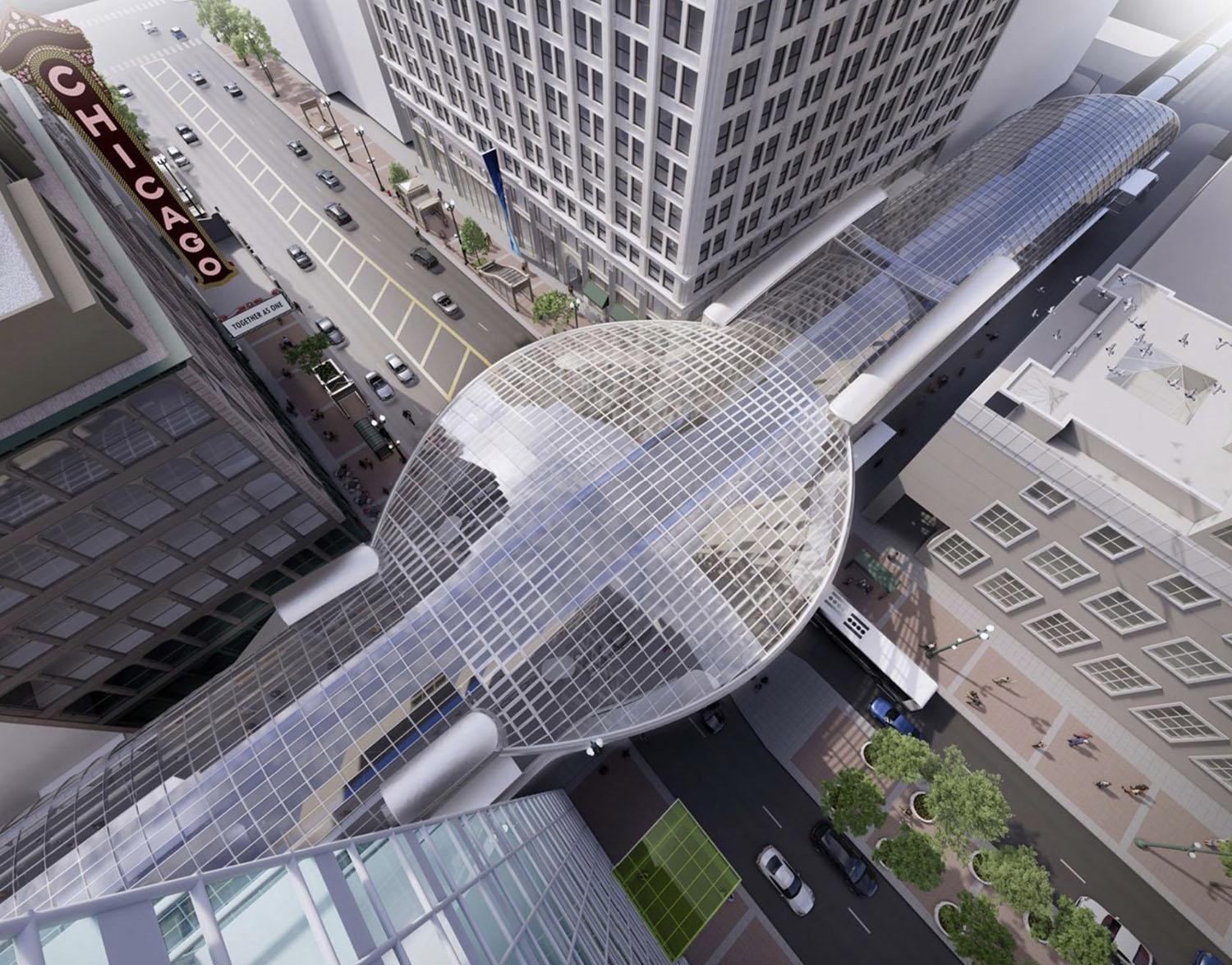
An aerial rendering of the new State/Lake station, looking southwest, showing the full-coverage glass canopy around the station. The long, smooth metal canopies cover stairways to the street or, in the case of the longer set, to the transfer bridge. For a larger view, click here.(Rendering courtesy of CDOT) |
The design concepts for the rebuilt State/Lake were released on June 9, 2021. The City described the design as being "a modern, fully accessible rail hub with wider platforms and a host of customer amenities, built to 21st Century design standards."10
The City explicitly viewed the project as a bold architectural design in keeping with recent "signature stations," as they called them, such as the 95th Street Terminal, the Washington/Wabash station, and the Damen Green Line station.11 "The intersection of State and Lake Streets is an iconic location in the heart of Chicago, and it deserves a station that makes a bold statement while meeting the needs of the 21st Century transit customer," said CTA President Dorval R. Carter, Jr. at the time of the designs' release.12
The design and construction process are being led by CDOT on behalf of the CTA. Design services for the station are being led by Skidmore, Owings & Merrill (SOM) in collaboration with Kansas City-headquartered TranSystems and a consultant team comprised of experts in the fields of historic preservation and public transit.13
The station is intended to function as a cultural hub and gateway to downtown for residents as well as visitors, and is located at a node of six of CTA's eight rail lines, plus connections to several bus routes. In addition to improving accessibility, safety, and comfort, the architects designed a transparent structure to bring plenty of natural light into the station.14
The design features platforms that are double the current width, to better accommodate customers. It also includes a full-coverage, glass canopy to protect customers from rain and snow, and elevators to make the station accessible to all riders, as well as a walkway connecting the inner and outer platforms,15 addressing a limitation of the old station wherein the two platforms were completely separate paid areas with no connection between them.
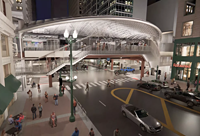
The proposed State/Lake station is seen in a digital rendering looking north. The elliptical domed canopy over the mezzanine fare control area is a prominent feature of the station's presence. For a larger view, click here.(Rendering courtesy of CDOT) |
The station's improvements begin at street level, with an increased number of access points as well as streetscape improvements. There will be stairways and an elevator on all four corners -- the stairs and elevators on the northeast and northwest corners leading to the Outer Loop fare control area, and those on the southeast and southwest corners leading to the Inner Loop fare control area. Each stairway on each corner will have two street-level access points -- one facing State Street and the other facing away -- which ascend to a meeting at a mid-point landing before rising to the fare control/platform level.16 There will be two escalators, one to each fare control area, located on Lake Street east of State Street.17 Having two elevators to each side rather than just one provides redundancy in case of failure or maintenance outage, as well as increased convenience and safety resulting from a reduced need to cross busy streets to get to an elevator. Making the station fully accessible marks a big step in the CTA's All Stations Accessibility Plan, a blueprint to make all CTA train stations accessible.18
The project involves public realm enhancements at street level as well. Work includes street-level lighting upgrades, wider street corners, an improved pedestrian crossing, and an accessible connection to the plaza to the north.19 The width of the sidewalks on both sides of Lake Street will be expanded by reducing the width of the street to just two traffic lanes, with the extra space used for new stairways, escalators and elevators without the new elements excessively reducing the existing sidewalk circulation space.20 Improvements made to the station's structural design will remove obstructive columns and offer safety to pedestrians and vehicle traffic along the main street.21
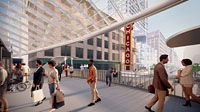
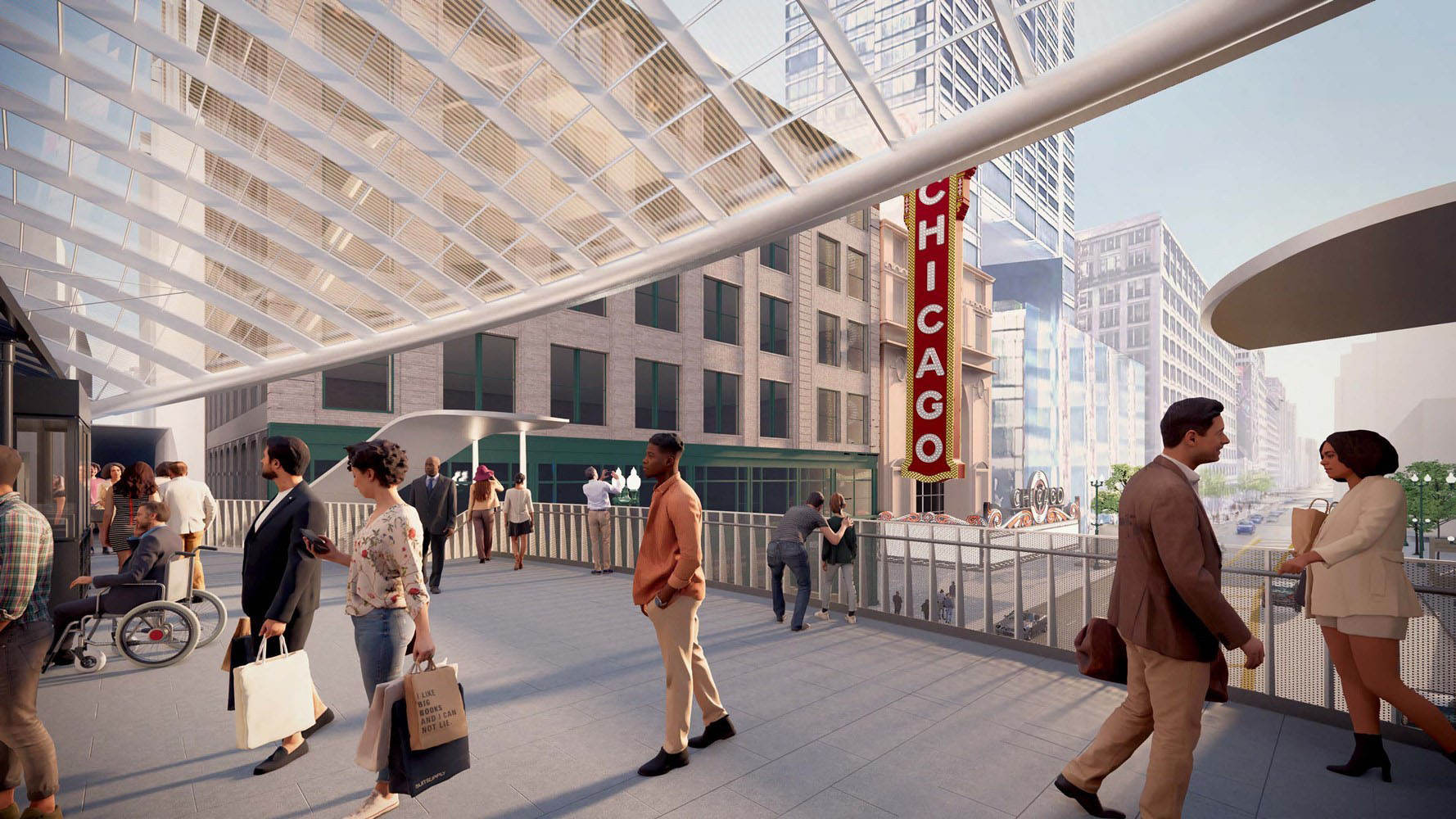
A curved balcony will extend out from each elevated fare control area, providing scenic overlooks of State Street, including an up-close view of the landmark Chicago Theater. The stairs down to the street are on each side of the balcony; the CA booth is visible on the left. For a larger view, click here.(Rendering courtesy of CDOT) |
As at the old station, there will be two fare control areas, one for each platform, located at platform level. Unlike the old station, each will be airy, open and spacious, with plenty of room for circulation. Each takes the form of a semi-circular balcony-type extension of the platform structure, centered over and projecting outward from the station over State Street. The entry stairs from street level ascend and join the unpaid area along the curved outer perimeter of the projecting deck. The wide balconies have railings but are otherwise open and unenclosed, facing north and south to create scenic overlooks of State Street, including an up-close view of the landmark Chicago Theater.22
The unpaid fare control area on each side includes stairs from street level rising from the sides along the curved outer perimeter landing passengers in the middle of the balcony over State Street, elevators from the street at the east and west far ends, an escalator from street level next to the east elevator, and a fare control in the center, with turnstiles in the middle, a Customer Assistant booth and fare vending machines to the east of the turnstiles, an equipment room to the west of the turnstiles, and exit rotogates and Transit Information Panels with map and timetable posters at the far ends near the elevators. Granite flooring is to be used in the unpaid area and fare control area.
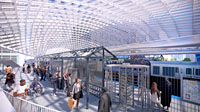
Under the modern lattice canopy, the new station plans to preserve and re-purpose the original 1895 canopies as enclosures for the turnstiles, fare vending, and attendant kiosks. For a larger view, click here.(Rendering courtesy of CDOT) |
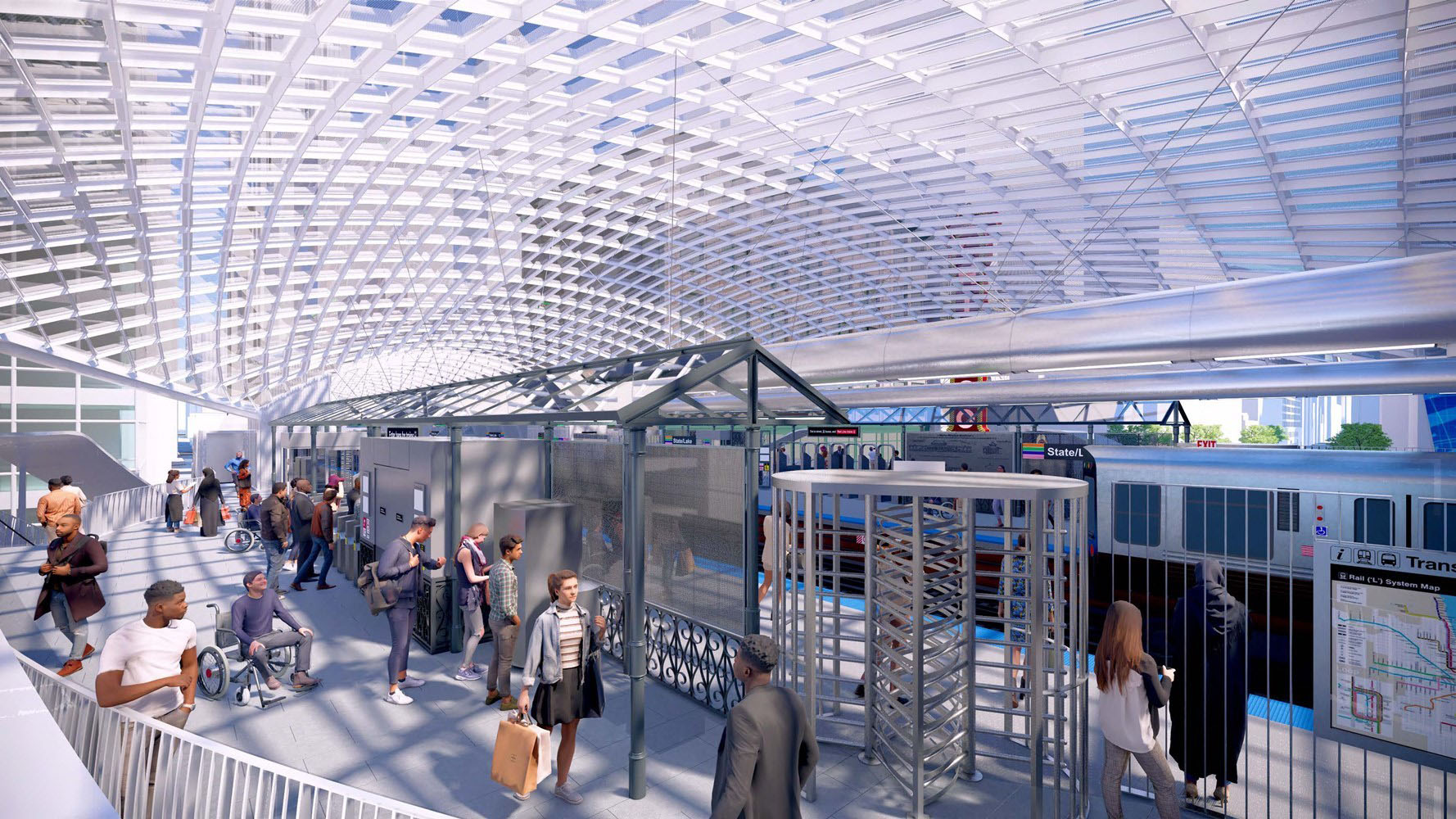
The architects sought to integrate historic materials from the existing station into the design to provide harmony between past and future.23 As part of this effort, original 1895-vintage platform canopy posts and ornate railings are to be salvaged from the old station and reused to frame the vending and Customer Assistance kiosks,24 essentially creating a lower, more intimate canopy over these elements but under the cover of the overall domed canopy of the station.
The new station will consist of two side platforms in roughly the same location as the current platforms, typically about 14-16 feet wide depending on other platform elements. The platforms will use a precast concrete deck.
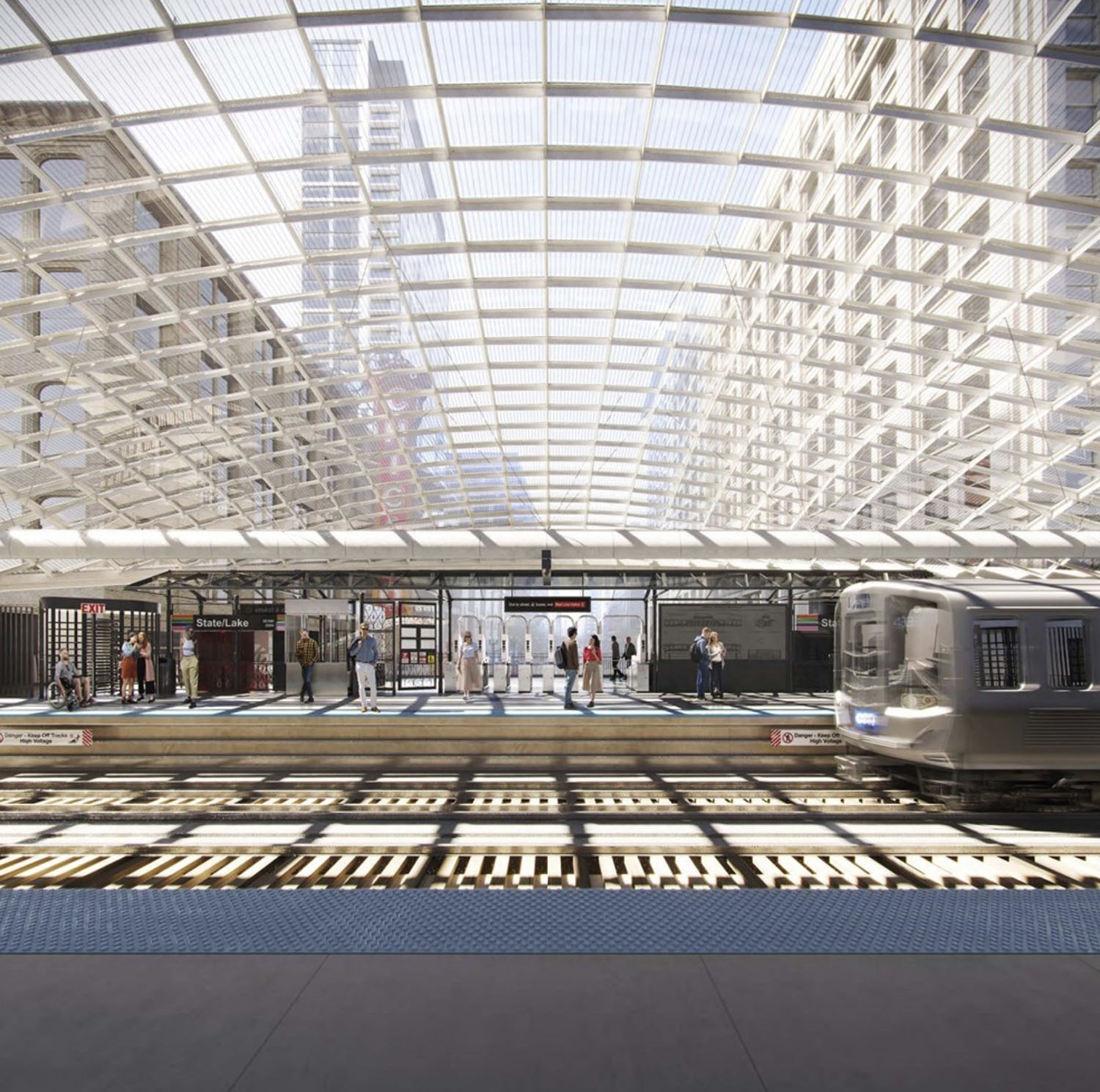
The station's most dominant, signature element is the canopy covering the entire station, including both platforms, the tracks, and the fare control areas. At the ends of the platforms, east and west of State Street, the canopy is an arched barrel vault, extending all the way down to the back edge of each platform. The result is a tube- or tunnel-like structure, not totally unlike the canopy at Cermak-McCormick Place (another CDOT-managed "showcase" CTA station design), providing full coverage from rain, wind and other elements, even from the sides. The opening at each end of the station is angled, owing to the platforms being slightly staggered, giving it a distinct appearance. In the middle of the station, over State Street, the canopy opens up on the sides and takes on the appearance of a floating dome over the fare control areas and balconies over State Street.25
The glass canopy is designed with a bird-friendly frit pattern that provides shading in the summer and protection from harsh winds in the winter, all while diffusing natural daylight into the station.26 According to SOM, the canopy's latticed pattern "draws upon Chicago's history of structural innovation, from bascule bridges and early skyscrapers, to the John Hancock Center and Willis Tower."27 The transparency provides expanded views towards the Chicago Theatre marquee, historical buildings, and architectural landmarks along the State Street corridor.28
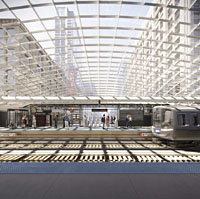
A view across the station from the opposite platform toward Inner Loop platform and fare controls shows the open and airy environment planned for the new State/Lake station. For a larger view, click here. (Rendering courtesy of CDOT) |
Under the canopy, a light tray will be suspended by cables from above, over the platform near the trackside edge, running the length of the platform. This trough will have lighting, signage (both static and digital), PA speakers, security cameras attached to it,29 and like will contain related and other systems cabling to neatly organize it and hide it from view. Some elements like benches, windbreaks and leaning bars will be mounted directly to the sides of the canopy arch structure.
A new glass and metal-clad transfer bridge on the western end of the station, west of State Street, will connect the Inner and Outer Loop platforms on the paid side. The transfer bridge will be accessible by both stairs and elevators, making the paid connection between the platforms fully accessible.30 So while each platform will still have its own entrance as in the old station, the ability to cross between platforms without leaving the paid area will improve access and flexibility by tying the station together internally.
Auxiliary exit stairs are also to be provided from the west end of the Outer Loop platform toward Dearborn Street, and the east end of the Inner Loop platform toward Wabash Avenue.31
The State/Lake reconstruction project also includes improvements to the connectivity between the Loop elevated lines and the Red Line subway under State Street.32 However, this will not involve a direct, in-station connection between the two stations' paid areas (such as between the Roosevelt subway and elevated stations). Instead, the Lake-Randolph mezzanine of the State Street Subway -- the north end of the Lake station closest to State/Lake station, where transfers are currently made -- will be made accessible through the installation of two elevators. One elevator, located on the west side of State Street, will connect the street and mezzanine levels. A second elevator will connect the mezzanine paid area, down a corridor along side and beyond the stairs and escalator, with the subway platform.33

An image published by Streetsblog Chicago a CDOT project presentation shows the planned modifications to the Lake-Randolph subway mezzanine to add elevators. For a larger view, click here. (Image from Streetsblog Chicago) |
The new subway elevators will improve convenience and access for wheelchair users and others with mobility challenges by making both ends of the Lake subway station ADA accessible via elevators, as well as improving the convenience of accessible transfers between the Loop and Red Line subway by making the two adjacent station entrances elevator-equipped. The distance between the new Lake-Randolph subway entrance elevator and the State/Lake elevator on the southwest corner will only be about 160 feet.34 However, it remains an "out-of-system" transfer, requiring one to exit and then re-enter the paid area (requiring use of the same farecard to avoid a transfer charge) and exposing users to the elements during inclement weather.
According to CDOT, who is managing the design and construction portions of the project, creating an in-station connection was deemed excessively costly and challenging. According a city official, building an underground passageway from State/Lake to the existing Red Line mezzanine would likely have required "costly land acquisition" of property currently owned by the adjacent building owners, because there isn't sufficient space for the tunnel in the existing city-owned land footprint.35 CDOT spokesperson Mike Claffey said, "it was physically not possible. The alignment of the subway mezzanine [located one level below the the street] and Red Line underground platform and tracks [located one level below the mezzanine] in relation to the elevated tracks were the determining factors that made a direct elevator and stair connection untenable. The underground mezzanine is too far to the south of the elevated tracks to make a direct elevator connection."36
Station Construction
As of mid-2021, CDOT was going through the federal NEPA (National Environmental Policy Act) process which is required in order to be eligible for federal funding. The process included extensive outreach and consultation with stakeholders, including owners of adjacent properties.37
Construction began in summer 2025 with advance utility work before major construction on the station itself. Beginning Monday, August 18, Lake Street from Dearborn Street to Wabash Ave was reduced to one lane for utility work. A week later, on Monday, August 25, State Street from Lake Street to Randolph Street was reduced to one lane in each direction. The lane reductions allowed crews to begin utility potholing in preparation for major excavation work. The potholing work, also known as "daylighting" and expected to last approximately three to four months, involved carefully excavating small, precise holes to locate and verify the position of underground utilities, structures, and unknown objects. This process is essential for avoiding damage to critical infrastructure and ensuring the safety of all future construction activities associated with the new station. The existing State/Lake station remained open during this phase.38
The State/Lake station closed at 2am, Monday, January 5, 2026, to allow for demolition and the start of major construction activities. Trains on the Loop 'L' continue to operate through the project site, and customers are advised to use the adjacent and fully accessible stations at Washington/Wabash and Clark/Lake as alternatives to the closed State/Lake station. The 'walking transfer' between the Loop elevated and Red Line subway is relocated to between Washington/Wabash on the Loop and the Randolph-Washington entrance of the Lake subway station. The Lake Red Line subway station will remain open during construction.39
Once heavier construction activities commence in January 2026, daytime work will transition into heavy excavations and concrete removal to install structures for the subway elevator access and construction of the new elevated facility. The majority of the nighttime work will involve the decommissioning and demolition of the station structure.40
Station construction is expected to be completed in 2029.41
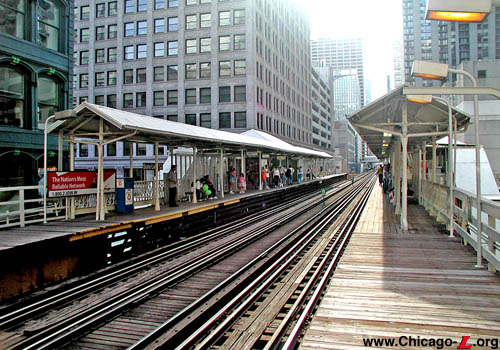
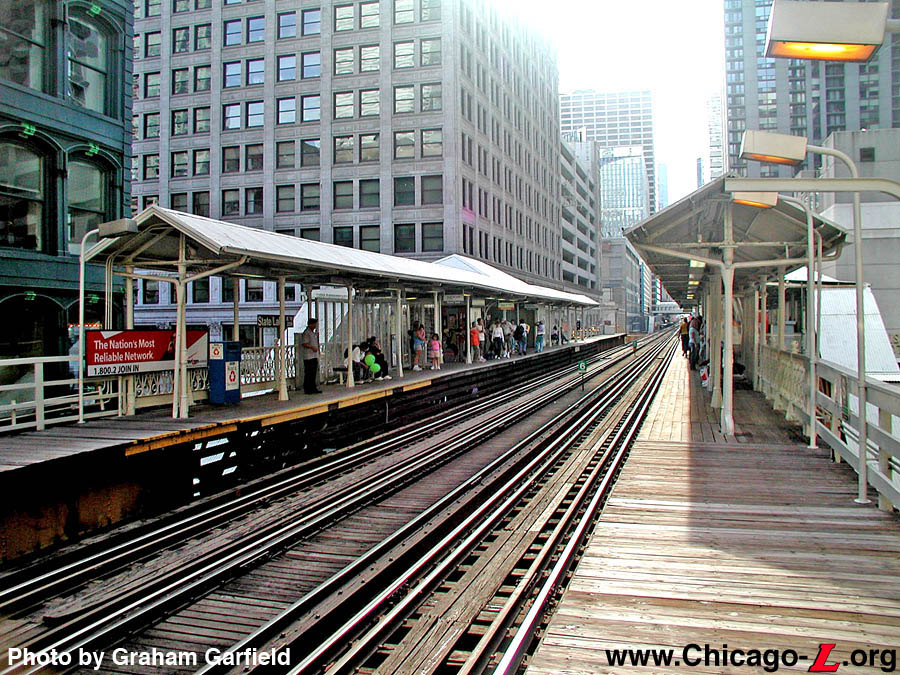
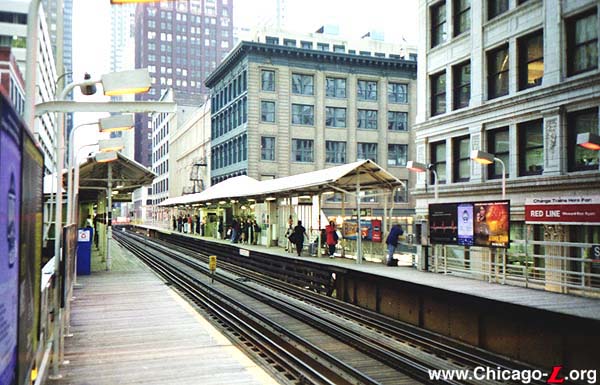
The State/Lake elevated
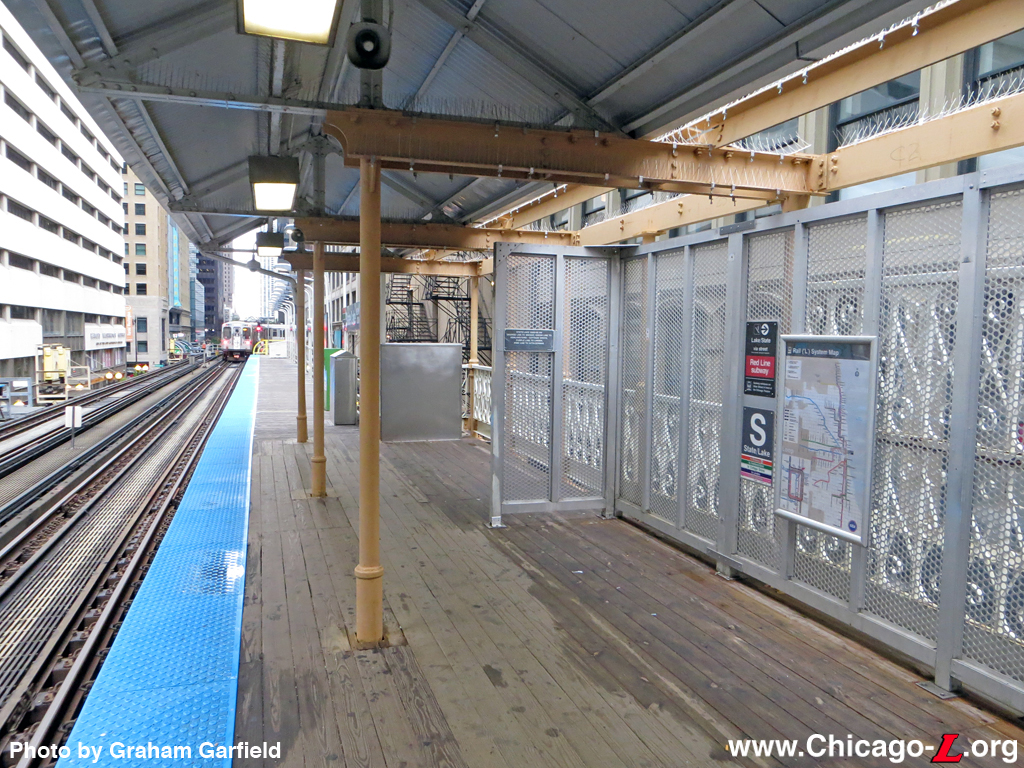
station, looking west on the Outer Loop platform on August
22, 2004. The station's original 1895 canopies, as well as
the original decorative railing (beneath the canopies) are
still in place, allowing this station keep much of its
character. For a larger view, click here.
(Photo by Graham
Garfield)
|

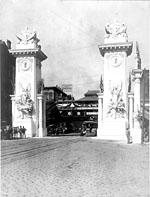 |
state-lake00a.jpg (81k)
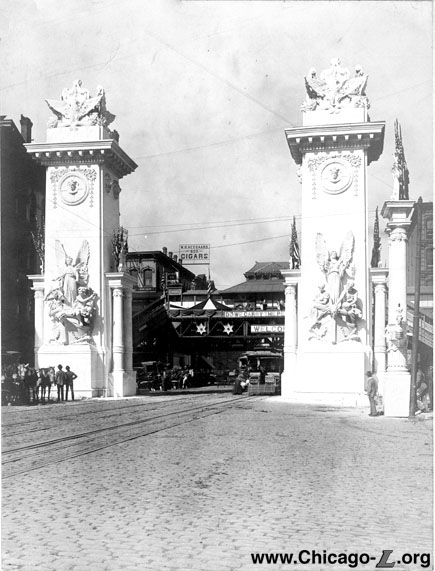
The original State & Lake station is seen peaking out behind the tall pylons marking the north end of the Court of Honor, looking north on State Street toward Lake Street, at the 1899 Autumn Festival of Chicago. The Festival, held October 4-11, 1899, celebrated the United States' victory in the Spanish-American War. The handsomely decorated and brilliantly illuminated Court of Honor included temporary arches, pylons, Venetian masts and rostral columns, with hung draperies on State Street buildings, such as the bunting and draperies on the "L" station in the background. The pylons were designed by famed sculptor Lorado Taft -- the pylon at left symbolizes Prosperity, and on the right is Peace. |
|
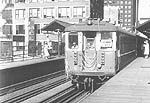
cta4000s05.jpg
(130k)
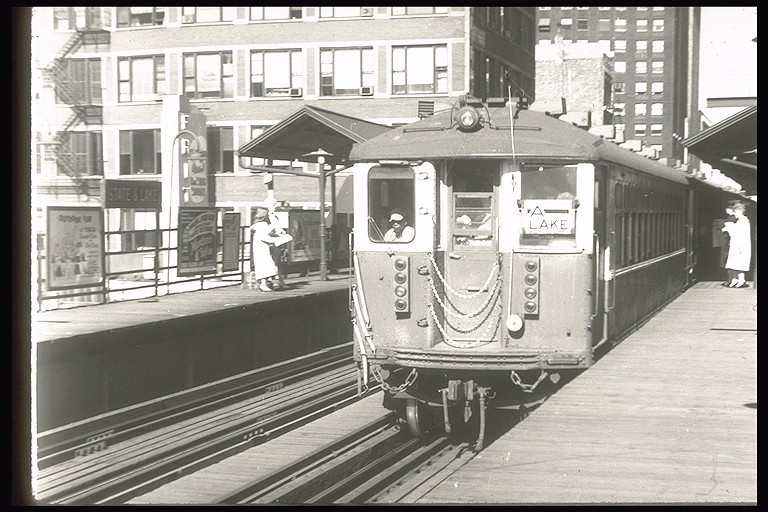
A Lake "A" train of 4000s
stops at State & Lake while heading westbound on the
Inner Loop circa the 1950s. At this time, the Loop was
operated uni-directionally (counterclockwise) with Evanston
Express and (usually) Ravenswood trains on the Outer Loop
and Lake, Garfield, and Douglas trains on the Inner Loop.
(Collection of Joe Testagrose)
|
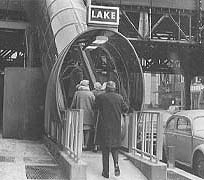 |
state-lake02.jpg (18k)
Christmas shoppers try out a covered escalator at State & Lake station. The moving stairs opened Dec. 23, 1966. |
|
state-lake10.jpg
(235k)
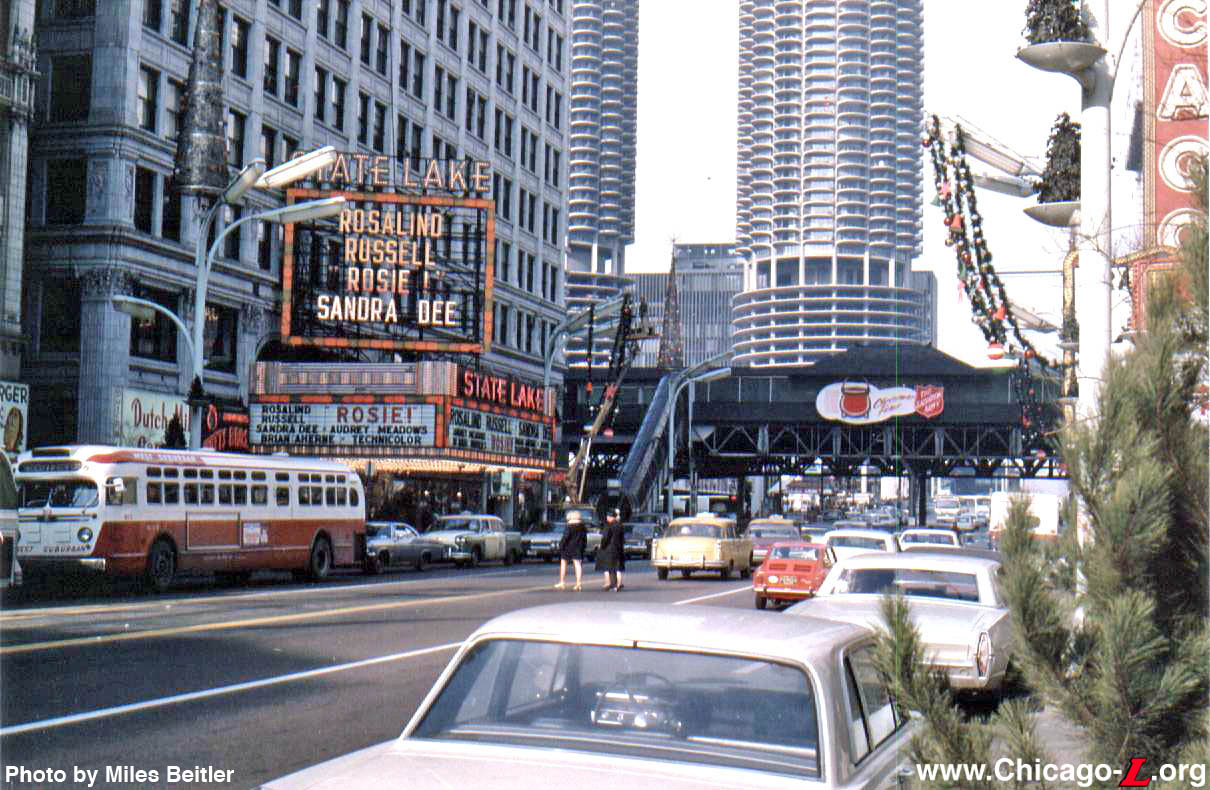
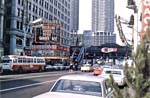
State & Lake station is seen looking north on State
Street in during the Christmas season of 1967, with the
holiday decorations on the street lights and stations. The
escalator to the station behind the State-Lake Theater
marque was installed earlier that year and Marina City,
towering in the background, had been completed three years
previous. The bus in the left foreground is on one of two
Joliet-Chicago routes of the West Suburban Transit Lines, a
descendant of an interurban railway. (Photo
by Miles Beitler)
|
|
cta2237b.jpg
(153k)
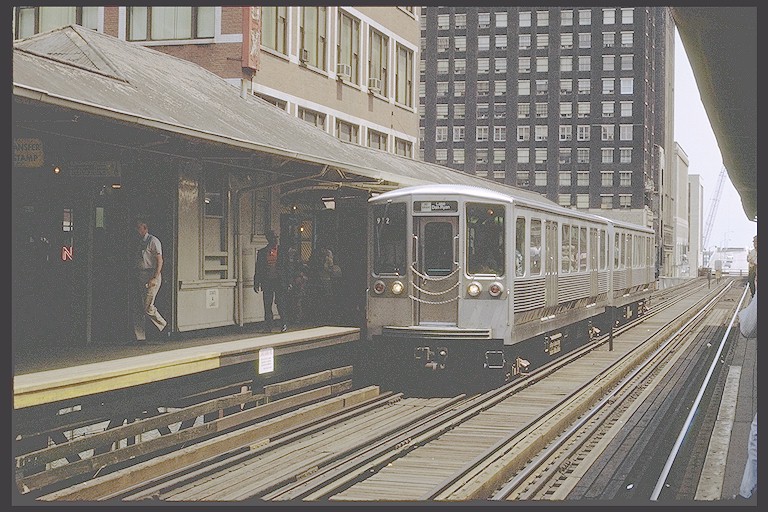
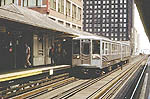
A midday 2-car Lake-Dan Ryan All-Stop is led by car 2237,
pulling into State & Lake on July 4, 1971.
(Photo by Joe Testagrose)
|
|
cta2249.jpg
(147k)
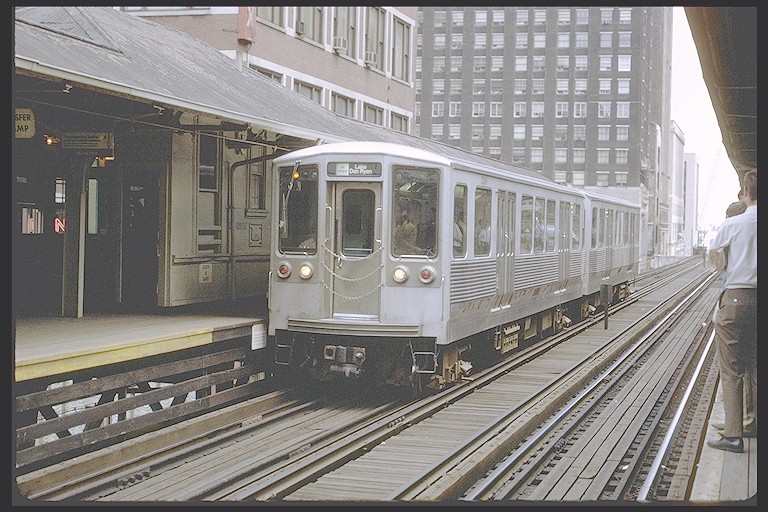
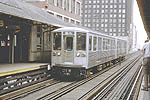
Car 2249 leads a Lake-Dan Ryan
All-Stop at State & Lake on July 4, 1971. Note the
rather plain white metal sign below the agent's window that
simply reads "State & Lake": these signs, which predated
the CTA's symbol signs, were common on Loop station
platforms. (Photo by Joe
Testagrose)
|
|
cta2029.jpg
(141k)
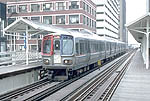
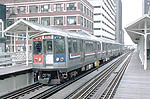
Car 2029, in the Spirit of Chicago paint scheme, leads a
Lake-Dan Ryan "A" train at State/Lake on August 30, 1982.
(Photo by Doug Grotjahn, Collection of Joe
Testagrose)
|
|
cta2485.jpg
(143k)
By 1982, the vast majority of 2400-series
cars were assigned to the Lake-Dan Ryan Line. This practice
is once again the case today with the Green Line. Car 2485
leads a Lake-Dan Ryan "A" train, looking east at State/Lake
on August 30, 1982. (Photo by Doug Grotjahn,
Collection of Joe Testagrose)
|
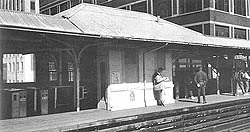 |
state-lake01.jpg (23k)
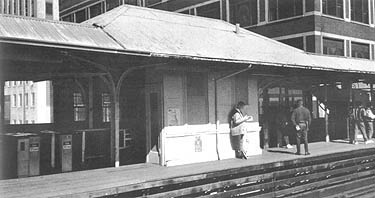
State/Lake outer (north, westbound) platform. The wall that the man is leaning on and the outer wall with the windows were once two walls of an enclosed waiting area, removed by 1913.
(Photo by Bruce G. Moffat) |
|
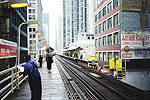
state-lake03.jpg
(88k)
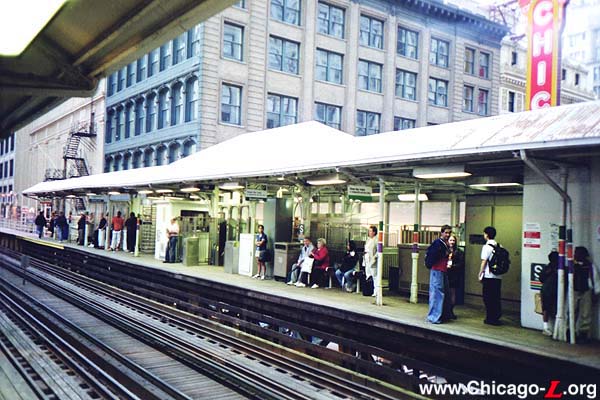
State/Lake station's platforms, looking west on the
Inner Loop in 1999. The canopies covered the original
station platform, which could berth only 2-3 car trains. The
photo shows just how much the platforms have been extended,
far enough that 8-car trains can now fully berth.
(Photo from the CTA Collection)
|
|
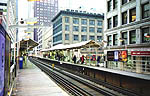
state-lake04.jpg
(86k)
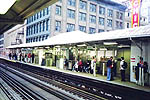
The platforms at State/Lake, looking west on the
Inner Loop in 1999. The station serves as a indirect
transfer to the Red Line subway, with riders having to leave
the paid area to enter the subway station at Lake.
The sign on the far right was erected to let riders know
they could transfer, but was eventually taken down as it was
nonstandard. (Photo from the CTA
Collection)
|
|
state-lake06.jpg
(89k)
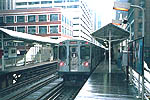
The Inner Loop station house at State/Lake, looking
southeast in 1999. The track-level station house is fully
integrated into the platform, blurring the line between the
two. The Chicago Theater is in the background.
(Photo from the CTA Collection)
|
|
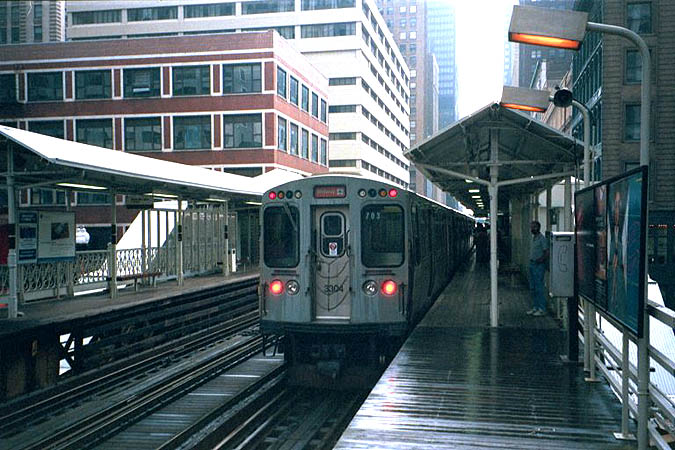
cta3304d.jpg
(91k)
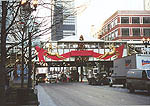
An Orange Line train, trailed by car 3304, stops at
State/Lake in this view looking east on September 10, 2000.
(Photo by Ernie Baudler)
|
|
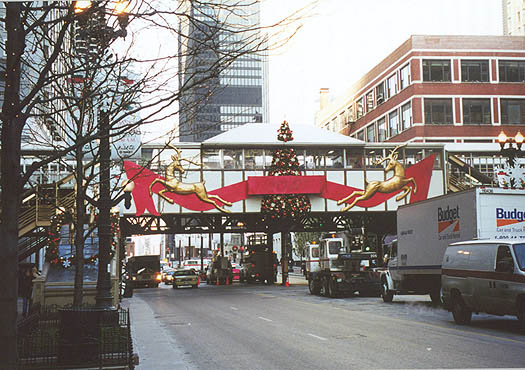
state-lake@X-Mas.jpg
(76k)
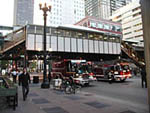
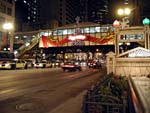
State/Lake at Christmas time!! The Inner Loop station
house is all dressed up for the holidays, looking north in
2000. This was the station used for the exterior shots in
the film While
You Were Sleeping. (Photo by
Graham Garfield)
|
|
state-lake08.jpg
(168k)
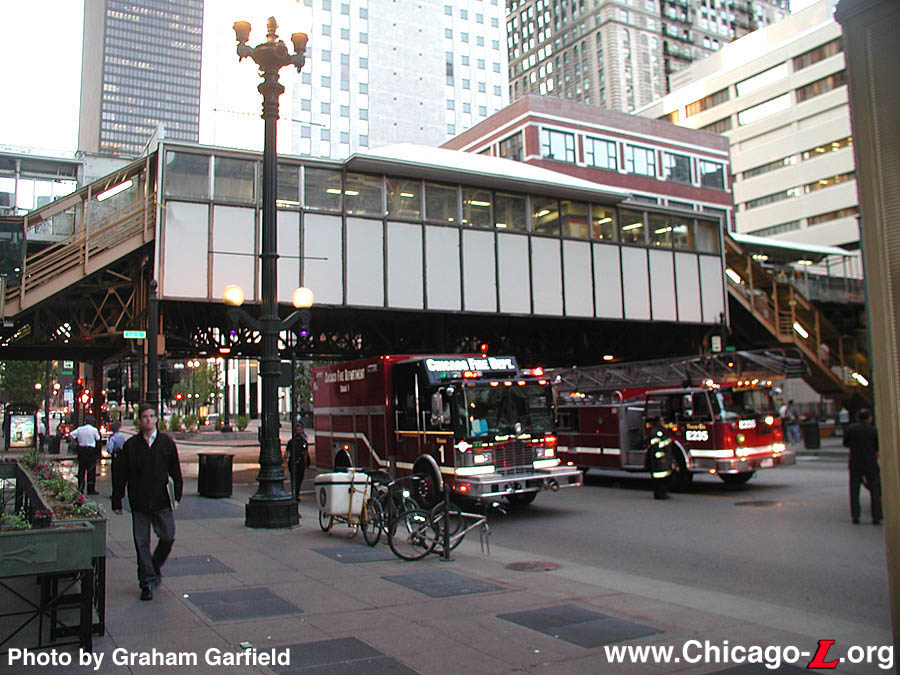
The intersection under the State/Lake station was
filled with emergency vehicles during the aftermath of a
June 19, 2003 incident in which a women fell of the Outer
Loop platform in front of a berthing Brown Line train.
Service on the Lake leg of the Loop was suspended for four
hours in the height of rush hour. This view looks northeast
just after officers removed the barricade around the site,
life in the Loop was just getting back to
normal. (Photo by
Graham Garfield)
|
|
state-lake@X-Mas02.jpg
(185k)
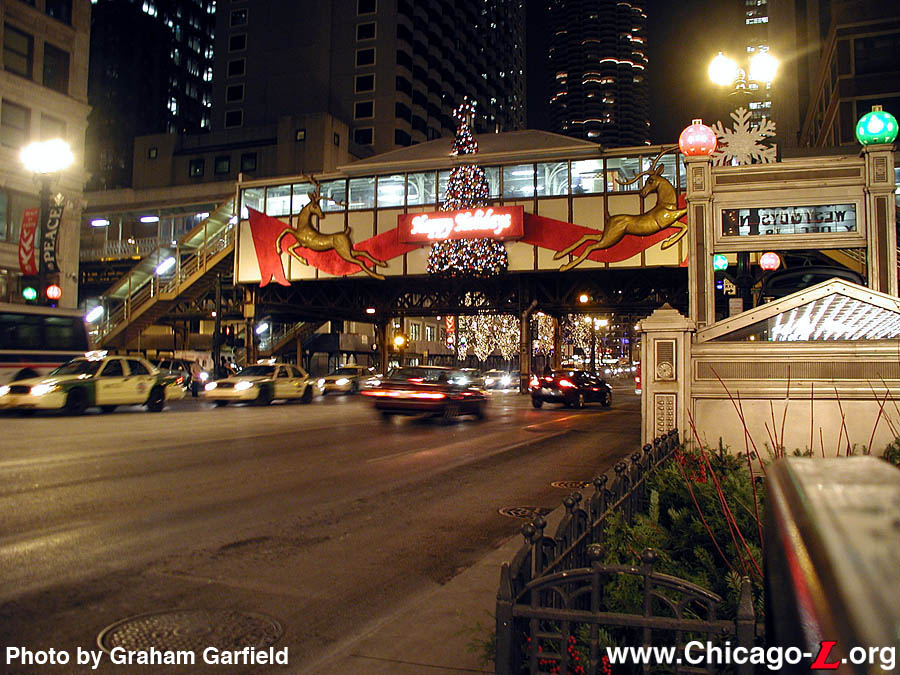
The decorations of the holiday season are seen at
State/Lake on December 18, 2003, with reindeer, ribbon, and
Christmas lights on the station, as well as colored globes
on the stairway kiosk of the Lake-Randolph
subway station. The State Street Council sponsors most of
the decorations on State Street during the
holidays. (Photo by
Graham Garfield)
|
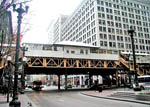 |
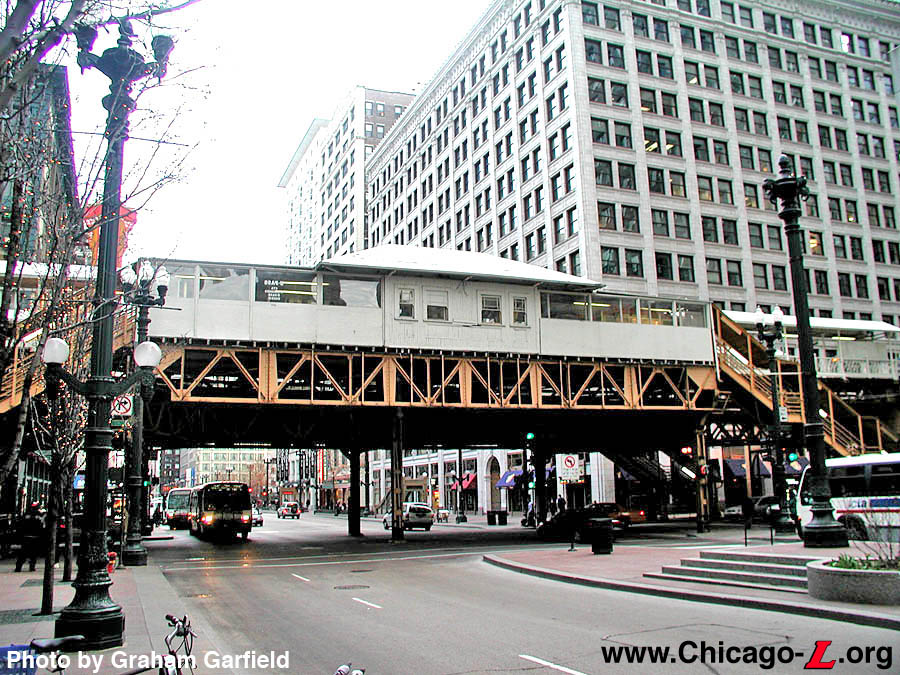
state-lake07.jpg (233k)
The State/Lake Outer Loop elevated station, looking south on State Street on April 8, 2004. The center section with the peaked roof is the old section of the station; the other Plexiglas and wood curtain walls were added later. Note the Chicago Theater in the background. (Photo by
Graham Garfield) |
|
state-lake11.jpg
(114k)
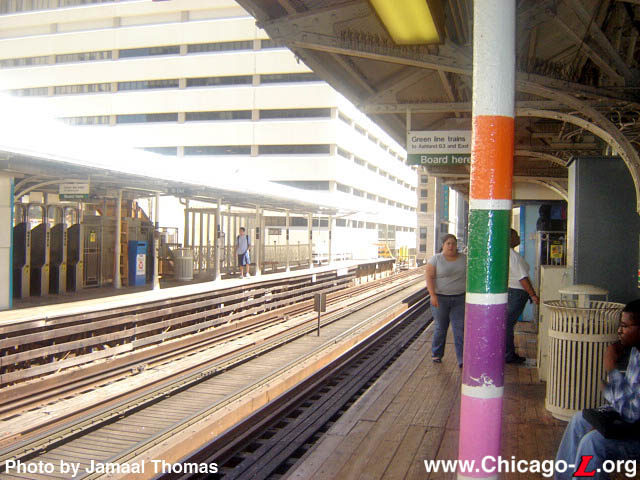
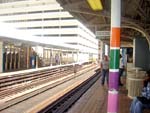
The State/Lake platforms are seen looking east from
the Inner Loop platform on August 12, 2006. The pink stripe
on the column was added less than two months before when the
Pink Line
service was inaugurated.
(Photo by Jamaal Thomas)
|
|
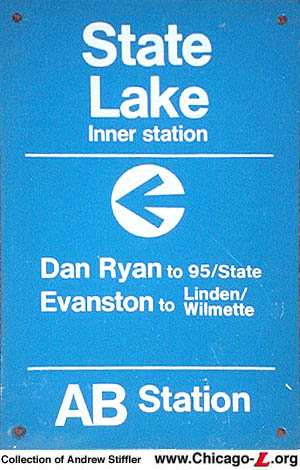
state-lake_SignInner.jpg
(70k)
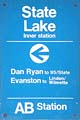
A KDR-type
symbol sign from the State/Lake Inner Loop station, with its
blue background denoting its status as an AB or All-Stop
station. The KDR
symbol signs on the Loop were different in that they simply
spelled out the entire station name at the top rather than
using a large first letter of the station name (the
"symbol", so to speak) with the name below that. They also
denoted whether the station was on the Inner or Outer Loop.
(Sign from the Andrew Stiffler
Collection)
|
|
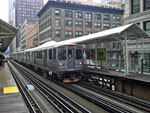
cta5009l.jpg (203k)
Assigned to the Pink Line, car 5009 leads a rush period 54th/Cermak train entering State/Lake station, seen looking west from the Outer Loop platform on January 4, 2011. (Photo by Graham Garfield) |
 |
cta2433b.jpg (303k)
An 8-car train of 2400-series cars stops at State/Lake on November 7, 2012, trailed by car 2433. The destination sign on the rear car is not an error -- the train is operating on the Orange Line. 2400-series cars began to be assigned to the Orange Line at the end of October 2012. Rather than replacing 3200s assigned to the line, the 2400s supplemented the fleet and increased the line's car count. The intent was to use them on additional Brown Line runs scheduled to originate from Midway Yard beginning December 16, 2012, and as such the 2400s were chosen because it would limit the use of the 36-year old cars to rush periods. However, the cars occasionally found their way onto Orange Line trips as well. The 2400s are the first type to be permanently assigned to the line other than the 3200-series type the line opened with in 1993. (Photo by Graham Garfield) |
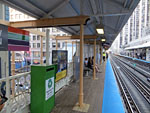
|
state-lake13.jpg (243k)
Looking west on the State/Lake Inner Loop platform on June 24, 2016, new columns and beams have been installed to modify the vintage canopy to accommodate the soon-to-be-widened platform. A new set of columns down the middle of the platform replaced the original ones, and mimic their look. The new overhead beam transfers the load of the canopy from the columns along the old back of the platform -- which have already been cut off at the top and will be removed, along with the original back railing -- to new columns along the new, deeper back of the platform. (Photo by
Graham Garfield) |
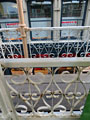
|
state-lake14.jpg (234k)
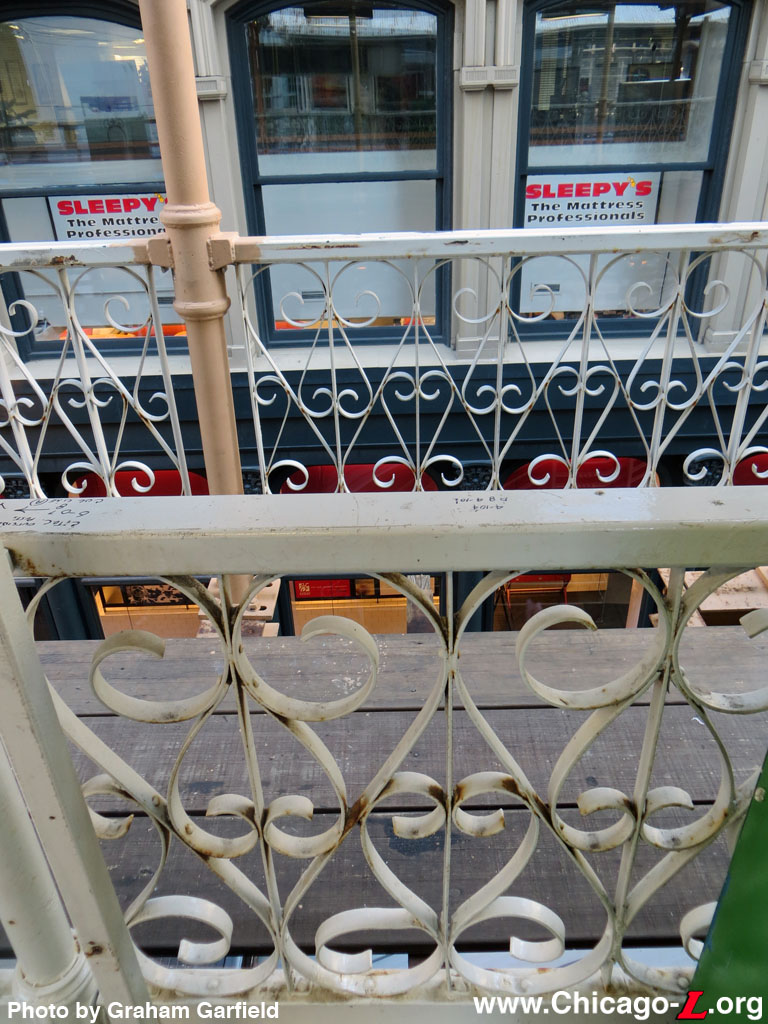
The CTA Ironworkers performing the structural work for the widened Inner platform at State/Lake made the new railings for the expanded platform to match the design of the original 1895 ornate railings. This June 27, 2016 compares the two, with the originals in the foreground. The design was replicated very closely; one of the few differences eagle-eyed observers might notice is that the straps of curved metal on the original are connected by small rivets, whereas the modern replicas are welded. (Photo by
Graham Garfield) |
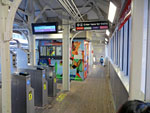
|
state-lake15.jpg (199k)
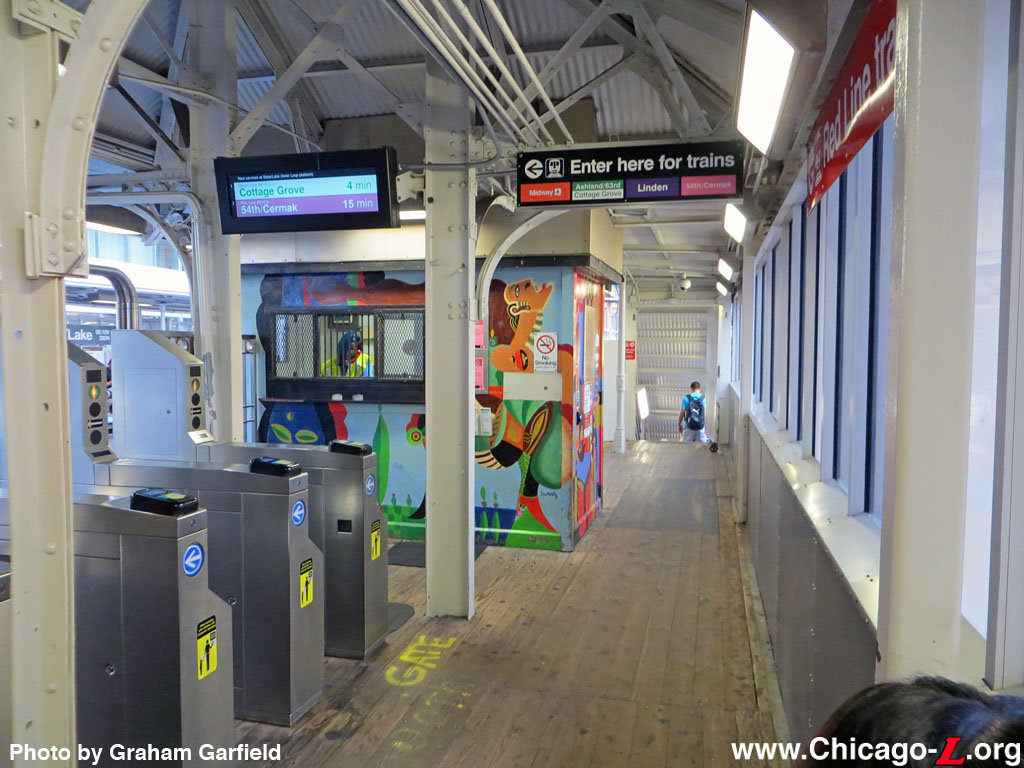
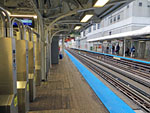
The State/Lake Inner Loop fare control area is seen looking east on the unpaid side on September 21, 2016, shortly before its reconfiguration and refurbishment. The mural-decorated booth is long enough to fit two ticket agents -- the other window is on the other side of the booth -- a requirement long since obsolete since ticket agents had been transitioned to customer assistants two decades earlier. The long booth created a narrow passage past it on the unpaid side; an equally narrow walkway also resulted on the paid side, between the booth and the edge of the platform. (Photo by
Graham Garfield) |
|
state-lake16.jpg (264k)
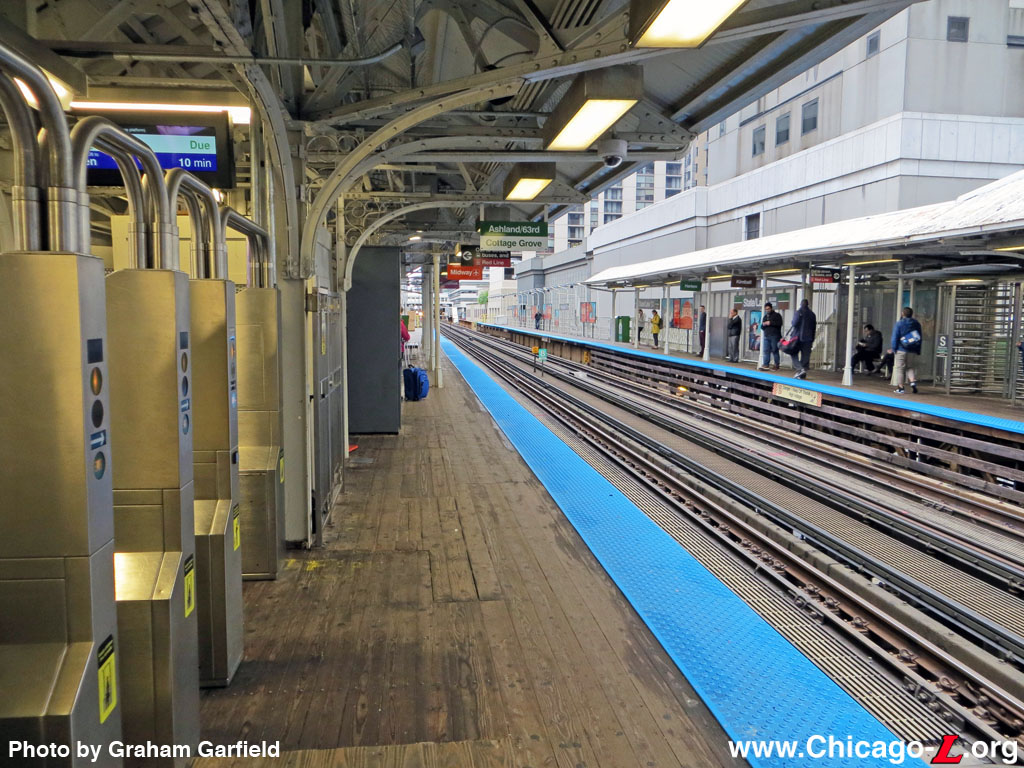
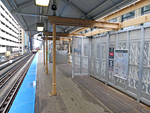
The Inner Loop platform at State/Lake is seen looking west at the turnstiles on May 24, 2017, after the project to improve circulation. The new, smaller CA booth can just be seen behind the turnstiles in the background. While still not a wide platform by modern standards, the relocation and downsizing the booth did help remove a pinch-point here -- previously, the circulation space between the platform edge and nearest obstruction (the old booth) was about half of what it is now, seen here. Note the original 1895 brackets with ornamental scrollwork. (Photo by
Graham Garfield) |
|
state-lake17.jpg (834k)
The widened State/Lake Inner platform area, where the largest number of passenger congregate and wait, is seen looking east on May 24, 2017. The decorative railings seen behind the aluminum windbreak and in the background are reproductions and mimic the originals. Roofing still needs to be installed on the canopy over the new, widened portion of the platform, as does final painting. (Photo by
Graham Garfield) |
|
state-lake18.jpg (228k)
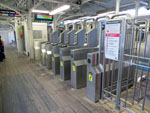
The reconfigured fare controls a State/Lake Inner are seen looking northwest from the unpaid side on May 24, 2017. The new, smaller CA booth is in the background. In the refurbishment project, the position of the booth and the turnstiles were flipped (the turnstiles were previously on the other side of the old booth), two additional exit-only turnstiles were added (nearest to the camera) to help serve the larger number of customers were use the middle and east portions of the platform and help get them off the platform quicker, and a swing gate turnstile was added (closest to the booth, not clearly visible), which are usually primarily used for wheelchairs but, as State/Lake is not accessible, was added here to assist customers with luggage (this being the side for Orange Line trains to Midway), carts, strollers, and other large parcels. (Photo by
Graham Garfield) |
 |
state-lake-2021rendering1.jpg (347k)
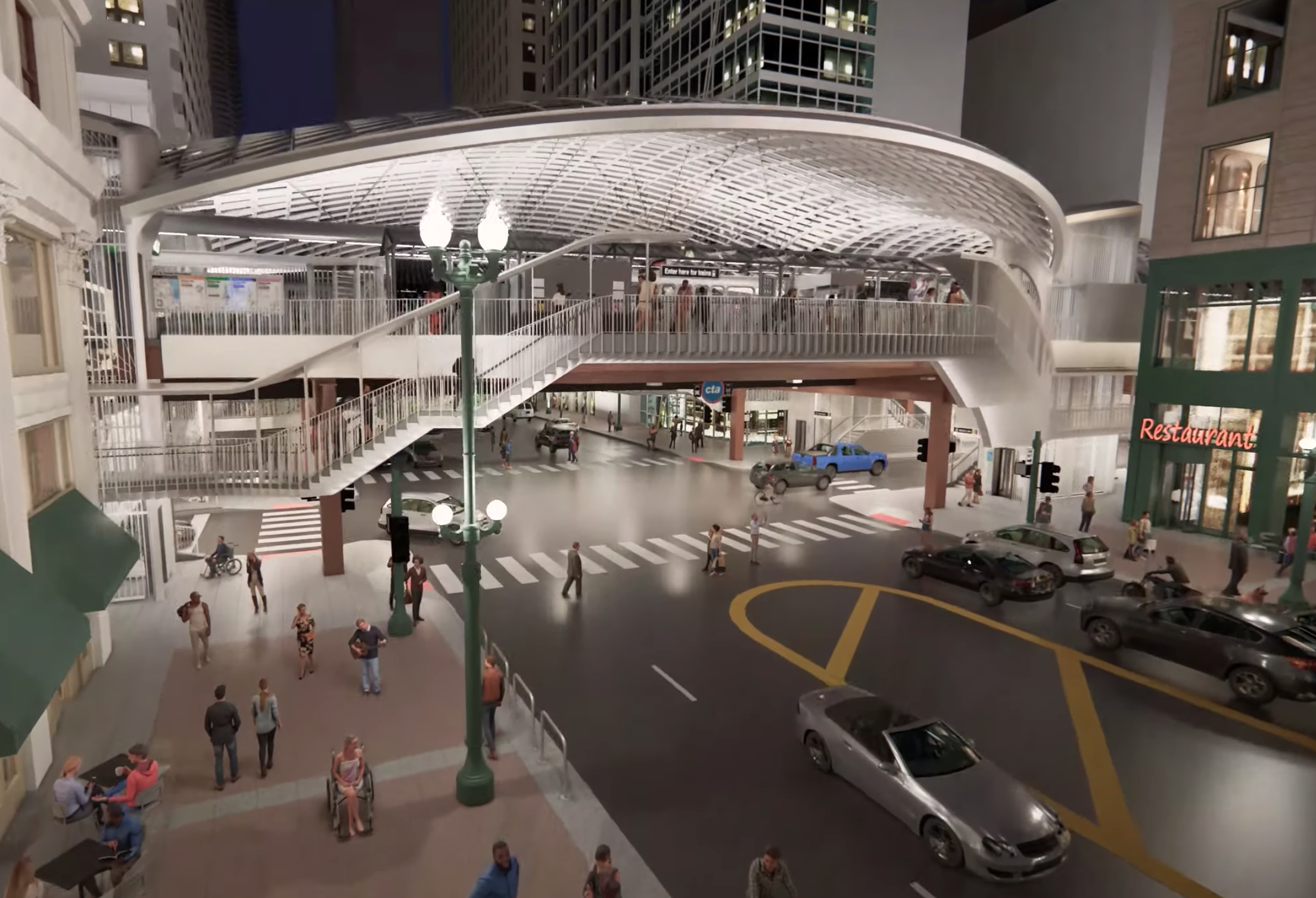
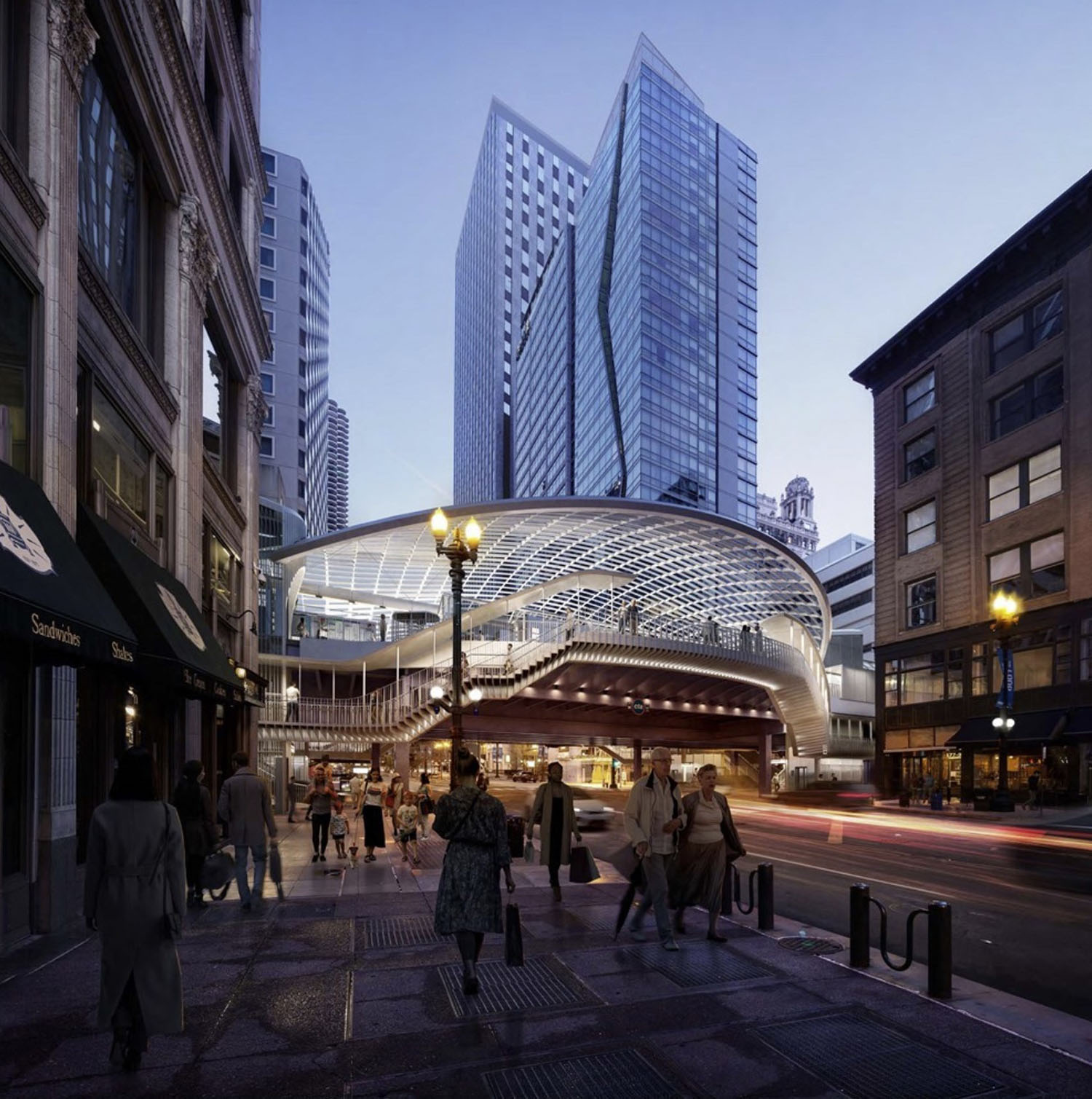
A nighttime rendering of the planned new State/Lake shows the station dramatically hovering over State Street, aglow under the domed elliptical canopy. (Rendering courtesy of CDOT) |
 |
state-lake-2021rendering4.jpg (410k)
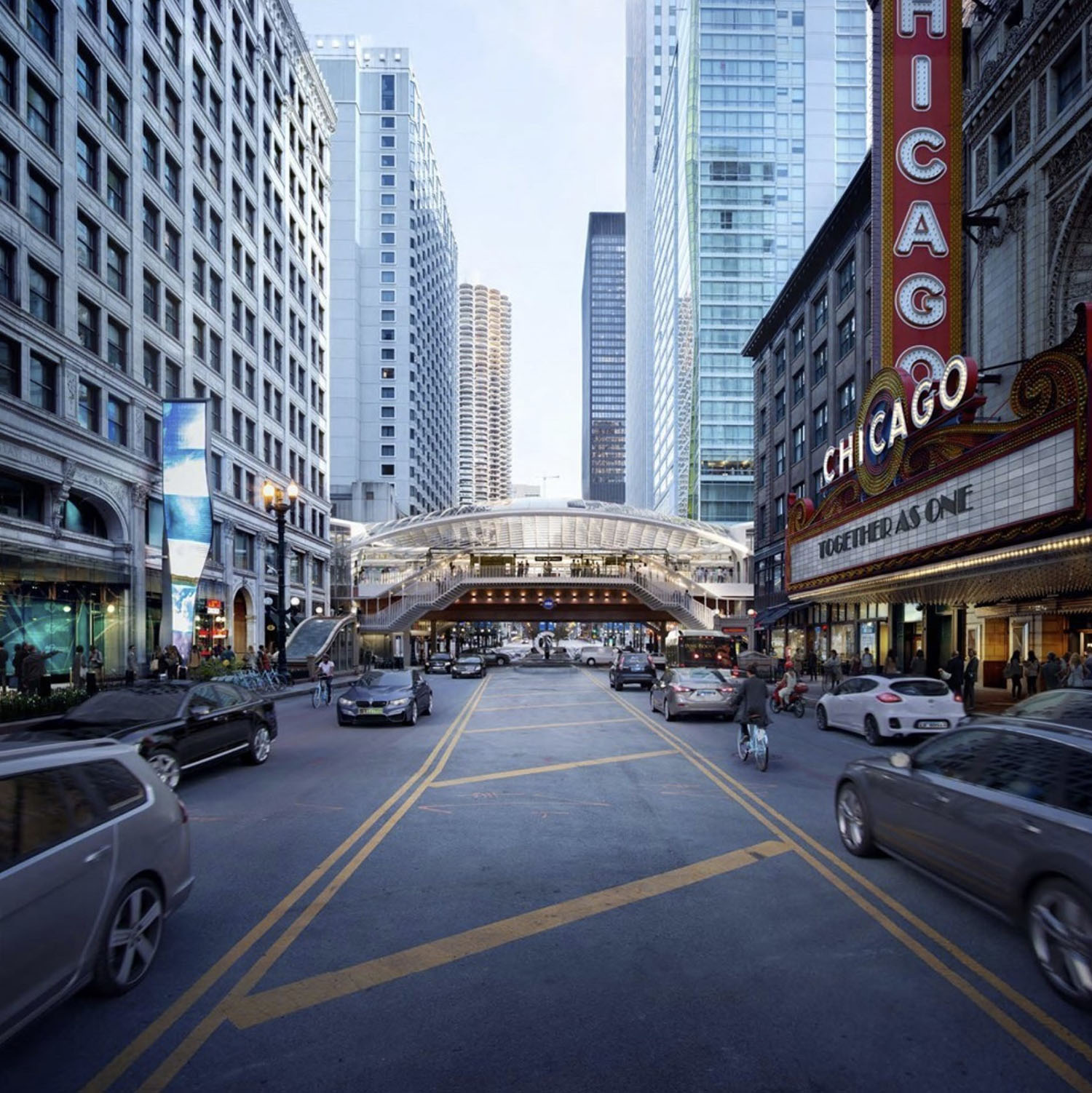
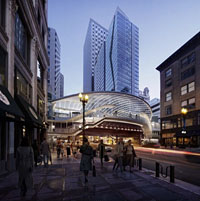
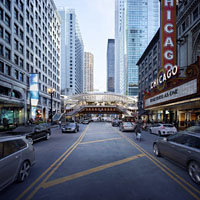
A rendering with a view north up State Street shows how the planned new State/Lake station would fit into the streetscape and vista of the famous shopping and theater district. (Rendering courtesy of CDOT) |

Notes:
1. "Safety @ Work: State/Lake Elevated inner platform capacity project," CTA Up to Speed newsletter, Volume 19, Winter 2017, pg. 3.
2. Ibid.
3. "State / Lake Elevated Transit Station." Coffey Group Architecture, LLC. Accessed October 6, 2021.
4. "Mayor Emanuel, CDOT and CTA Announce Critical Federal Funding is Secured for New State and Lake Train Station." City of Chicago press release, October 12, 2017.
5. McCoppin, Robert. "CTA and Metra stations, Barrington, Naperville and other transportation projects get federal funding." Chicago Tribune, October 11, 2019.
6.
City of Chicago press release, 2017.
7. McCoppin, ibid.
8.
Ibid.
9. "Mayor Lightfoot, CDOT and CTA Unveil Design for State-of-the-Art, Fully Accessible New State and Lake CTA Station", City of Chicago/CTA press release, June 9, 2021.
10. Ibid.
11. Ibid.
12. Ibid.
13. Hickman, Matt. "SOM unveils a reimagined State/Lake "L" station in downtown Chicago." The Architect's Newspaper, June 16, 2021.
14. Petridou, Christina. "SOM and transystems bring new vitality to one of chicago's oldest train stations." Design Boom, June 11, 2021.
15. City of Chicago press release, 2021.
16. CDOTnews. "State & Lake Elevated Station (CDOT)". YouTube, posted June 8, 2021. Accessed July 19, 2021.
17. Ibid.
18. City of Chicago press release, 2021.
19. Petridou, ibid.
20. CDOTnews, ibid.
21. Stouhi, Dima. "SOM and TranSystems Redesign Chicago's Oldest Elevated Rail Station." ArchDaily, June 11, 2021.
22. City of Chicago press release, 2021.
23. Petridou, ibid.
24. City of Chicago press release, 2021.
25. CDOTnews, ibid.
26. Stouhi, ibid.
27. Hickman, ibid.
28. Petridou, ibid.
29. CDOTnews, ibid.
30. CDOTnews, ibid.
31. Ibid.
32. City of Chicago press release, 2021.
33. Greenfield, John. "CDOT: Direct State/Lake - Red transfer was impossible, but wheelchair access will improve." Streetsblog Chicago, July 8, 2021, updated July 9, 2021.
34. Ibid.
35. Ibid.
36. Ibid.
37. City of Chicago press release, 2021.
38. "Advance Utility Work Begins This Month for New State and Lake CTA Station," City of Chicago press release, August 8, 2025.
39. "Construction to Begin in January on New, Fully Accessible State/Lake CTA Station." CDOT press release, December 4, 2025.
40. Ibid.
41. Ibid.